

ナマリイロヒラハシ 対 フタイロヒタキ
Myiagra rubecula 対 Myiagra inquieta
ナマリイロヒラハシとフタイロヒタキのクイズ
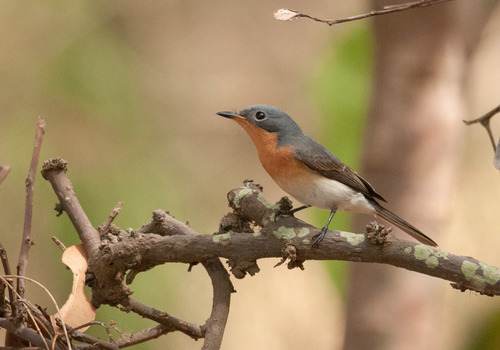 ナマリイロヒラハシ
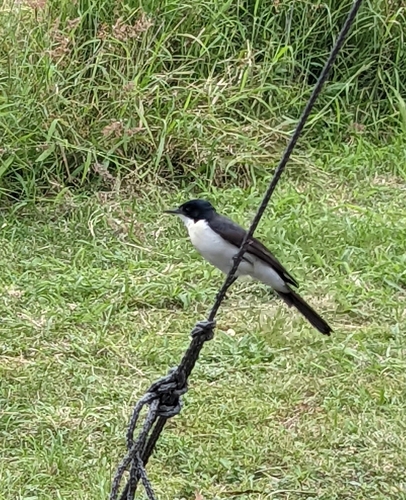 フタイロヒタキ
要点
The most reliable field mark between Leaden and Restless Flycatchers is the throat and breast color: adult male Leaden Flycatchers show a lustrous blue-grey head and back with a pure white throat and underparts, while adult Restless Flycatchers have a glossy dark blue crest, grey-blue back, and also white underparts, but lack any rufous or orange on the throat. Female Leaden Flycatchers are distinctive with their orange-tan (rufous) throat and breast, a feature never shown by Restless. Juvenile Leaden Flycatchers resemble females but have paler wing edges, while Restless juveniles are not described as having this feature. Size and structure also help: Restless is noticeably larger and longer-bodied. Both species can be active and agile, but Restless often hovers in a distinctive way. If you see a flycatcher with a rufous throat, it's a female or juvenile Leaden; if the throat is white and the bird is large and sleek, it's likely a Restless.
識別のコツ
- Throat and breast color (all ages/sexes): Female and juvenile Leaden Flycatchers have a rufous (orange-tan) throat and breast, a feature never shown by Restless Flycatcher of any age or sex.
- Adult male plumage: Male Leaden is lustrous blue-grey above with a pure white throat and underparts. Restless male is glossy dark blue on the crest and grey-blue on the back, with white underparts, but never rufous on the throat.
- Juvenile wing edges: Juvenile Leaden Flycatchers show paler wing edges, especially visible in fresh plumage; Restless juveniles do not have this feature.
- Size and structure: Restless Flycatcher is larger (20 cm, 17 g) and longer-bodied than Leaden (15 cm, 14 g). In the field, Restless often appears sleeker and more elongated.
- Bill and legs: Both species have dark bills and legs; this is not a useful separator.
- Hovering behavior: Restless Flycatcher frequently hovers with head and tail pointed down while foraging, a behavior rarely seen in Leaden.
- Wing color: Leaden Flycatcher wings have a brownish tinge; Restless wings are not described as such.
- Underparts: Both have white bellies, but only Leaden (female/juvenile) shows rufous on the upper breast.
- Vocalization: Restless Flycatcher gives a distinctive mechanical "razor grinder" call; Leaden's call is guttural but not as striking or unique.
- Habitat: Leaden prefers forest edge, mangroves, and coastal scrub; Restless is more common in open woodland, farmland, and sometimes urban parks.
- Range: Both occur in eastern Australia, but Leaden is more likely in the north and east, Restless in the south and east.
- Perched jizz: Leaden often appears more compact and upright; Restless is longer and may look more slender.
- Sex differences: Only Leaden shows strong sexual dimorphism (female with rufous throat/breast); Restless sexes are similar.
- Pitfalls: Immature Leaden can be mistaken for Restless if the rufous throat is overlooked; always check for pale wing edges in juveniles and rufous on the throat in females/immatures.
- When in doubt: If the bird is hovering and giving a grinding call, it's Restless; if perched with a rufous throat, it's Leaden.
大きさ
Restless Flycatcher is larger and heavier, averaging about 20 cm in length and 17 g in mass, compared to Leaden Flycatcher's 15 cm and 14 g. In the field, Restless appears longer-bodied and more robust, while Leaden is more compact. This size difference is often apparent when both are seen in quick succession or side-by-side, but can be subtle if only one bird is present and no direct comparison is possible.
羽色
-
Juveniles: Juvenile Leaden Flycatchers resemble adult females, showing a leaden-grey head and back with a rufous (orange-tan) throat and breast, plus paler wing edges. This pale edging is a useful mark for young Leaden, especially in flight or at rest. Juvenile Restless Flycatchers are not described as having rufous on the throat or pale wing edges, so a young bird with these features is a Leaden.
-
Adult males: Leaden males are lustrous lead-grey (almost blue) on the head and back, with a white throat, breast, and belly. Restless males have a glossy dark blue crest, grey-blue back, and white underparts, but never show rufous on the throat or breast. Both have dark bills and legs.
-
Adult females: Female Leaden Flycatchers are diagnostic with their orange-tan (rufous) throat and breast, contrasting with a leaden-grey head and back and a white belly. Restless Flycatcher females (and males) always have a white throat and underparts, never rufous or orange.
-
Wings: Leaden Flycatcher wings have a brownish tinge; juveniles show paler wing edges. Restless wings are not described as having this tinge or pale edging.
-
Underparts: Both species have white bellies, but only Leaden (female/juvenile) shows rufous on the upper breast.
行動
Both species are active, agile, and feed on insects by sallying from perches. However, Restless Flycatcher is especially noted for its hovering behavior, often hanging in the air with head and tail pointed down as it picks insects from foliage. Leaden Flycatcher is more likely to hop between branches and catch insects in flight, but does not typically hover in the same way. Restless is also known for its distinctive, repetitive foraging style, which can help separate it from Leaden in the field.
生息環境
Leaden Flycatcher is found in sclerophyll forests, rainforest margins, mangroves, and coastal scrub, primarily in eastern and northern Australia. Restless Flycatcher is native to eastern and southern Australia, and is more likely in open woodland, farmland, and sometimes urban parks. There is some overlap in range, especially in eastern Australia, but Leaden is more tied to forested and edge habitats, while Restless is more common in open country and less dense woodland.
声
Restless Flycatcher is famous for its distinctive, mechanical "razor grinder" or "scissors grinder" call, which is a rapid, metallic, grinding sound. This vocalization is unique and diagnostic when heard. Leaden Flycatcher has a guttural call (sometimes called 'frogbird'), but it is not as mechanical or distinctive as the Restless's call. If you hear the "razor grinder" sound, you are almost certainly hearing a Restless Flycatcher.