

アオムネマンゴーハチドリ 対 ミドリトゲオハチドリ
Anthracothorax prevostii 対 Discosura conversii
アオムネマンゴーハチドリとミドリトゲオハチドリのクイズ
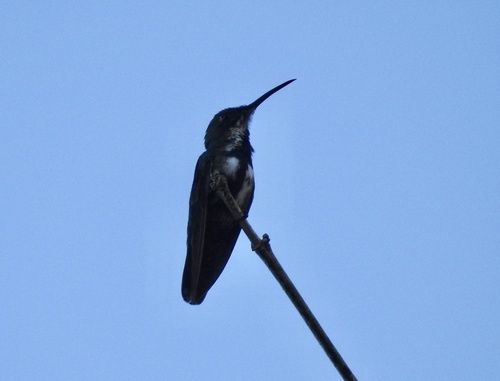 アオムネマンゴーハチドリ
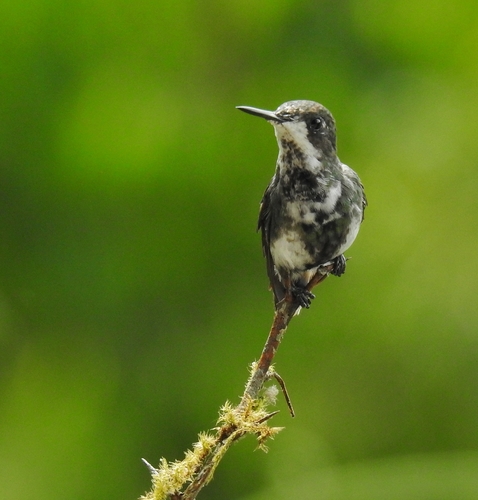 ミドリトゲオハチドリ
要点
The most reliable field mark to separate Green-breasted Mango from Green Thorntail is tail shape: adult male Green Thorntail has a dramatically long, deeply forked, needle-like tail, while Green-breasted Mango’s tail is shorter and less deeply forked. Female and juvenile Green Thorntails have a notched but not elongated tail, with distinctive white bases and tips on the outer feathers, while female Mango shows a more uniform tail with less contrast. Also, Green-breasted Mango of all ages and sexes shows a bold, dark central stripe down the underparts, bordered by metallic green or blue, which is never present on Green Thorntail. In perched or flight views, look for the Mango’s heavier, decurved bill and bulkier body compared to the daintier, short-billed Thorntail. Both species are metallic green hummingbirds, but their structure and underpart patterns are diagnostic.
識別のコツ
- Tail shape is the single best field mark: Adult male Green Thorntail has a dramatically long, deeply forked, needle-like tail, while Green-breasted Mango’s tail is shorter, broader, and less forked. Female Thorntail’s tail is notched with white bases/tips, never as long or deeply forked as the male, and always more patterned than any Mango.
- Underpart pattern: Green-breasted Mango of all ages and sexes shows a bold, dark central stripe down the chin, throat, and chest, bordered by metallic green or blue. Green Thorntail never shows this stripe; its throat and breast are metallic green or dull black, sometimes with a greenish blue center in males.
- White cheek patch: Female and juvenile Green Thorntail have a broad white cheek patch, absent in Mango of any age or sex.
- Tail pattern in females and immatures: Female Thorntail’s tail has white bases and tips on the outer feathers; Mango female’s tail is more uniform with blue-black and purple, sometimes with whitish tips but never with the same bold white base/tip contrast.
- Bill shape: Mango has a heavier, slightly decurved, dull black bill; Thorntail’s bill is shorter, finer, and straighter.
- Body structure: Mango is bulkier and heavier, with a robust build. Thorntail is smaller, daintier, and more delicate, especially the female.
- Rump and back: Male Thorntail has a coppery bronze rump with a white band, and a more metallic green back; Mango’s upperparts are metallic bronze green without a white rump band.
- Flank and undertail coverts: Mango’s undertail coverts are dusky purple (male) or dusky with wide white edges (female); Thorntail’s flanks are dull green with a white spot, undertail coverts not described as distinctive.
- Juvenile marks: Juvenile Mango has a white chin/throat/center breast with chestnut on the sides; juvenile Thorntail has a grayish white chin.
- Foraging behavior: Thorntail often hovers with tail cocked at a right angle and forages high in the canopy; Mango forages at all levels and is more likely at feeders or lower vegetation.
- Habitat context: Mango is common in open woodlands, gardens, and urban edges; Thorntail is a forest canopy specialist, rarely seen in open or urban areas.
- Geographic range: If seen in Mexico or Venezuela, it is Mango; Thorntail is limited to Costa Rica, Panama, Colombia, and Ecuador.
- Sex differences: Only male Thorntail has the extremely long, forked tail; female Thorntail’s tail is notched and patterned, but never as long as the male’s or as uniform as Mango’s.
- Size impression: Mango always appears larger and heavier than Thorntail, especially when both are seen together.
- Plumage pitfalls: Both are metallic green, but only Mango has the dark central underpart stripe; only Thorntail (female/immature) has a white cheek patch and white tail bases/tips.
大きさ
Green-breasted Mango is significantly larger and heavier: adults are 10.3–12.1 cm long and weigh 5.7–7.0 g [wikipedia], while Green Thorntail males are 9.5–10.2 cm (females 6.6–7.5 cm) and average only 3.0 g [wikipedia]. Mango is bulkier, with a more robust build and a thicker, decurved bill. Thorntail is noticeably smaller, especially the female, and appears more delicate overall.
羽色
-
Juvenile/immature birds: Juvenile Green-breasted Mango resembles adult female but has a white chin, throat, and breast center with chestnut on the sides. Juvenile Green Thorntail is like the adult but with a grayish white chin. No distinctive upperwing or flight pattern differences are described for either species at any age.
-
Adult males: Green Thorntail males have a dark green crown, metallic green back, coppery bronze rump with a white band, and a deeply forked, needle-like bluish black tail. Their throat is bright metallic green, and the breast/center is metallic greenish blue. Green-breasted Mango males have a metallic bronze green crown and upperparts, a velvety black stripe down the chin, throat, and chest bordered by metallic bluish green, and a shorter, less forked tail with purple gloss.
-
Adult females: Female Mango has less bronzy upperparts, a similar dark central stripe (which turns bluish green on the breast and dusky on the belly), and a tail with blue-black outer feathers with purple bases and whitish tips. Female Thorntail has a notched (not elongated) tail with white bases and tips on the outer feathers, a broad white cheek patch, and a dull black chin with white spots. The Mango’s underparts are metallic green with a dark central stripe; Thorntail’s are dull black with green flanks and a white spot.
-
Tail pattern: Thorntail males have the most distinctive tail: extremely long, deeply forked, and needle-like. Mango’s tail is shorter, broader, and less forked in all ages and sexes. Female Thorntail’s tail is notched with white bases/tips, unlike the more uniform Mango tail.
行動
Green Thorntail typically forages high in the canopy, often at the tops of flowering trees, and cocks its tail at a right angle while hovering. Males perch on high bare twigs and perform dive displays. Green-breasted Mango forages at all levels from understory to canopy, often visiting feeders and taking insects by hawking or gleaning. Mango is more likely to be seen at lower levels and in a wider range of habitats, including human-altered areas.
生息環境
Green-breasted Mango is found from eastern Mexico through Central America, Colombia, and Venezuela, and is often seen in open woodlands, edges, gardens, and even urban areas. It is more adaptable and widespread. Green Thorntail is restricted to humid montane and lowland evergreen forests in Costa Rica, Panama, Colombia, and Ecuador, primarily in the canopy and at forest edges, usually at mid-elevations (600–1,400 m). Thorntail is much less likely in open or urban habitats.