

オオクロノスリ 対 オオハシノスリ
Buteogallus urubitinga 対 Rupornis magnirostris
オオクロノスリとオオハシノスリのクイズ
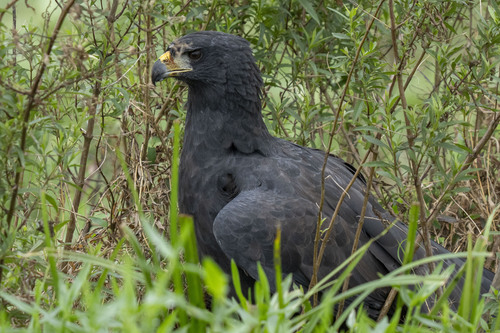 オオクロノスリ
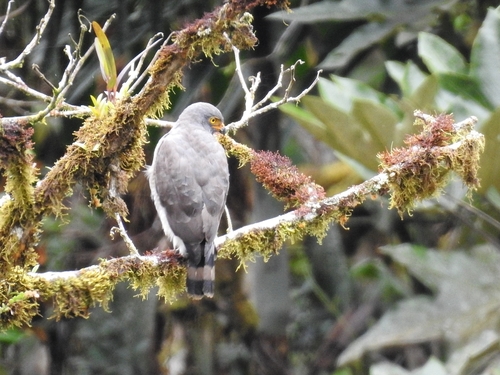 オオハシノスリ
要点
The most reliable field mark between Great Black Hawk and Roadside Hawk is overall size and structure: Great Black Hawk is much larger, with very broad wings and a short white tail with a bold black tip, while Roadside Hawk is noticeably smaller, with a longer tail and short, rounded wings. In flight, immature Great Black Hawks show buffy underparts with dark spots and a tail with multiple dark bars, which can overlap with some Roadside Hawk plumages, but adults are all-black with a striking white tail base and black tip. Roadside Hawk adults are brown or grayish with barred underparts and a tail with several gray bars, and often show a touch of rufous in the wings. Voice and jizz are also quite different: Great Black Hawk gives a piping 'ooo-wheeeeee', while Roadside Hawk has a high-pitched squeak and is much more likely to be seen perched conspicuously or soaring near roads.
識別のコツ
- Size is the most immediate clue: Great Black Hawk is more than twice the weight and much longer than Roadside Hawk. If the bird looks massive, with a heavy bill and thick legs, it's likely Great Black Hawk.
- Tail pattern in adults: Great Black Hawk adult has a short tail that is mostly white with a single broad black tip—unique among these two. Roadside Hawk always has a longer tail with four or five narrow gray bars and no solid white base.
- Wing shape in flight: Great Black Hawk shows very broad, paddle-shaped wings, while Roadside Hawk has short, rounded wings and a proportionally longer tail, giving a more compact, agile appearance in flight.
- Plumage in immatures: Immature Great Black Hawks are dark brown above with streaks and spots, buffy below with dark spots, and have a tail with several black/dusky bars. Juvenile Roadside Hawks are paler, often with less contrast, and still show a longer, more obviously barred tail.
- Leg and cere color: Both species have yellow legs and cere, so this is not a useful separation point.
- Bill size: Roadside Hawk's bill is relatively large for its size, but still much smaller than the massive bill of Great Black Hawk.
- Rufous in the wings: Roadside Hawk often shows a touch of rufous in the wings, especially in flight—never seen in Great Black Hawk.
- Underparts: Adult Great Black Hawk is entirely black below; Roadside Hawk is barred brown and white on the underparts.
- Perched posture: Roadside Hawk often perches conspicuously on wires or posts in open country; Great Black Hawk prefers large trees and is less likely to be seen in the open.
- Vocalizations: Great Black Hawk gives a piping 'ooo-wheeeeee'; Roadside Hawk gives a high, piercing squeak. If you hear the call, this is a strong clue.
- Habitat: Roadside Hawk is common in open areas, forest edges, and urban parks; Great Black Hawk is rare and prefers forested or riparian areas.
- Flight style: Great Black Hawk soars with slow, heavy wingbeats; Roadside Hawk soars more quickly and often flaps with shallow, rapid beats.
- Relative abundance: Roadside Hawk is often the most common raptor in its range; Great Black Hawk is rare to vagrant in North America.
- Sex differences: Both species are sexually similar in plumage; size difference (females larger) is more pronounced in Roadside Hawk, but not a reliable field mark unless birds are side by side.
- Subspecies variation: Roadside Hawk shows considerable plumage variation across its range, but always retains the barred tail and smaller size compared to Great Black Hawk.
大きさ
Great Black Hawk is dramatically larger: 56–64 cm (22–25 in) long and about 1.1 kg (2 lb 7 oz) [wikipedia], making it a massive raptor with broad wings and a heavy build. Roadside Hawk is much smaller, only 31–41 cm (12–16 in) long and 250–300 g (8.8–10.6 oz) [wikipedia], with a noticeably slighter frame and proportionally longer tail. The size difference is obvious even at a distance, and is the single most reliable separation point if seen together or with other raptors for scale.
羽色
Immature Great Black Hawks are dark brown above with spotting and streaks, buffy below with dark spots, and have a tail with several black and dusky bars—features that can overlap with juvenile Roadside Hawk, but the Great Black Hawk is always bulkier and darker overall. Adult Great Black Hawks are entirely black except for a short tail that is white with a broad black tip; wings are very broad and the legs and cere are yellow. Roadside Hawk adults are brown or grayish above, with barred brown and white underparts and a tail with four or five gray bars. In flight, Roadside Hawk often shows a touch of rufous in the wings, especially in some subspecies, and the tail is longer and more obviously barred. Immature Roadside Hawks are similar to adults but may be paler and less distinctly barred. The black-and-white tail pattern of Great Black Hawk (solid white with a single broad black tip) is unique and does not occur in Roadside Hawk at any age.
行動
Great Black Hawk is typically less conspicuous, often seen soaring with slow, heavy wingbeats or perched in large trees near water or forest edges. Roadside Hawk is much more likely to be seen perched openly on wires, posts, or small trees along roadsides, and frequently soars with quick, shallow wingbeats. Roadside Hawk is also more vocal and often the most common raptor in its range, whereas Great Black Hawk is rare in North America and generally less approachable.
生息環境
Roadside Hawk is highly adaptable and often the most common raptor in open areas, forest edges, urban parks, and especially along roads throughout its range. Great Black Hawk prefers more forested or riparian habitats and is rarely seen in open country or urban settings. In North America, Great Black Hawk is a vagrant and extremely rare, while Roadside Hawk is common in its range.
声
Great Black Hawk gives a distinctive piping 'ooo-wheeeeee' call, which is lower-pitched and more drawn out than the Roadside Hawk. Roadside Hawk has a very high-pitched, piercing squeak, often repeated and given from a perch or in flight. The difference in pitch and quality is usually clear if both are heard.