

ヨーロッパノビタキ 対 ハシグロヒタキ
Saxicola rubicola 対 Oenanthe oenanthe
ヨーロッパノビタキとハシグロヒタキのクイズ
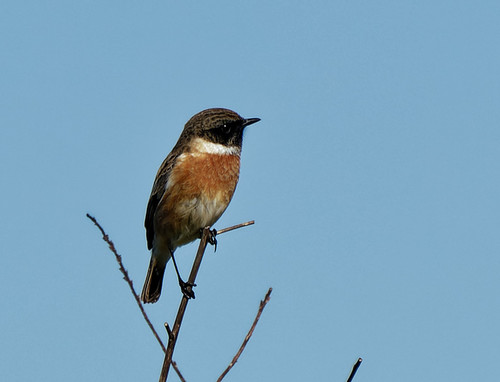 ヨーロッパノビタキ
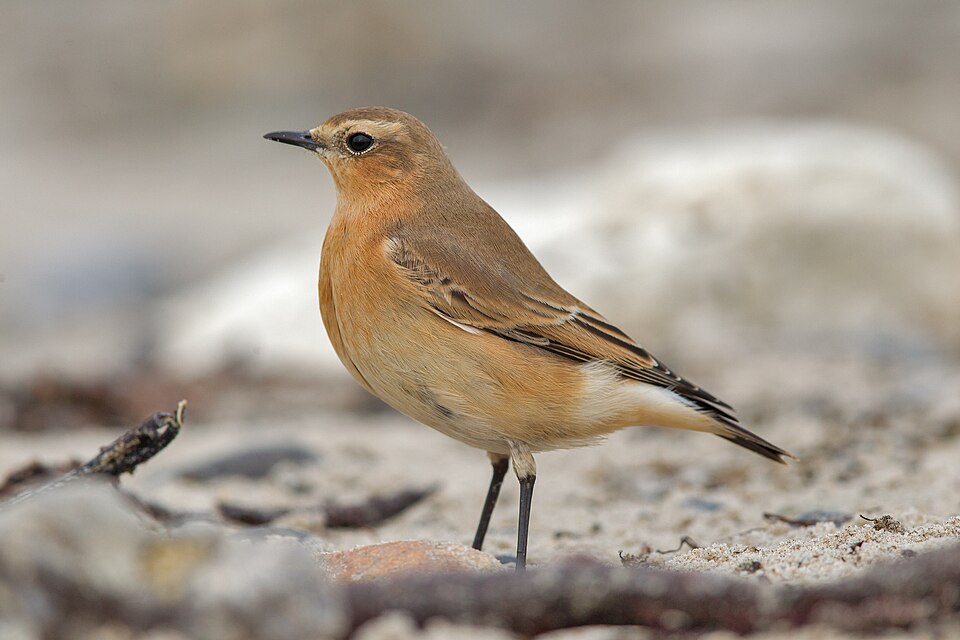 ハシグロヒタキ
要点
The most reliable field mark to separate European Stonechat from Northern Wheatear in any age or season is the rump and tail pattern in flight: Northern Wheatear of all ages shows a bold white rump and tail with a black inverted T at the tip, while European Stonechat has a much smaller, often streaked white rump (males only) and a dark tail without the T-pattern. Perched, Stonechat males show a black head and orange breast, but females and immatures are much duller and can be confused with female/immature Wheatear. Wheatear is distinctly larger, longer-winged, and longer-tailed, with a more upright stance and a tendency to perch on rocks or open ground, while Stonechat is smaller, rounder, and more often perches on low shrubs. In autumn and winter, both species can appear drab, but the tail/rump pattern remains diagnostic in flight.
識別のコツ
- Rump and tail in flight (all ages): Wheatear always shows a bright white rump and tail base with a black inverted T at the tip. Stonechat males have a much smaller, often streaked white rump, and females/immatures lack white rump entirely; tail is all dark.
- Tail pattern perched: If the bird flicks its tail, look for the bold white and black T-pattern (Wheatear) vs. plain dark tail (Stonechat).
- Wing shape and length: Wheatear has long, pointed wings extending well past the rump when perched; Stonechat’s wings are short and rounded, barely reaching the base of the tail.
- Size and structure: Wheatear is larger, longer-legged, and more upright, with a longer tail and a more elongated silhouette. Stonechat is smaller, rounder, and more compact.
- Perching behavior: Wheatear often perches on rocks, bare ground, or fence posts, while Stonechat prefers low shrubs, brambles, or gorse.
- Adult male plumage (spring/summer): Stonechat male has a black head, orange throat and breast, white neck-sides, and a small white scapular patch. Wheatear male has a black face mask, grey upperparts, buff throat, and black wings, lacking orange tones.
- Adult female/immature plumage: Female/immature Wheatear is pale brown above, buff below, with a white rump and tail. Female/immature Stonechat is darker, streaked brown above, and lacks any white on the rump or tail; may show a pale (often buffy) scapular patch.
- Scapular patch: Stonechat (both sexes) may show a small white or buffy-white scapular patch; Wheatear never shows this.
- Head pattern: Stonechat male has a full black head; Wheatear male has a black face mask but pale crown and nape. Females of both are plainer, but Stonechat is darker and more streaked.
- Underparts color: Stonechat (especially males) has a strong orange throat and breast; Wheatear is buff or pale below, never orange.
- Habitat context: In open, stony, or rocky habitats, especially away from shrubs, expect Wheatear. In grassy, shrubby, or heathland areas, Stonechat is more likely.
- Behavior on the ground: Wheatear frequently runs or hops on the ground; Stonechat rarely does so, preferring to sally from perches.
- Vocalizations: Stonechat’s 'tac-tac' call is drier and more mechanical than Wheatear’s 'chack'; songs are different but can be hard to separate unless familiar.
- Seasonal confusion: In autumn and winter, both species become duller and more similar, but the rump/tail pattern remains diagnostic.
- Pitfalls: Female and immature Stonechats are often mistaken for Wheatear due to their plainness, but always lack the white rump and tail pattern. Very pale southern Stonechats can approach Wheatear tones but still lack the bold tail/rump contrast.
大きさ
Northern Wheatear is noticeably larger: 14.5–16 cm in length and 17–30 g in weight, with a wingspan of 26–32 cm [wikipedia], compared to the European Stonechat’s 11.5–13 cm and 13–17 g [wikipedia]. Wheatear looks longer-bodied and longer-tailed, while Stonechat is more compact and round. In the field, Wheatear often appears taller and more upright, especially when standing on rocks or bare ground.
羽色
- Juvenile/immature and adult female: The most important difference is in the rump and tail. Northern Wheatear of all ages and sexes shows a bright white rump and tail base, with a clear black inverted T at the tail tip—this is always visible in flight and often when the tail is flicked. European Stonechat males in summer have a small white rump patch, but it is streaked with black and much less extensive; females and immatures lack any white rump, showing only brown and streaked tones. The Stonechat's tail is all dark, without the T-pattern.
- Adult breeding males: Stonechat males have a black head, orange throat and breast, white neck-sides, and a small white scapular patch; Wheatear males have a black face mask, grey upperparts, buff throat, and black wings, lacking the orange tones. Both have white below, but only Wheatear has the bold white rump and tail.
- Adult females: Both are brown above and buff below, but female Wheatear is paler and more uniform, with a white rump and tail; female Stonechat is darker, with streaked brown upperparts and no white rump or tail. Only Stonechat females may show a pale (often buffy) scapular patch.
- In autumn/winter: Wheatear becomes plainer and more like the female, but the tail/rump pattern remains. Stonechat males become duller but retain some orange and the dark head; females remain streaky and dark.
- Wing pattern: Stonechat has short, rounded wings with a small white scapular patch; Wheatear has longer, pointed wings that are all dark, with no white panel.
行動
Northern Wheatear is more likely to be seen running or hopping on the ground, especially on open, stony areas, and often perches on rocks or fence posts. Its upright stance and habit of tail-flicking reveal the white rump and tail. European Stonechat is more often seen perched on low shrubs, brambles, or gorse, sallying out for insects and returning to the same perch. Stonechat rarely spends much time on the ground and appears more restless, flicking wings and tail but not showing a white rump.
生息環境
European Stonechat prefers rough grassland, heathland, coastal dunes, and areas with scattered low shrubs or bramble, often in wetter or more vegetated habitats. Northern Wheatear favors open, stony country, rocky fields, uplands, and even bare ground, often far from shrubs. If you see a bird in a rocky, treeless field or on a stone wall, Wheatear is more likely; if it’s in a bushy, grassy area, Stonechat is favored.
声
Northern Wheatear gives a whistling, crackly song and a typical 'chack' call, with a flight call that is similar. European Stonechat has a sharp, dry 'tac-tac' call (like two stones being knocked together) and a simple, repetitive song. Both can sound superficially similar, but Stonechat’s call is drier and more mechanical.