

Eastern Shrike-tit 対 Northern Shrike-tit
Falcunculus frontatus 対 Falcunculus whitei
Eastern Shrike-titとNorthern Shrike-titのクイズ
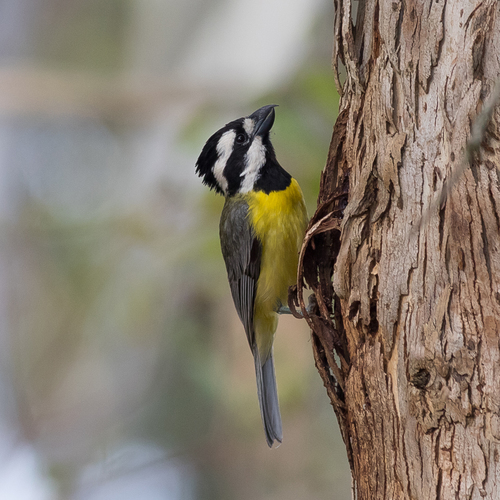 Eastern Shrike-tit
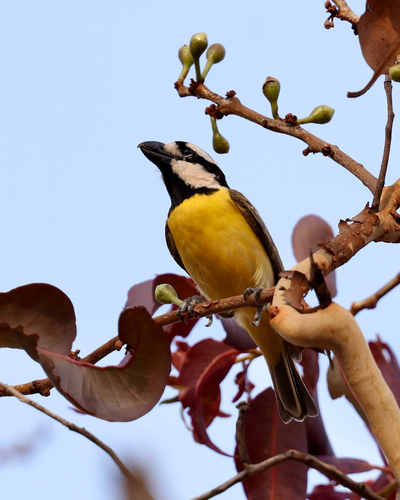 Northern Shrike-tit
要点
The most reliable field mark between Eastern and Northern Shrike-tits is the wing and covert pattern: Northern Shrike-tit shows broad yellow wing-margins and brownish-grey wing coverts, while Eastern Shrike-tit has olive-brown to olive-green upperparts and lacks these yellow wing edges. Juveniles of Eastern Shrike-tit have buffy underparts and browner wings, but still lack the Northern's yellow-edged wings. Both species share a bold black-and-white head pattern and strong bill, but their ranges do not overlap: Eastern is found in southeastern Australia, Northern in the far northwest. If you see a shrike-tit with broad yellow wing-margins, it's Northern; otherwise, check range and covert color for confirmation.
識別のコツ
- Broad yellow wing-margins (Northern only): If you see a shrike-tit with obvious yellow edges to the wings, especially in flight or when perched with wings closed, it is Northern Shrike-tit. This is the most diagnostic mark for all ages.
- Brownish-grey wing coverts (Northern): Northern shows brownish-grey coverts, contrasting with the olive-brown to olive-green upperparts of Eastern. Look for this on perched birds or in good flight views.
- Olive-brown/olive-green upperparts (Eastern): Eastern lacks the yellow wing-margins and has more uniformly olive upperparts. If the wings blend with the back and lack yellow edges, it is likely Eastern.
- Juvenile underparts (Eastern): Juvenile Eastern Shrike-tits have buffy-white throats, breast, and belly, and browner wings, but still lack yellow wing-margins. This helps separate juvenile Eastern from Northern of any age.
- Head pattern (both): Both species have a bold black-and-white head pattern with a thick black eyeline and crown stripe. This is not useful for separation.
- Throat color (Eastern): Male Eastern has a black throat, female has olive-brown. Northern's throat color is not described as distinctive, so use with caution.
- Bill size and shape (both): Both have a large, strong bill for bark-stripping. Not diagnostic between these two.
- Crest (Eastern): Male Eastern can show an erectable crest, but this is not described for Northern. Use only as supporting evidence.
- Underparts color (Eastern): Eastern has bright yellow underparts; Northern's underparts are not described in detail, but yellow wing-margins are more reliable.
- Range/location: If you are in southeastern Australia, you are almost certainly seeing Eastern Shrike-tit. In the Kimberley or Top End, it is Northern. There is no normal range overlap.
- Habitat: Both occur in woodland and forest, so habitat type is not diagnostic, but geographic location is.
- Foraging behavior: Both species forage by levering bark, but only Eastern is noted for tool use. This is rarely seen and not a reliable field mark.
- Size: Both are similar in size and structure; do not rely on size for separation.
- Flight views: In flight, look for yellow wing-margins (Northern) versus uniform olive-brown/green wings (Eastern). Juvenile Easterns may have browner wings but still lack yellow edges.
- Sex and age: Sex differences (black vs olive-brown throat in Eastern) can help within Eastern, but not between species. Age-related marks are most useful for Eastern juveniles versus all Northern.
大きさ
Eastern Shrike-tit averages around 28 g in body mass, with males reaching up to 40 g and females as low as 23 g [wikidata]. No direct mass data is available for Northern Shrike-tit, but both are similar in overall size and structure, with no strong size-based separation in the field. Length and wingspan are also similar, so size is not a reliable distinguishing feature.
羽色
Juveniles of Eastern Shrike-tit have buffy-white throats, breast, and belly, and their wings are browner than adults, but they do not show the broad yellow wing-margins of Northern Shrike-tit. Adult Eastern Shrike-tit has olive-brown to olive-green mantle, back, and rump, bright yellow underparts, and a striking black-and-white head pattern with a thick black eyeline and crown stripe. Males have a black throat, females olive-brown. Northern Shrike-tit is distinguished by broad yellow wing-margins and brownish-grey wing coverts, which are absent in Eastern. Both have a large, strong bill and similar head patterns, but covert and wing edge color are key. The Western Shrike-tit (not in this comparison) would show a white belly and yellow-edged remiges, but Northern's yellow wing-margins are unique among these two.
行動
Both species forage in the canopy, often in pairs or small groups, using their strong bills to lever bark for insects. Eastern Shrike-tit is noted for occasional tool use (using twigs to extract prey), but this is not described for Northern. Foraging style and movement are otherwise very similar and not reliably separable in the field.
生息環境
Eastern Shrike-tit is found in southeastern Australia, including southeast South Australia, Victoria, eastern New South Wales, and southeastern Queensland, with some scattered records further north and west. Northern Shrike-tit is restricted to the Kimberley region of northwestern Australia and the Top End of the Northern Territory. There is no overlap in their normal ranges, so location is a strong clue: shrike-tits in the southeast are Eastern, those in the far northwest are Northern.