

ノドグロヒメウソ 対 ハシブトイカル
Sporophila ruficollis 対 Saltator maxillosus
ノドグロヒメウソとハシブトイカルのクイズ
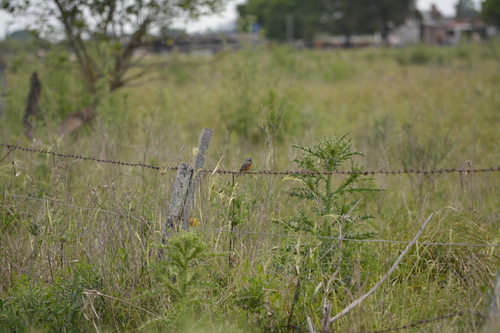 ノドグロヒメウソ
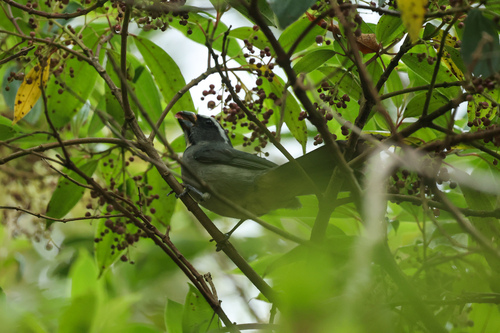 ハシブトイカル
要点
The most reliable field mark between Dark-throated Seedeater and Thick-billed Saltator is overall size and bill structure: the Saltator is nearly twice as long and has a massive, thick, often yellow-based bill, while the Seedeater is tiny with a small, rounded bill. If you glimpse a small bird with a rufous belly and a dark throat, especially in grassland, it's the Seedeater; a much larger bird with a striking white eyebrow and a huge bill in forest is the Saltator. Immature and female Seedeaters can be confused with other brownish birds, but never match the Saltator's size or bill. Always check for the Saltator's long white eyebrow and the Seedeater's rufous underparts and dark throat patch in males.
識別のコツ
- Size is the quickest check: Saltator is almost twice as long as Seedeater. If the bird looks thrush-sized, it's the Saltator; sparrow-sized, it's the Seedeater.
- Bill structure: Saltator has a massive, thick, tall bill, often yellow at the base (especially in males), while Seedeater's bill is small, rounded, and dark (gray to black in males, horn to blackish in females). This is visible even at a distance.
- White eyebrow (supercilium): Only male Saltator shows a long, bold white eyebrow starting at the bill base. Seedeater never has a white eyebrow in any plumage.
- Throat and underparts (adult males): Male Seedeater has a dark brown-black throat and upper breast with rufous below; Saltator male has a buff or rusty underpart but never a dark throat patch.
- Crown color: Male Seedeater has a gray crown and nape, giving a helmeted look; Saltator male is dark gray above but lacks the helmeted effect.
- Rufous/cinnamon tones: Only Seedeater (especially males) shows rufous or dark cinnamon on lower back, rump, and underparts. Saltator is rusty below but never rufous above.
- Primary patch: Both sexes and ages of Seedeater show a small whitish patch at the base of the primaries (on folded wing or in flight). Saltator never shows this feature.
- Female/immature confusion: Female and juvenile Seedeaters are warm brown with buff faces and underparts, lacking strong facial markings. Female Saltator is green-backed with a greener face and buff throat, and always has a much thicker bill.
- Tail: Seedeater's tail is blackish with gray edges (male) or dark brown (female); Saltator's tail is not described as distinctive but is proportionally longer and fits its larger body.
- Habitat context: Seedeater is in open grassland or scrub, Saltator in forest edge or highland forest. Habitat alone can often separate them.
- Behavior: Seedeater is more likely to be seen low in grass or on stems; Saltator perches higher and is more conspicuous.
- Song: If you hear a strong, four-note phrase with the third note loudest, it's the Saltator. Seedeater's song is not described here.
- Leg color: Both have dark legs, not a separator.
- Iris color: Both have dark brown irises, not a separator.
- Seasonal presence: Seedeater breeds December–February; Saltator sings from August onwards, but both can be present year-round in parts of their range.
大きさ
Dark-throated Seedeater is a very small bird, 10–11 cm long and weighing 7–9.7 g, one of the smallest in its genus. Thick-billed Saltator is much larger at about 19 cm, with a notably robust and tall bill. This size difference is dramatic in the field: the Saltator is nearly twice as long and appears much bulkier, while the Seedeater is delicate and sparrow-sized. If you see both together, confusion is unlikely, but lone birds can be misjudged at a distance without a size reference.
羽色
- Juvenile/Immature/First-year: Juvenile and female Dark-throated Seedeaters are warm brown above with buff faces and underparts, and a small whitish primary patch on the wing, but lack any strong facial markings. Immature Saltators are greenish above with a black bill, and never show the Seedeater's rufous tones or primary patch.
- Adult Males: Male Seedeater is gray-crowned with a blackish brown face, throat, and upper breast, and rufous underparts. It has a small white patch at the base of the primaries (visible on the folded wing). Male Saltator is dark gray above, with a long white eyebrow, rusty underparts, and a thick yellow-based bill; no rufous belly or dark throat patch.
- Adult Females: Female Seedeater is warm brown with a buff face and underparts, and a small pale wing patch. Female Saltator has a green back, greener face, buff throat, and a very thick bill, lacking the Seedeater's rufous or cinnamon tones.
- Wings in Flight: Only the Seedeater shows a small whitish patch at the base of the primaries (all ages/sexes), never present in Saltator.
行動
Dark-throated Seedeater is typically seen low in tall grasslands or scrub, often perching on grass stems or low shrubs. It is unobtrusive and moves with quick, sparrow-like hops. Thick-billed Saltator is more robust and often perches higher in forest edges or clearings, sometimes singing from exposed branches. It moves more deliberately and is less likely to be seen on the ground. The Saltator's feeding and singing behavior is more conspicuous, while the Seedeater is generally shy and stays low.
生息環境
Dark-throated Seedeater prefers tall, undisturbed grasslands, grassy roadsides, and sometimes scrubby areas, rarely venturing into dense forest. It is less tied to water than some related species. Thick-billed Saltator is a bird of highland Atlantic Forest, forest edges, and clearings in southeastern Brazil and adjacent areas, rarely found in open grassland. If you find a small bird in open grass, it's likely a Seedeater; a large bird in forest or edge habitat is likely a Saltator.
声
The Saltator's song is a series of four strong, clear calls, with the third note the loudest, and it sings from August onwards. The Seedeater's vocalizations are not described in the provided notes, so song is not a reliable separator here unless you know the Saltator's distinctive pattern.