

Motmot

カンムリオオツリスドリ 対 クリガシラオオツリスドリ

Psarocolius decumanus 対 Psarocolius wagleri

カンムリオオツリスドリとクリガシラオオツリスドリのクイズ
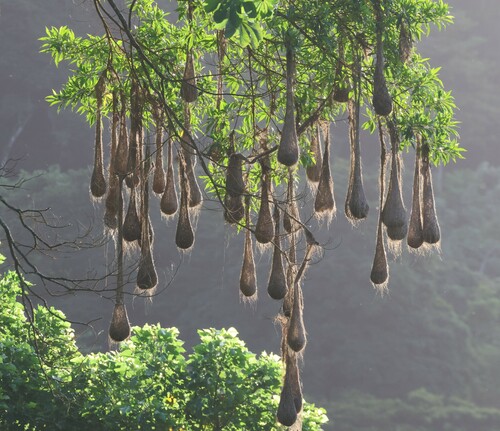
カンムリオオツリスドリ (Psarocolius decumanus) カンムリオオツリスドリ
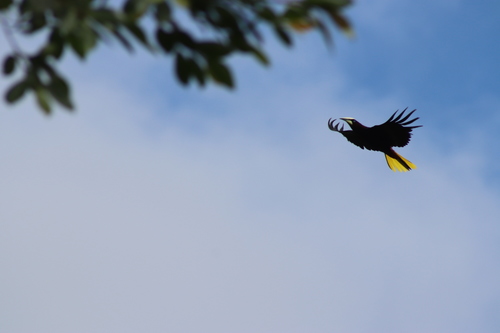
クリガシラオオツリスドリ (Psarocolius wagleri) クリガシラオオツリスドリ

メディア

読み込み中…

要点

The most reliable field mark to separate Crested Oropendola from Chestnut-headed Oropendola is the color and extent of the head and underparts: Crested Oropendola is mostly glossy black with only a chestnut rump and undertail, while Chestnut-headed Oropendola has a rich chestnut head, throat, and upper breast contrasting with a blackish body. Both species have striking yellow tails (with black central feathers), but only Chestnut-headed shows a dark chestnut rump and uppertail coverts, and more chestnut on the flanks and undertail. Structural differences are also useful: Crested is much larger and longer overall, with a more prominent crest on males. Both have large, pale bills and blue irises, but the bill color and shape are subtly different. Juveniles of both are duller and browner, but the head color contrast remains a key clue. Vocalizations differ markedly, with Crested giving complex, rattling songs and Chestnut-headed producing short, popping and crashing notes.

識別のコツ

  1. Head and upper breast color: Chestnut-headed Oropendola of all ages and sexes shows a rich chestnut (or brownish in juveniles/females) head, throat, and upper breast, sharply contrasting with the blackish body. Crested Oropendola is mostly glossy black (or brownish in females/juveniles) with no chestnut on the head or breast—only on the rump and undertail.
  2. Rump and undertail: Both species have chestnut rumps and undertail coverts, but Chestnut-headed also has chestnut on the flanks and belly, while Crested is black-bodied with chestnut limited to the rump and undertail.
  3. Tail pattern: Both have yellow tails with black central feathers, but Chestnut-headed shows black edges on the outermost tail feathers, and juveniles may have some yellow on the forehead. This is subtle and best seen at close range.
  4. Crest: Male Crested Oropendola has a long, shaggy crest on the nape, visible when perched or displaying. Chestnut-headed males have only a slight crest, and females/juveniles of both species have little or no crest.
  5. Bill color and shape: Both have large, pale bills with a swollen casque. Crested's bill is ivory to pale yellow, while Chestnut-headed's is ivory with a bluish or greenish tinge, sometimes with a gray tip. This is subtle and not always reliable at a distance.
  6. Iris color: Both species have blue irises as adults, but juveniles have brownish eyes. This is not a strong field mark for separation.
  7. Size and structure: Crested Oropendola is much larger and bulkier (especially males), with a longer tail and overall more imposing jizz. Chestnut-headed is smaller and appears more slender, but still long-winged in flight. If seen together, the size difference is obvious.
  8. Flight appearance: Chestnut-headed Oropendola looks especially long-winged in flight, but both species have long tails and wings. No distinctive upperwing pattern is described for either species in juvenile or adult plumage, so rely on body color and structure.
  9. Juvenile plumage: Juvenile Chestnut-headed Oropendola is duller but still shows a brownish-chestnut head and upper breast, while juvenile Crested Oropendola is overall dull brownish-black without a contrasting head. Both have brownish bills and eyes as juveniles.
  10. Vocalizations: Crested Oropendola gives complex, rattling, gurgling songs with liquid hoots, often while displaying with wing-flapping. Chestnut-headed Oropendola gives short, popping and crashing notes, with calls like 'waku-waku' and 'whaaakka', and noisy wingbeats in flight. If you hear the song, identification is straightforward.
  11. Habitat and range: In Central America (Mexico to Panama), only Chestnut-headed Oropendola is expected. In northern South America (Colombia, Ecuador), both may occur; Crested is more widespread in lowland South America, while Chestnut-headed is the only oropendola in most of Central America.
  12. Sex differences: Females of both species are duller and browner, with less gloss and a reduced crest. The head color contrast remains a key mark for Chestnut-headed, even in females.
  13. Display behavior: Crested Oropendola males display by bowing, raising the tail, and flapping wings while singing; Chestnut-headed males display with ruffled feathers and upright postures. Behavioral context can help if observed.
  14. Pitfalls: Do not rely solely on the yellow tail, pale bill, or blue iris—these are shared by both species. Focus on head color, size, and overall structure.
  15. Colony size: Large nesting colonies (over 40 nests) are more typical of Crested Oropendola, especially in Trinidad, but this is not a reliable field mark elsewhere.

大きさ

Crested Oropendola is substantially larger and heavier than Chestnut-headed Oropendola. Male Crested average 47 cm (19 in) in length and 285 g (10 oz), while females are 37 cm (15 in) and 160 g (5.6 oz). In contrast, male Chestnut-headed Oropendola average 35 cm (14 in) and 214 g (7.5 oz), with females at 28 cm (11 in) and 113 g (4.0 oz) [wikipedia][wikidata]. This size gap is obvious in the field, especially when both species are seen together. Crested Oropendola appears bulkier and longer-tailed, while Chestnut-headed looks more compact and slender, though still long-winged.

羽色

Juveniles of both species are duller than adults, with brownish tones and less gloss, but the key difference is that Chestnut-headed Oropendola juveniles already show a brownish-chestnut head and upper breast, while Crested Oropendola juveniles are overall dark brownish-black without a contrasting head. In all plumages, Crested Oropendola is mostly glossy black (or brownish in females/juveniles) with a chestnut rump, uppertail, and undertail, and a black central tail with yellow outer feathers. Chestnut-headed Oropendola always has a rich chestnut head, throat, and upper breast, with the rest of the body blackish and the rump, uppertail, and undertail also chestnut, plus chestnut on the rear flanks. The yellow tail is similar in both, but Chestnut-headed has black edges on the outermost tail feathers, and sometimes scattered yellow feathers on the forehead in juveniles. Both sexes of both species have a large, pale bill with a swollen casque and blue iris, but Crested's bill is ivory to pale yellow, while Chestnut-headed's is ivory with a bluish or greenish tinge. Males of both have a crest, but it is longer and more obvious in Crested Oropendola; females and juveniles have a minimal or absent crest.

行動

Both species are colonial nesters, often seen in groups. Crested Oropendola males display by bowing, raising the tail, and flapping wings while singing, and are more likely to be seen in large colonies (especially in Trinidad). Chestnut-headed Oropendola males also display with ruffled feathers and upright postures. In flight, Chestnut-headed Oropendola looks especially long-winged. Both species hang their woven nests from tree branches, but Crested Oropendola colonies can be very large (over 40 nests in Trinidad).

生息環境

Crested Oropendola is widespread in South America (except Chile and Uruguay), reaching into Panama, Costa Rica, and Trinidad and Tobago, and is the most common oropendola in much of its range. Chestnut-headed Oropendola is found from southern Mexico through Central America (except El Salvador) and into Colombia and Ecuador. Where their ranges overlap (Panama, Costa Rica, Colombia, Ecuador), habitat can help but is not always diagnostic. Both favor open woodland, forest edges, and areas with tall trees for nesting, but Crested is more likely in lowland South America, while Chestnut-headed is the only oropendola in much of Central America.

声

Crested Oropendola males give a complex song starting with low liquid notes, building into a rattling crescendo, and ending with a quavering, hooting phrase, often accompanied by wing-flapping. The song is variable and includes staccato flutes and liquid gurgles. In contrast, Chestnut-headed Oropendola's song is short and variable, with low popping sounds followed by harsh, crashing noises (likened to a machete cutting vegetation). Common calls include a liquid, low-pitched 'waku-waku' and a scratchy, electric 'whaaakka'. Males' wings are noisy in flight. The difference in song structure and quality is striking if both are heard.

より良い説明を送る

比較と同じ項目を使ってください。文章はすぐに公開されます。

The most reliable field mark to separate Crested Oropendola from Chestnut-headed Oropendola is the color and extent of the head and underparts: Crested Oropendola is mostly glossy black with only a chestnut rump and undertail, while Chestnut-headed Oropendola has a rich chestnut head, throat, and upper breast contrasting with a blackish body. Both species have striking yellow tails (with black central feathers), but only Chestnut-headed shows a dark chestnut rump and uppertail coverts, and more chestnut on the flanks and undertail. Structural differences are also useful: Crested is much larger and longer overall, with a more prominent crest on males. Both have large, pale bills and blue irises, but the bill color and shape are subtly different. Juveniles of both are duller and browner, but the head color contrast remains a key clue. Vocalizations differ markedly, with Crested giving complex, rattling songs and Chestnut-headed producing short, popping and crashing notes.

  1. Head and upper breast color: Chestnut-headed Oropendola of all ages and sexes shows a rich chestnut (or brownish in juveniles/females) head, throat, and upper breast, sharply contrasting with the blackish body. Crested Oropendola is mostly glossy black (or brownish in females/juveniles) with no chestnut on the head or breast—only on the rump and undertail.
  2. Rump and undertail: Both species have chestnut rumps and undertail coverts, but Chestnut-headed also has chestnut on the flanks and belly, while Crested is black-bodied with chestnut limited to the rump and undertail.
  3. Tail pattern: Both have yellow tails with black central feathers, but Chestnut-headed shows black edges on the outermost tail feathers, and juveniles may have some yellow on the forehead. This is subtle and best seen at close range.
  4. Crest: Male Crested Oropendola has a long, shaggy crest on the nape, visible when perched or displaying. Chestnut-headed males have only a slight crest, and females/juveniles of both species have little or no crest.
  5. Bill color and shape: Both have large, pale bills with a swollen casque. Crested's bill is ivory to pale yellow, while Chestnut-headed's is ivory with a bluish or greenish tinge, sometimes with a gray tip. This is subtle and not always reliable at a distance.
  6. Iris color: Both species have blue irises as adults, but juveniles have brownish eyes. This is not a strong field mark for separation.
  7. Size and structure: Crested Oropendola is much larger and bulkier (especially males), with a longer tail and overall more imposing jizz. Chestnut-headed is smaller and appears more slender, but still long-winged in flight. If seen together, the size difference is obvious.
  8. Flight appearance: Chestnut-headed Oropendola looks especially long-winged in flight, but both species have long tails and wings. No distinctive upperwing pattern is described for either species in juvenile or adult plumage, so rely on body color and structure.
  9. Juvenile plumage: Juvenile Chestnut-headed Oropendola is duller but still shows a brownish-chestnut head and upper breast, while juvenile Crested Oropendola is overall dull brownish-black without a contrasting head. Both have brownish bills and eyes as juveniles.
  10. Vocalizations: Crested Oropendola gives complex, rattling, gurgling songs with liquid hoots, often while displaying with wing-flapping. Chestnut-headed Oropendola gives short, popping and crashing notes, with calls like 'waku-waku' and 'whaaakka', and noisy wingbeats in flight. If you hear the song, identification is straightforward.
  11. Habitat and range: In Central America (Mexico to Panama), only Chestnut-headed Oropendola is expected. In northern South America (Colombia, Ecuador), both may occur; Crested is more widespread in lowland South America, while Chestnut-headed is the only oropendola in most of Central America.
  12. Sex differences: Females of both species are duller and browner, with less gloss and a reduced crest. The head color contrast remains a key mark for Chestnut-headed, even in females.
  13. Display behavior: Crested Oropendola males display by bowing, raising the tail, and flapping wings while singing; Chestnut-headed males display with ruffled feathers and upright postures. Behavioral context can help if observed.
  14. Pitfalls: Do not rely solely on the yellow tail, pale bill, or blue iris—these are shared by both species. Focus on head color, size, and overall structure.
  15. Colony size: Large nesting colonies (over 40 nests) are more typical of Crested Oropendola, especially in Trinidad, but this is not a reliable field mark elsewhere.

Crested Oropendola is substantially larger and heavier than Chestnut-headed Oropendola. Male Crested average 47 cm (19 in) in length and 285 g (10 oz), while females are 37 cm (15 in) and 160 g (5.6 oz). In contrast, male Chestnut-headed Oropendola average 35 cm (14 in) and 214 g (7.5 oz), with females at 28 cm (11 in) and 113 g (4.0 oz) [wikipedia][wikidata]. This size gap is obvious in the field, especially when both species are seen together. Crested Oropendola appears bulkier and longer-tailed, while Chestnut-headed looks more compact and slender, though still long-winged.

Juveniles of both species are duller than adults, with brownish tones and less gloss, but the key difference is that Chestnut-headed Oropendola juveniles already show a brownish-chestnut head and upper breast, while Crested Oropendola juveniles are overall dark brownish-black without a contrasting head. In all plumages, Crested Oropendola is mostly glossy black (or brownish in females/juveniles) with a chestnut rump, uppertail, and undertail, and a black central tail with yellow outer feathers. Chestnut-headed Oropendola always has a rich chestnut head, throat, and upper breast, with the rest of the body blackish and the rump, uppertail, and undertail also chestnut, plus chestnut on the rear flanks. The yellow tail is similar in both, but Chestnut-headed has black edges on the outermost tail feathers, and sometimes scattered yellow feathers on the forehead in juveniles. Both sexes of both species have a large, pale bill with a swollen casque and blue iris, but Crested's bill is ivory to pale yellow, while Chestnut-headed's is ivory with a bluish or greenish tinge. Males of both have a crest, but it is longer and more obvious in Crested Oropendola; females and juveniles have a minimal or absent crest.

Both species are colonial nesters, often seen in groups. Crested Oropendola males display by bowing, raising the tail, and flapping wings while singing, and are more likely to be seen in large colonies (especially in Trinidad). Chestnut-headed Oropendola males also display with ruffled feathers and upright postures. In flight, Chestnut-headed Oropendola looks especially long-winged. Both species hang their woven nests from tree branches, but Crested Oropendola colonies can be very large (over 40 nests in Trinidad).

Crested Oropendola is widespread in South America (except Chile and Uruguay), reaching into Panama, Costa Rica, and Trinidad and Tobago, and is the most common oropendola in much of its range. Chestnut-headed Oropendola is found from southern Mexico through Central America (except El Salvador) and into Colombia and Ecuador. Where their ranges overlap (Panama, Costa Rica, Colombia, Ecuador), habitat can help but is not always diagnostic. Both favor open woodland, forest edges, and areas with tall trees for nesting, but Crested is more likely in lowland South America, while Chestnut-headed is the only oropendola in much of Central America.

Crested Oropendola males give a complex song starting with low liquid notes, building into a rattling crescendo, and ending with a quavering, hooting phrase, often accompanied by wing-flapping. The song is variable and includes staccato flutes and liquid gurgles. In contrast, Chestnut-headed Oropendola's song is short and variable, with low popping sounds followed by harsh, crashing noises (likened to a machete cutting vegetation). Common calls include a liquid, low-pitched 'waku-waku' and a scratchy, electric 'whaaakka'. Males' wings are noisy in flight. The difference in song structure and quality is striking if both are heard.

変更を破棄しますか?

保存していない編集があります。今離れると失われます。

カンムリオオツリスドリ · クリガシラオオツリスドリ · 苦手な鳥