

ミナミカラカラ 対 キバラカラカラ
Caracara plancus 対 Daptrius chimachima
ミナミカラカラとキバラカラカラのクイズ
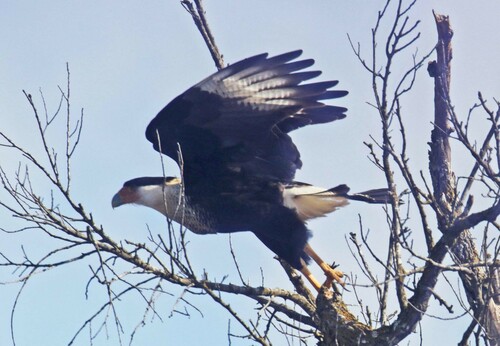 ミナミカラカラ
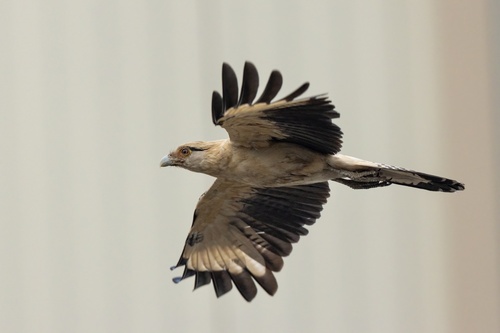 キバラカラカラ
要点
The most reliable field mark between Crested Caracara and Yellow-headed Caracara is overall size and structure: Crested Caracara is much larger, bulkier, and more imposing, while Yellow-headed Caracara is noticeably smaller and slimmer. In flight, both show pale patches at the base of the primaries, but the Crested Caracara’s wing 'window' is larger and more striking. Adult Crested Caracara has a dark cap and contrasting pale neck and chest, while Yellow-headed Caracara shows a pale head and underparts with a thin dark eye-stripe. Juveniles of both are paler and streakier, but the size and head pattern differences remain strong clues. If you see a caracara walking on the ground, check the head pattern and bulk first.
識別のコツ
- Size is the quickest separator: Crested Caracara is much larger and bulkier than Yellow-headed Caracara. If the bird looks eagle-sized, it is almost certainly Crested.
- Head pattern in adults: Crested Caracara shows a solid dark cap contrasting with a pale neck and chest; Yellow-headed Caracara has a pale buff or creamy head with a thin dark eye-stripe, lacking the bold cap.
- Flight 'window': Both species show a pale patch at the base of the primaries in flight, but it is much more extensive and obvious in Crested Caracara of all ages.
- Facial skin and leg color: Crested Caracara has bare facial skin and cere that are deep yellow to reddish-orange (can change with mood), and yellow legs. Yellow-headed Caracara has bright yellow facial skin and pea-green legs.
- Juvenile plumage: Juvenile Crested Caracara is paler and streakier than adults, with grey legs and pale to pinkish facial skin. Juvenile Yellow-headed Caracara is browner above and streaked below, but still shows the pale head and eye-stripe.
- Tail pattern: Crested Caracara has a dark tail tip with a pale base, often with barring; Yellow-headed Caracara has a buff tail with dusky bars and a black band near the end.
- Bill size and shape: Crested Caracara has a heavier, more powerful bill, fitting its larger size; Yellow-headed Caracara’s bill is slimmer and less robust.
- Behavior at carcasses: Crested Caracara is dominant and aggressive at carcasses, often displacing vultures; Yellow-headed Caracara is less assertive and more likely to be seen picking at ticks or small prey.
- Perched jizz: Crested Caracara sits upright, often appearing long-legged and heavy-chested; Yellow-headed Caracara is more slender and less imposing.
- Habitat overlap: In areas where both occur, Crested Caracara is more likely in open, dry country; Yellow-headed Caracara is more adaptable to disturbed or urban edges.
- Social context: Crested Caracara is usually solitary or in small groups at food; Yellow-headed Caracara may join mixed flocks or be seen in pairs.
- Facial expression: The facial skin color of Crested Caracara can change with mood, sometimes appearing reddish; Yellow-headed Caracara’s facial skin remains bright yellow.
- Leg color: Yellow-legged in Crested, pea-green in Yellow-headed (though this can be hard to see at a distance).
- Relative abundance: In Central and northern South America, Yellow-headed Caracara is more common in disturbed areas; Crested Caracara is more localized.
- When in doubt: If the bird looks small, pale-headed, and is picking at ticks on mammals, it is almost always Yellow-headed Caracara.
大きさ
Crested Caracara is dramatically larger: 50–65 cm (20–26 in) long with a 120–132 cm (47–52 in) wingspan and a hefty weight (0.9–1.6 kg, averaging over 1.3 kg) [wikipedia][avonet]. Yellow-headed Caracara is much smaller: 40–45 cm (16–18 in) long, wingspan 74–95 cm (29–37 in), and weighs only 277–364 g [wikipedia][avonet]. In the field, Crested Caracara appears eagle-like and robust, while Yellow-headed Caracara is closer to a slim crow in size and build.
羽色
Juveniles of both species are paler and streakier than adults, but the main age-related field mark is the pale patch at the base of the primaries visible in flight: both species show this, but it is much larger and more obvious in Crested Caracara of all ages. Adult Crested Caracara has a striking dark brownish cap, belly, thighs, and tail tip, with a pale, barred chest, neck, and back; the face and cere are bare and deep yellow to reddish-orange (changing with mood), and the legs are yellow. Juvenile Crested Caracara is paler overall, with streaking on the chest, neck, and back, grey legs, and a pale to pinkish facial skin. Yellow-headed Caracara adults have a buff to creamy yellowish-white head, neck, and underparts, a thin dark eye-stripe, and blackish-brown back and wings. Their tail is buff with dusky bars and a black subterminal band. Immatures are browner above and have brown streaks below. The face is surrounded by bare bright yellow skin, and the legs are pea green. The most consistent difference is the Crested Caracara’s dark cap and heavier barring versus the Yellow-headed Caracara’s pale head and thin eye-stripe.
行動
Both species are often seen walking on the ground and are opportunistic feeders, but Crested Caracara is more dominant at carcasses, often displacing vultures and other raptors. Yellow-headed Caracara is more likely to be seen picking ticks from mammals or foraging in the fur of sloths, and is less likely to be treated as a threat by other birds. Crested Caracara is typically solitary or in small groups at food sources, while Yellow-headed Caracara may be seen in a wider variety of social contexts, including mixed-species flocks.
生息環境
Both species are widespread in open and semi-open habitats across the Neotropics. Crested Caracara ranges from the southern US through most of Latin America, favoring open country, savannas, and ranchlands. Yellow-headed Caracara is found from Nicaragua to Uruguay, often in similar open habitats but also in more urban and disturbed areas. In regions of overlap, Crested Caracara tends to prefer drier, more open areas, while Yellow-headed Caracara is more adaptable to wetter or more wooded edges.