

アフリカクマタカ 対 モモジロクマタカ
Aquila africana 対 Aquila spilogaster
アフリカクマタカとモモジロクマタカのクイズ
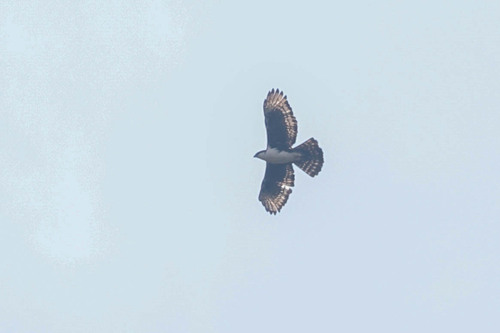 アフリカクマタカ
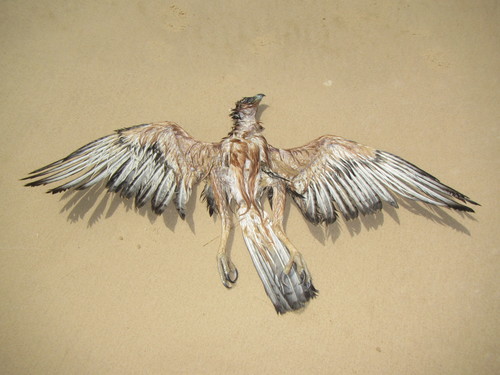 モモジロクマタカ
要点
The most reliable way to separate Cassin's Hawk-Eagle from African Hawk-Eagle is by focusing on age-specific underwing and body patterns in flight: juvenile Cassin's show pale underwing coverts and heavy black spotting on the belly, while juvenile African Hawk-Eagles have tawny-rufous underparts with only faint or absent streaks. Adults differ in the density and type of underpart markings and in the pattern of the upperwing and tail. Structurally, African Hawk-Eagle is the larger, longer-necked, and longer-legged species, often appearing more robust and with a more protruding head. Habitat can also be a clue: Cassin's is a secretive specialist of dense primary rainforest, while African Hawk-Eagle is more often seen in open or edge habitats. Voice is not described in the notes, so visual marks are key.
識別のコツ
- Juvenile underwing pattern: In flight, juvenile Cassin's Hawk-Eagle shows pale underwing coverts, while juvenile African Hawk-Eagle lacks this and instead has a tawny-rufous underwing and underparts. This is one of the best marks for immatures.
- Juvenile underpart spotting: Juvenile Cassin's has dense black spotting on the belly and flanks; African Hawk-Eagle juveniles have little to no streaking, usually only faint black shaft streaks on the flanks.
- Adult underpart markings: Adult Cassin's is white below with black blotches along the sides of the lower breast (sometimes all white); adult African Hawk-Eagle is white below with small, sparse blackish drop-shaped streaks, denser in females.
- Adult underwing coverts: In flight, adult Cassin's has dark underwing coverts and a black band along the rear edge of the wing; African Hawk-Eagle adults show black trailing edges and a pale grey window at the base of the primaries above, plus solid black diagonal markings on the greater coverts below.
- Tail pattern: Both have a broad subterminal band, but Cassin's tail is brown with three black bars and a broad black subterminal band; African Hawk-Eagle's tail is grey with thin dark bars and a broad subterminal band, with a white tip.
- Head and neck structure: African Hawk-Eagle has a longer neck and more protruding head, with a prominent beak; Cassin's is more compact with a shorter neck and less pronounced bill.
- Legs and feet: African Hawk-Eagle has longer, more slender feathered legs and larger, more robust feet; Cassin's legs are shorter and the bird appears less leggy overall.
- Size impression: African Hawk-Eagle is noticeably larger and more robust than Cassin's, both perched and in flight.
- Upperwing pattern (adult): African Hawk-Eagle adults show a pale window at the base of the primaries from above, not present in Cassin's.
- Perched jizz: African Hawk-Eagle may perch more openly or lower in trees, with a longer neck and legs visible; Cassin's is rarely seen perched except high in dense canopy, and appears more compact.
- Eye color: Adult Cassin's has yellowish-brown eyes; adult African Hawk-Eagle has rich yellow eyes. Juveniles of both have browner eyes but this is subtle at distance.
- Habitat context: Deep, mature rainforest strongly favors Cassin's; open woodland, edge, or savanna favors African Hawk-Eagle.
- Sexual dimorphism in underpart markings: In African Hawk-Eagle, females are more densely marked below than males; Cassin's shows less sexual difference in underpart pattern.
- Transition plumages: Both species take several years to mature; intermediate birds can be confusing, but Cassin's immatures become blacker above and whiter below, while African Hawk-Eagle immatures darken above and become more streaked below.
- Behavioral clues: Cassin's is extremely secretive and rarely seen except soaring over forest; African Hawk-Eagle is more likely to be seen perching or flying in open or edge habitats.
大きさ
African Hawk-Eagle is the larger and more robust of the two, with a longer neck, longer and more slender feathered legs, and larger feet. Cassin's Hawk-Eagle is relatively small for an Aquila, with shorter, more rounded wings and a proportionally longer, rounded tail. Both species have feathered legs (booted eagles), but the African Hawk-Eagle's size and structure are noticeably more powerful and elongated, especially in the legs and neck. In direct comparison, Cassin's will look more compact and less heavy-billed.
羽色
- Juvenile/immature flight: Juvenile Cassin's Hawk-Eagle shows pale underwing coverts and dense black spotting on the belly and flanks, with a brown or rufous head and a dark gray tail with white tip and dark barring. Juvenile African Hawk-Eagle, in contrast, has tawny-rufous underparts with only faint or absent black shaft streaks (usually just on the flanks), a moderately dark brown upper side with pale edging, and a more clearly barred tail than the adult.
- Adult flight: Adult Cassin's Hawk-Eagle is dark brown above with white spots, a brown tail with three black bars and a broad black subterminal band, and underparts that are all white or white with black blotches along the sides of the lower breast. In flight, adults show dark underwing coverts and a black band along the rear edge of the wing. Adult African Hawk-Eagle is slate black-grey above with extensive white flecks, a longish grey tail with thin dark bars and a broad subterminal band, and white underparts with small, sparse blackish drop-shaped streaks (denser on females). In flight, adults show a significant pale whitish-grey window at the base of the primaries above, black trailing edges, and solid black diagonal markings on the greater coverts below.
- Transition to adult: Both species take several years to reach full adult plumage, with Cassin's becoming blacker above and whiter below, and African Hawk-Eagle darkening above and becoming more streaked below as it matures.
行動
Cassin's Hawk-Eagle is highly secretive and rarely seen except when soaring over the forest canopy; it is almost never perched in the open and is difficult to observe due to its preference for dense primary rainforest. African Hawk-Eagle, while also often perched within foliage, is more likely to be seen perching in the open or lower down in tall trees, and is generally more conspicuous in open or edge habitats. In flight, African Hawk-Eagle shows powerful, shallow wingbeats and a well-protruding head and neck, while Cassin's appears more compact and rounded.
生息環境
Cassin's Hawk-Eagle is a strict specialist of primary rainforest in western, central, and marginally eastern Africa, and is almost always associated with dense, mature forest. African Hawk-Eagle is not described in detail here, but is known to occur in more open habitats, woodland edges, and savanna regions, and is less tied to deep forest. If seen in deep, unbroken rainforest, Cassin's is far more likely; in more open or edge habitats, African Hawk-Eagle is the default.