

Motmot

ハグロシロハラミズナギドリ 対 ミナミオナガミズナギドリ

Pterodroma nigripennis 対 Ardenna bulleri

ハグロシロハラミズナギドリとミナミオナガミズナギドリのクイズ
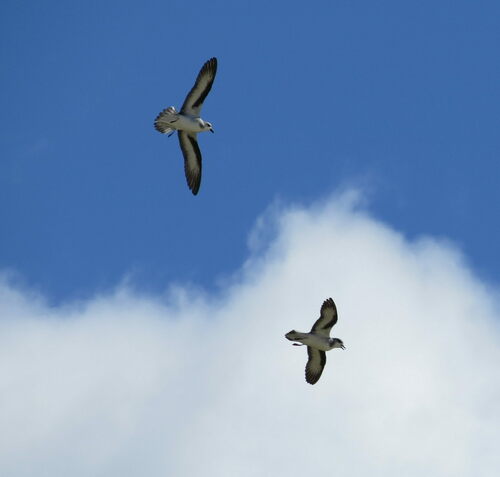
ハグロシロハラミズナギドリ (Pterodroma nigripennis) ハグロシロハラミズナギドリ
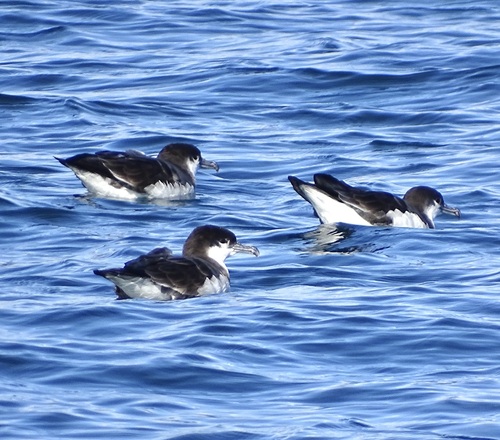
ミナミオナガミズナギドリ (Ardenna bulleri) ミナミオナガミズナギドリ

メディア

読み込み中…

要点

ブラックウィングペトレルとミナミオナガミズナギドリを区別する最も信頼できるフィールドマークは、飛行中の上翼のパターンです:すべての年齢のミナミオナガミズナギドリは、上翼に大胆で壊れた黒の'M'を示しますが、ブラックウィングペトレルは、'M'の形がない淡い内翼を持つより均一な暗い外翼を持っています。ミナミオナガミズナギドリは、ペトレルに比べてはるかに大きく、ずんぐりした体型で、くさび形の尾を持っていますが、ペトレルは小さく、細身で、四角い尾を持っています。両種は白い腹部と淡い顔を持っていますが、ミナミオナガミズナギドリのサイズと独特の上翼パターンは、海上で間違いなく識別できます。構造、尾の形、飛行スタイルも、難しい視界での助けになります。

識別のコツ

  1. 飛行中の上翼のパターン(すべての年齢): ミナミオナガミズナギドリは、上翼に大胆で壊れた黒の'M'を示し、暗い初列羽と、初列羽から覆羽までの暗いストライプの間に淡いパネルがあります。この'M'はすべての羽衣で見られ、大型のミズナギドリの中でユニークです。ブラックウィングペトレルはこのパターンがなく、代わりにより均一な暗い外翼と淡い内翼を示し、'M'や強いコントラストはありません。
  2. サイズと構造: ミナミオナガミズナギドリは、はるかに大きく、重く、広い翼幅と頑丈な体を持っています。ブラックウィングペトレルは小さく、細身で、より繊細な構造です。一緒に見られると、サイズの違いは劇的です。
  3. 尾の形: ミナミオナガミズナギドリはくさび形の黒っぽい尾を持ち、ブラックウィングペトレルは黒と白の縞模様のある四角い尾を持っています。これは、特にバンクや着陸時に良い視界で見ることができます。
  4. 頭のパターン: 両種は淡い顔を持っていますが、ミナミオナガミズナギドリは目まで伸びる灰色と非常に白い頬を持ち、明るい光の中で輝いて見えることがあります。ブラックウィングペトレルは淡い灰色の帽子と後頭部、白い頬、暗い灰色の襟を持っています—襟を探して区別するのに役立ててください。
  5. 腹部: 両方とも下側は白いので、これでは区別できません。
  6. 飛行スタイル: ミナミオナガミズナギドリは、安定した力強い滑空と浅い翼の拍動を使用し、そのサイズを反映しています。ブラックウィングペトレルはより浮力があり、敏捷で、急速なフリックと素早い方向転換を使用します。
  7. くちばし: 両方とも暗いくちばしを持っていますが、ミナミオナガミズナギドリは相対的に長く重く、大きな頭に合っています。これは遠くから見ると微妙です。
  8. 羽衣の落とし穴: ミナミオナガミズナギドリの'M'パターンは、ガドフライペトレルと間違えられることがありますが、サイズははるかに大きいです。ブラックウィングペトレルの暗い外翼は、一見するとミズナギドリのように見えることがありますが、'M'がなく、はるかに小さいです。
  9. 幼鳥の区別: 幼鳥のミナミオナガミズナギドリはすでに成鳥の翼パターンを示しているため、'M'は常に存在します。ブラックウィングペトレルの未熟な羽衣は、成鳥と異なるとは記述されていません。
  10. 文脈と範囲: ミナミオナガミズナギドリは、特にアメリカの西海岸近くで、夏の終わり/秋に見られる可能性が高いです;ブラックウィングペトレルはより中央太平洋にいます。場所を使用して、フィールドマークをサポートし、置き換えないでください。
  11. 尾の縞模様: ブラックウィングペトレルの尾に黒と白の縞模様を探してください;ミナミオナガミズナギドリの尾は均一に暗く、くさび形です。
  12. 頬のコントラスト: 両方とも白い頬を示すことがありますが、ミナミオナガミズナギドリの頬は特に明るく、目まで伸びる灰色によって際立っています。
  13. 混合群れ: 両方とも混合給餌群れに参加することがありますが、ミナミオナガミズナギドリは船を追う可能性が高いです。
  14. 止まっている/巣作りの視界: 陸上では、ミナミオナガミズナギドリは森林の斜面や岩の隙間に巣を作ります;ブラックウィングペトレルは草の斜面の砂地にトンネルを掘りますが、これらはバーダーによく見られません。
  15. 疑わしい場合: 上翼のパターンと全体のサイズに焦点を当ててください—これらは海上で最も信頼できる、かつ目に見える違いです。

大きさ

ミナミオナガミズナギドリはブラックウィングペトレルのほぼ2倍の重さ(326 g対167 g)で、はるかに長く(46–47 cm対29 cm)、翼幅も広い(97–99 cm対67 cm)です [wikidata, wikipedia]。フィールドでは、ミナミオナガミズナギドリは大きく広い翼を持つミズナギドリとして現れ、ブラックウィングペトレルは小さく細身のペトレルで、長く狭い翼を持っています。一緒に見られると、サイズのギャップは明らかです;ミナミオナガミズナギドリはずんぐりしており、飛行中はより力強く、ブラックウィングペトレルは繊細で敏捷に見えます。

羽色

飛行中の上翼のパターンは、すべての年齢における重要な違いです:ミナミオナガミズナギドリは、上翼に目を引く壊れた黒の'M'を示し、黒っぽい初列羽と、初列羽から覆羽までの暗いストライプの間に淡い灰色のパネルがあります。この'M'は大型のミズナギドリの中でユニークであり、一部の小型のガドフライペトレルに似ていますが、ブラックウィングペトレルのものよりもはるかに大胆で広いです。対照的に、ブラックウィングペトレルは淡い灰色の内翼と暗い灰色-黒の外翼を持っていますが、'M'や強いコントラストはなく、暗い部分は主に外側の端に制限されています。両方とも白い腹部を持っています。頭部では、両種とも淡い顔を示していますが、ミナミオナガミズナギドリは上部の灰色が目の高さまで伸びており、明るく見える白い頬を持っています。ブラックウィングペトレルは淡い灰色の帽子と後頭部、白い頬、暗い灰色の襟を持っています。尾は異なります:ミナミオナガミズナギドリはくさび形で黒っぽく、ブラックウィングペトレルは四角く、黒と白の縞模様があります。幼鳥のミナミオナガミズナギドリはすでに成鳥の'M'パターンを示しているため、このマークはすべての年齢において信頼できます;ブラックウィングペトレルの未熟な羽衣は、これらの情報源では成鳥と異なるとは記述されていません。

行動

ミナミオナガミズナギドリは通常、安定した力強い滑空と浅い翼の拍動で飛び、そのサイズと長い翼を使用してダイナミックなソアリングを行います。ブラックウィングペトレルはより浮力があり、敏捷で、急速なフリックと素早い方向転換を使用することがよくあります。海上では、ミナミオナガミズナギドリは船を追ったり、混合給餌群れに参加したりすることがありますが、ブラックウィングペトレルは一人または小さな群れで見られる可能性が高く、波の上を低く滑空します。陸上では、両方とも巣穴に巣を作りますが、ミナミオナガミズナギドリは森林の斜面や岩の隙間を好み、ブラックウィングペトレルは草の斜面の砂地にトンネルを掘ります。

生息環境

両種は外洋性で、ほとんどの生活を海の遠くで過ごし、繁殖のためにのみ陸に来ます。ミナミオナガミズナギドリは主にニュージーランド北部のプアナイツ諸島で繁殖し、太平洋全体に広く分布し、夏の終わりと秋にアメリカの西海岸でよく見られます。ブラックウィングペトレルは、オーストラリア東部からフランス領ポリネシアまでの散在する太平洋の島々で繁殖し、繁殖シーズン外ではペルーとハワイの間で最も一般的です。海上での重複は可能ですが、ミナミオナガミズナギドリは一般的にアメリカ近くの沿岸に多く、ブラックウィングペトレルはより中央太平洋にいます。両方とも混合海鳥の群れで見られることがありますが、視界が悪い場合は文脈と場所が役立つことがあります。

より良い説明を送る

比較と同じ項目を使ってください。文章はすぐに公開されます。

The most reliable field mark to separate Black-winged Petrel from Buller's Shearwater is the upperwing pattern in flight: Buller's Shearwater of all ages shows a bold, broken black 'M' across the upperwings, while Black-winged Petrel has a more uniform dark outer wing with pale inner wing, lacking the 'M' shape. Buller's is also much larger and bulkier, with a wedge-shaped tail, compared to the petrel's smaller, slimmer build and square-cut tail. Both species have white underparts and pale faces, but Buller's Shearwater's size and distinctive upperwing pattern are unmistakable at sea. Structure, tail shape, and flight style also help in challenging views.

  1. Upperwing pattern in flight (all ages): Buller's Shearwater shows a bold, broken black 'M' across the upperwings, with a pale panel between dark primaries and a dark stripe from tertials to coverts. This 'M' is visible in all plumages and is unique among large shearwaters. Black-winged Petrel lacks this pattern, instead showing a more uniform dark outer wing and pale inner wing, without any 'M' or strong contrast.
  2. Size and structure: Buller's is much larger and heavier, with a broad wingspan and robust body. Black-winged Petrel is small, slender, and more delicate in build. If seen together, the size difference is dramatic.
  3. Tail shape: Buller's Shearwater has a wedge-shaped, blackish tail, while Black-winged Petrel has a square-cut tail with black and white barring. This can be seen in good views, especially when banking or landing.
  4. Head pattern: Both species have pale faces, but Buller's has grey extending down to the eye and very white cheeks, which can appear to shine in bright light. Black-winged Petrel has a pale grey cap and nape, white cheeks, and a dark grey collar—look for the collar to help separate it.
  5. Underparts: Both are white below, so this is not helpful for separation.
  6. Flight style: Buller's uses steady, powerful glides and shallow wingbeats, reflecting its size. Black-winged Petrel is more buoyant and agile, with rapid flicks and quick turns.
  7. Bill: Both have dark bills, but Buller's is proportionally longer and heavier, matching its larger head. This is subtle at distance.
  8. Plumage pitfalls: The 'M' pattern of Buller's may be mistaken for a gadfly petrel, but the size is much greater. Black-winged Petrel's dark outer wing can look like a shearwater at a glance, but lacks the 'M' and is much smaller.
  9. Juvenile separation: Juvenile Buller's Shearwater already shows the adult wing pattern, so the 'M' is always present. Black-winged Petrel's immature plumage is not described as differing from adult.
  10. Context and range: Buller's is more likely near the Americas, especially off the US west coast in late summer/autumn; Black-winged Petrel is more central Pacific. Use location to support, not replace, field marks.
  11. Tail barring: Look for black and white barring on Black-winged Petrel's tail in good views; Buller's tail is uniformly dark and wedge-shaped.
  12. Cheek contrast: Both can show white cheeks, but Buller's are especially bright and set off by the grey extending to the eye.
  13. Mixed flocks: Both may join mixed feeding flocks, but Buller's is more likely to follow ships.
  14. Perched/nesting views: On land, Buller's nests in forested slopes or rocky crevices; Black-winged Petrel prefers sandy soil on grassy slopes, but these are rarely seen by birders.
  15. When in doubt: Focus on the upperwing pattern and overall size—these are the most reliable and visible differences at sea.

Buller's Shearwater is nearly twice as heavy as Black-winged Petrel (326 g vs 167 g) and is much longer (46–47 cm vs 29 cm) with a broader wingspan (97–99 cm vs 67 cm) [wikidata, wikipedia]. In the field, Buller's appears as a large, broad-winged shearwater, while Black-winged Petrel is a small, slender petrel with long, narrow wings. If seen together, the size gap is obvious; Buller's is bulkier and more powerful in flight, while Black-winged Petrel looks delicate and agile.

Upperwing pattern in flight is the key difference for all ages: Buller's Shearwater shows a striking, broken black 'M' across the upperwing, with blackish primaries and a dark stripe from tertials to coverts, separated by a pale grey panel that can look almost white in bright light. This 'M' is unique among large shearwaters and mimics some smaller gadfly petrels, but is much bolder and broader than anything on Black-winged Petrel. Black-winged Petrel, by contrast, has pale grey inner wings and dark grey-black outer wings, but lacks any 'M' or strong contrast—the dark is mostly confined to the outer edge. Both have white underparts. On the head, both species show pale faces, but Buller's has the grey of the upperparts extending down to eye level, with white cheeks that can appear bright. Black-winged Petrel has a pale grey cap and nape, white cheeks, and a dark grey collar. Tails differ: Buller's is wedge-shaped and blackish, while Black-winged Petrel's is square-cut and barred black and white. Juvenile Buller's Shearwater already shows the adult's 'M' pattern, so this mark is reliable for all ages; Black-winged Petrel's immature plumage is not described as differing from adult in these sources.

Buller's Shearwater typically flies with steady, powerful glides and shallow wingbeats, using its size and long wings for dynamic soaring. Black-winged Petrel is more buoyant and agile, often using rapid, flickering wingbeats and quick changes of direction. At sea, Buller's may follow ships or join mixed feeding flocks, while Black-winged Petrel is more likely to be seen alone or in small groups, skimming low over the waves. On land, both nest in burrows, but Buller's prefers forested slopes and rocky crevices, while Black-winged Petrel digs tunnels in sandy soil on grassy slopes.

Both species are pelagic and spend most of their lives far out at sea, only coming to land to breed. Buller's Shearwater breeds mainly on the Poor Knights Islands off northern New Zealand and ranges widely across the Pacific, often seen off the west coast of the Americas in late summer and autumn. Black-winged Petrel breeds on scattered Pacific islands from eastern Australia to French Polynesia, and is most common between Peru and Hawaii outside the breeding season. Overlap at sea is possible, but Buller's is generally more coastal near the Americas, while Black-winged Petrel is more central Pacific. Both may be seen in mixed seabird flocks, but context and location can help if the view is poor.

変更を破棄しますか?

保存していない編集があります。今離れると失われます。

ハグロシロハラミズナギドリ · ミナミオナガミズナギドリ · 苦手な鳥