

クロハサミアジサシ 対 オオハシアジサシ
Rynchops niger 対 Phaetusa simplex
クロハサミアジサシとオオハシアジサシのクイズ
 クロハサミアジサシ
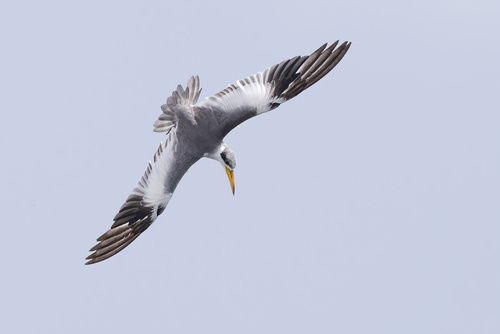 オオハシアジサシ
要点
The most reliable field mark between Black Skimmer and Large-billed Tern is the unique bill structure: Black Skimmer has a strikingly long, laterally compressed bill with a much longer lower mandible, while Large-billed Tern has a thick, all-yellow bill that is large but not elongated or uneven. In flight, Black Skimmer shows black upperwings with a white trailing edge and a dark tail, while Large-billed Tern has grey upperparts and white underparts with no black trailing edge. Juvenile Black Skimmers have brown upperparts with white feather tips, while Large-billed Tern immatures are not described as having such contrast. Both species can appear tern-like at a distance, but their structure and bill color are distinct. Habitat overlap is possible in northern South America, but Black Skimmer is more likely in coastal or estuarine settings, while Large-billed Tern is almost always inland on rivers and lakes.
識別のコツ
- Bill structure is the single most reliable field mark: Black Skimmer has a long, laterally compressed bill with a much longer lower mandible (red at base, black at tip); Large-billed Tern has a thick, all-yellow bill that is large but not elongated or uneven. This works for all ages and seasons.
- Juvenile/immature plumage: Only Black Skimmer immatures show brown upperparts with white feather tips and fringes. Large-billed Tern immatures are not described as having this pattern, so any brown and white-tipped upperparts point to skimmer.
- Upperwing in flight: Black Skimmer (all ages) shows black upperwings with a white trailing edge; Large-billed Tern has grey upperparts and no black trailing edge. This is visible in flight and sometimes when perched with wings spread.
- Tail shape and length: Black Skimmer has a longer, more pointed tail with white edges; Large-billed Tern has a short tail, which gives a more compact appearance when perched or in flight.
- Leg color: Black Skimmer has red legs; Large-billed Tern has yellow legs and feet. This is best seen when birds are perched or standing on sandbars.
- Crown and upperparts color: Black Skimmer adults have a black crown, nape, and upper body; Large-billed Tern has a black crown and ear-coverts but grey upperparts. In non-breeding season, both show paler crowns, but the skimmer's upperparts become browner, and a white nape collar appears.
- Forehead and underparts: Both species have white foreheads and underparts, but only skimmer has a sharp contrast with black upperparts.
- Flight style: Black Skimmer flies with steady, graceful wingbeats, often low over water with bill open and lower mandible slicing the surface. Large-billed Tern flies more like a typical tern, with less exaggerated skimming behavior.
- Perched posture: Black Skimmer often sits low, with bill closed and lower mandible protruding; Large-billed Tern stands more upright, showing its thick yellow bill.
- Vocalization: If you hear a barking 'kak-kak-kak', it's Black Skimmer. Large-billed Tern's voice is not described here.
- Habitat context: Black Skimmer is more likely in coastal or estuarine settings, especially in North America; Large-billed Tern is almost always inland on rivers and lakes in South America.
- Size and jizz: Black Skimmer is heavier, longer, and has a much greater wingspan, appearing lankier and longer-winged. Large-billed Tern is more compact and short-tailed.
- Seasonal changes: In non-breeding season, Black Skimmer develops a white nape collar and paler upperparts, but bill structure and color remain distinctive.
- Sex differences: Not strongly diagnostic in the field, but male Black Skimmers average heavier than females; this is not a reliable field mark.
- Common pitfalls: At a distance, both can appear tern-like with black caps and white underparts, but bill color and structure, upperwing pattern, and habitat are the best ways to separate them.
大きさ
Black Skimmer is noticeably heavier and slightly longer than Large-billed Tern. Average body mass is about 301.5 g for Black Skimmer versus 235 g for Large-billed Tern [wikidata], and Black Skimmer's length is 40–50 cm compared to the tern's 38 cm [wikipedia]. Wingspan is much greater in Black Skimmer (107–127 cm) than in Large-billed Tern (not specified, but shorter based on overall size and structure). In the field, Black Skimmer appears lankier and longer-winged, while Large-billed Tern is more compact and short-tailed.
羽色
- Juvenile/immature Black Skimmer: Brown upperparts with white feather tips and fringes; white forehead and underparts; upperwings black with white rear edge; underwing varies from white to dusky grey. This contrasts with Large-billed Tern, which is not described as having such distinct juvenile upperwing or body pattern—immature plumage is not detailed, but no mention of brown or white-tipped feathers.
- Adult Black Skimmer (breeding): Black crown, nape, and upper body; white forehead and underparts; black upperwings with white trailing edge; tail and rump dark grey with white edges. The bill is red at the base, black at the tip, with a much longer lower mandible.
- Adult Large-billed Tern (breeding): Black crown and ear-coverts, grey upperparts, white secondaries, primary coverts, lores, and underparts; tail is short; bill is large and all yellow; legs and feet are yellow. No black trailing edge on the wing; upperparts are grey, not black.
- Non-breeding adults: Both species have paler crowns and foreheads, but Black Skimmer develops a white nape collar and browner upperparts, while Large-billed Tern's crown and forehead become paler but retains the grey upperparts and yellow bill.
行動
Black Skimmer often feeds in large flocks, flying low over water with the lower mandible slicing the surface, mostly at night or in low light. Its flight is light and graceful, with steady wingbeats and a unique foraging style. Large-billed Tern behaves more like a typical tern, foraging over rivers and lakes, diving for prey, and rarely skimming. When perched, Black Skimmer often stands with its bill closed and lower mandible protruding, while Large-billed Tern perches more upright and shows its thick yellow bill clearly.
生息環境
Black Skimmer is found in coastal areas, estuaries, and sometimes large inland water bodies, especially in North and South America. It breeds on sandy beaches, islands, and sandbars. Large-billed Tern is almost exclusively found inland, along rivers and freshwater lakes throughout most of South America east of the Andes. Overlap is possible in northern South America, but Large-billed Tern is rarely coastal, and Black Skimmer is rarely found far from the coast except in some river systems.
声
Black Skimmer gives a distinctive barking 'kak-kak-kak' call. Large-billed Tern's voice is not described in the provided notes, so vocalization is only diagnostic if you hear the Black Skimmer's barking call.