

ヒメウズラシギ 対 アメリカヒバリシギ
Calidris bairdii 対 Calidris minutilla
ヒメウズラシギとアメリカヒバリシギのクイズ
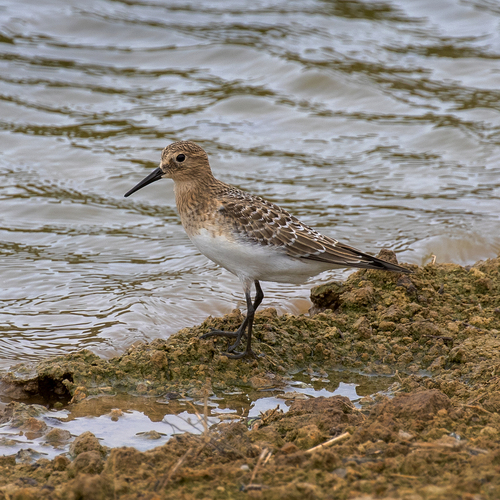 ヒメウズラシギ
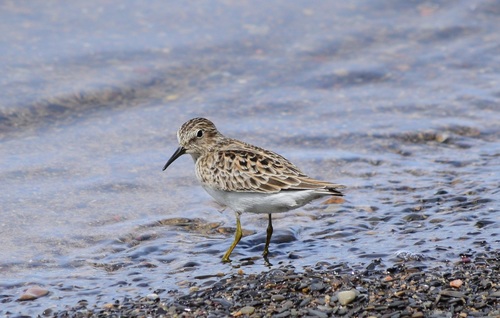 アメリカヒバリシギ
要点
The most reliable field mark to separate Baird's Sandpiper from Least Sandpiper is leg color: Baird's has black legs, while Least has yellow-green legs, visible even at a distance. For birds on the ground, Baird's shows very long wings that extend well beyond the tail, a feature not matched by Least. Juvenile Least Sandpipers are brighter and more rufous above, with white mantle stripes, while Baird's juveniles are duller and more uniform. Both species are small, but Least is the smallest North American shorebird, and Baird's appears slightly longer and slimmer. Both can be tricky in mixed 'peep' flocks, but careful attention to structure and leg color will usually resolve confusion.
識別のコツ
- Leg color is the most consistent field mark: Baird's Sandpiper always has black legs; Least Sandpiper always has yellow-green legs. This is visible even at a distance or in poor light, but beware of mud-stained legs on Least, which can look dark.
- Wing projection beyond the tail: On the ground, Baird's wings extend well past the tail, giving a long, attenuated look. Least's wings are shorter and do not project beyond the tail. This works for all ages and is especially useful in side views.
- Juvenile upperparts: Juvenile Least Sandpipers are brighter, with rufous tones and bold white mantle stripes. Juvenile Baird's are duller, more uniform brown above, lacking strong rufous or white striping.
- Overall structure: Baird's looks longer, slimmer, and more elongated, especially in the wings and tail. Least is compact, short-necked, and round-bodied.
- Bill shape: Both have short, thin, dark bills, but Baird's may appear slightly longer and straighter; Least's can look finer and slightly decurved at the tip, but this is subtle and variable.
- Breast pattern: Baird's has a pale brown breast with fine streaks, blending into the white belly. Least's breast streaking is often more concentrated at the sides, with a cleaner white center.
- Supercilium and crown: Least Sandpiper shows a pale line above the eye (supercilium) and a darker crown, especially in breeding plumage. Baird's head pattern is plainer and less contrasting.
- Rump and uppertail: Baird's has a dark rump patch, but this is not as obvious as in White-rumped Sandpiper and is rarely a primary field mark for these two species.
- Leg color in mud: If Least Sandpiper's legs are muddy, they can appear dark—always double-check for any hint of yellow-green.
- Flight jizz: Both species have rapid, low flight with quick wingbeats, but Baird's may look longer-winged and more pointed in flight.
- Habitat preference: If you see a peep in a very muddy, vegetated edge, Least is more likely; Baird's may prefer drier, more open flats, but this is not diagnostic.
- Size in mixed flocks: Least is the smallest peep; if one bird looks slightly larger and more elongated among Leasts, consider Baird's.
- Seasonal confusion: Both species can appear paler and greyer in winter, but leg color and wing projection remain reliable.
- Sex and age: No strong sexual dimorphism; all field marks above apply to both sexes. Juvenile marks are most useful in late summer and early fall.
- Beware of other peeps: Both can be confused with Semipalmated and Western Sandpipers; always check leg color and wing projection first.
大きさ
Least Sandpiper is the smallest shorebird in North America, measuring 13–15 cm in length and weighing 19–30 g [wikipedia]. Baird's Sandpiper is similar in size but slightly longer and slimmer overall (precise measurements not provided in the notes, but both are in the 'small peep' range). In the field, Baird's may look more elongated, especially due to its long wings and tail projection, while Least appears more compact and short-necked.
羽色
- Juvenile/immature birds: Juvenile Least Sandpipers are distinctly patterned above, with bright rufous tones and bold white mantle stripes. Baird's juveniles are more uniformly dark brown above with less contrast and lack the bright rufous and white striping.
- Leg color (all ages): Baird's always has black legs; Least always shows yellow-green legs, a key field mark.
- Adult breeding: Both are brown above and white below, but Baird's has a paler, streaked head and breast, and a dark rump patch. Least has a light supercilium and a darker crown.
- Winter plumage: Both become greyer above, but Baird's remains longer-winged and black-legged, while Least keeps yellow-green legs and a more compact look.
- Wing projection (all ages): Baird's wings extend well past the tail when perched; Least's do not.
行動
Both species forage on mudflats and shorelines, picking at the surface or probing for food. Least Sandpiper may appear more crouched and deliberate, often feeding in wetter, muddier areas. Baird's may look more upright, with a sleeker, more elongated posture due to its long wings and tail. Flock behavior is similar, but Baird's may mix more with other long-distance migrant sandpipers.
生息環境
Both species use similar habitats during migration—mudflats, shorelines, and the edges of ponds or lakes. Least Sandpiper breeds in North American tundra and bogs, while Baird's breeds farther north and west. In migration, Least Sandpiper may be more likely in muddier, vegetated edges, while Baird's can be found in more open, drier flats, but there is much overlap.