

アメリカムナグロ 対 フタオビチドリ
Pluvialis dominica 対 Charadrius vociferus
アメリカムナグロとフタオビチドリのクイズ
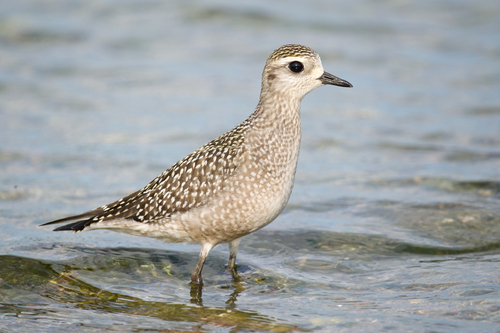 アメリカムナグロ
 フタオビチドリ
要点
The most reliable field mark to separate American Golden Plover from Killdeer is the presence of two bold black breast bands on Killdeer, versus a single solid black belly and undertail (in breeding plumage) or plain underparts (in nonbreeding) on American Golden Plover. In flight, Killdeer shows a bright white wing stripe and a rufous rump, while American Golden Plover lacks both. Structure also helps: Killdeer is longer-tailed and has a thicker bill, while American Golden Plover is slimmer with a smaller head and bill. Juvenile and nonbreeding birds can be confusing, but the breast band pattern and wing/rump contrasts remain reliable. Habitat and behavior may overlap, but Killdeer is far more likely in open fields and urban areas, while American Golden Plover prefers tundra or open mudflats during migration.
識別のコツ
- Breast bands: Killdeer always shows two bold black breast bands on a white background (adults and most juveniles). American Golden Plover never has two breast bands; breeding adults have a solid black belly, while nonbreeding and juvenile birds have plain, pale underparts.
- Wing stripe in flight: Killdeer shows a conspicuous white wing stripe at the base of the flight feathers, visible in all ages and seasons. American Golden Plover lacks any white wing stripe.
- Rufous rump: Killdeer flashes a rufous rump and upper tail in flight or when displaying. American Golden Plover’s rump is plain, without rufous.
- Tail pattern: Killdeer’s tail is brown with a black subterminal band and a white terminal band, often fanned in display. American Golden Plover’s tail is plain and lacks these contrasting bands.
- Bill shape: Killdeer has a short, thick, dark bill; American Golden Plover’s bill is shorter, slimmer, and more delicate.
- Head and face: Killdeer has a white forehead, white supercilium (eyebrow), and a black mask with a white collar. American Golden Plover in breeding plumage has a black face and throat with a white crown and nape, but no collar or mask.
- Eye ring: Killdeer has a noticeable red eye ring, absent in American Golden Plover.
- Upperparts: American Golden Plover shows gold-spotted upperparts in breeding plumage; Killdeer is plain brown with rufous fringes.
- Leg color: Killdeer has flesh-colored legs; American Golden Plover’s leg color is not specified but is not a strong field mark in this comparison.
- Juvenile confusion: Juvenile Killdeer may briefly show only one breast band, but quickly develops the second. American Golden Plover juveniles never show breast bands.
- Voice: If you hear a loud, repeated 'kill-deer' call, it is Killdeer. American Golden Plover is much quieter and less vocal in migration.
- Habitat: In urban, suburban, or agricultural settings, Killdeer is far more likely. American Golden Plover prefers tundra (breeding) or open mudflats/fields (migration), rarely in built-up areas.
- Behavior: Killdeer often performs the 'broken-wing' display, exposing its rufous rump and fanning its tail. American Golden Plover does not show this behavior.
- Seasonal timing: American Golden Plover molts into winter plumage later (September–October) than Pacific Golden Plover, but this is not diagnostic against Killdeer.
- Group size: Killdeer is often seen in pairs or small groups in open areas; American Golden Plover may be solitary or in loose flocks, especially on migration.
大きさ
American Golden Plover is slightly heavier on average (body mass ~145 g [wikidata]) compared to Killdeer (typically 72–121 g [wikipedia]), but both are similar in length (American Golden Plover: 24–28 cm; Killdeer: 20–28 cm) and wingspan (American Golden Plover: 65–67 cm; Killdeer: 59–63 cm). In the field, Killdeer often appears taller and longer-tailed, while American Golden Plover looks more compact and slim, especially when feeding or alert.
羽色
- Juvenile/immature flight: Killdeer of all ages shows a strong white wing stripe at the base of the flight feathers and a rufous rump, both visible in flight. American Golden Plover lacks both these features, showing plain gray axillaries and no white wing stripe or rufous rump.
- Adult breeding: American Golden Plover has a striking black face, neck, breast, and belly, with a white crown/nape and gold-spotted back. Killdeer never shows this pattern; instead, it has brown upperparts, a white forehead, and two black breast bands on a white belly.
- Adult nonbreeding/juvenile: American Golden Plover becomes gray-brown above and pale below, with a whitish eyebrow but no breast bands. Killdeer retains its two black breast bands year-round, and juveniles show a single breast band when very young, quickly acquiring the second. Killdeer also has a white collar with a black upper border and a red eye ring, while American Golden Plover lacks these features.
- Tail and rump: Killdeer has a brown tail with a black subterminal band, a white terminal band, and a rufous rump; American Golden Plover’s tail and rump are plain, lacking these contrasts.
行動
Both species are ground-dwelling and often run in short bursts, but Killdeer is especially noted for its 'broken-wing' distraction display, where it feigns injury and exposes its rufous rump to lure predators away from the nest. Killdeer is also more vocal and conspicuous, often calling in flight or on the ground. American Golden Plover is more reserved, especially on migration, and is less likely to perform distraction displays. Both defend territories, but Killdeer is more likely to be seen in pairs or small groups in open human-altered habitats.
生息環境
Killdeer is highly adaptable and common in open fields, agricultural land, gravel lots, and even rooftops, often far from water. American Golden Plover breeds on Arctic tundra and migrates through open mudflats, short grass, and sometimes agricultural fields, but is much less likely to be found in urban or suburban settings. If you see a plover in a city park or parking lot, it is almost certainly a Killdeer.
声
Killdeer is extremely vocal, with a loud, repeated 'kill-deer' or 'kee-deeyu' call, often heard even at night. Its alarm call is a rapid trill. American Golden Plover is quieter and less likely to call persistently in migration or winter; its calls are not described in the provided notes, but are generally softer and less distinctive than Killdeer’s.