

White-bellied Parrot vs Blaze-winged Parakeet
Pionites leucogaster contro Pyrrhura devillei
Fai un quiz con White-bellied Parrot e Blaze-winged Parakeet
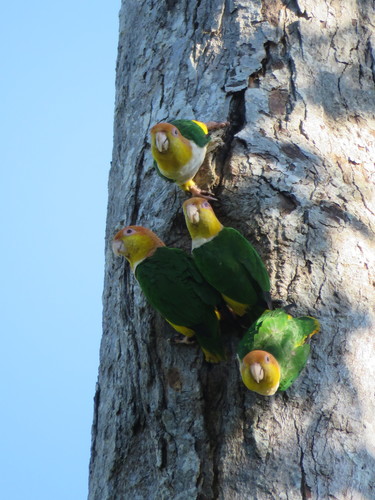 White-bellied Parrot
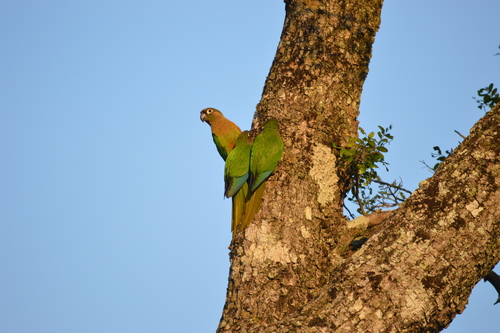 Blaze-winged Parakeet
In breve
The most reliable field mark between White-bellied Parrot and Blaze-winged Parakeet is the White-bellied Parrot’s striking white lower breast and belly, contrasting with its yellow and green upperparts, versus the Blaze-winged Parakeet’s overall green plumage with a maroon belly and scaly, brown-edged breast. In flight or perched, the parrot’s chunky, short-tailed shape and pale bill stand out against the parakeet’s slimmer build, longer tail, and dark bill. Immature White-bellied Parrots may show a brownish crown, but still lack the Blaze-winged’s scaly breast and maroon belly. The two species overlap in range in Brazil and Bolivia, but their preferred habitats differ, and their wing patterns and body structure are distinct at all ages.
Consigli di identificazione
- White lower breast and belly (White-bellied Parrot): Only the parrot shows a clean white lower breast and belly, often with yellow upper breast and green thighs. The parakeet always has a maroon belly and green underparts with a scaly look. Works for all ages.
- Scaly breast and maroon belly (Blaze-winged Parakeet): The parakeet’s breast is yellowish green with brown feather edges, giving a scaly appearance, and the central belly is maroon. The parrot never shows this pattern.
- Head coloration: White-bellied Parrot has a mostly yellow head with an orange crown and nape (adults), or brownish crown/nape in immatures. Blaze-winged Parakeet has a brownish crown and reddish brown ear coverts, with a yellowish green face—never yellow or orange.
- Tail shape and color: The parrot’s tail is short and bright green (or yellow in xanthurus), while the parakeet’s tail is longer, olive green above with a maroon outer third and dull rufous below. In flight, the parakeet’s tail is noticeably longer and more pointed.
- Wing pattern in flight: White-bellied Parrot shows mostly green wings with reddish-orange axillaries and dark blue primaries; Blaze-winged Parakeet has green wings with blue primaries, a red carpal area, and red/yellow underwing coverts. Only the parakeet shows a red carpal area and yellow underwing coverts.
- Bill color: White-bellied Parrot has a pale horn bill with a bright pinkish cere; Blaze-winged Parakeet has a dark bill. This is visible at close range or in good light.
- Leg and foot color: The parrot has bright pink (or blackish in some subspecies) legs and feet, while the parakeet’s leg color is not specified but never bright pink.
- Body structure: The parrot is chunky and short-tailed, giving a compact, almost stubby impression. The parakeet is slimmer and longer-tailed, with a more streamlined look.
- Size impression: Both are similar in length, but the parrot is heavier and bulkier; the parakeet is lighter and more elongated.
- Juvenile confusion: Immature White-bellied Parrots have a brownish crown/nape but still show white/yellow underparts and lack any maroon or scaly pattern. Blaze-winged Parakeet immatures are not described separately but always have the scaly breast and maroon belly.
- Habitat context: If seen in humid, dense rainforest, White-bellied Parrot is more likely; if in drier, open woodland, gallery forest, or forest edge, Blaze-winged Parakeet is favored.
- Group size and behavior: Parakeets often occur in larger, noisier flocks, while parrots are more often in pairs or small groups and less raucous.
- Vocalizations: A noisy, shrill 'krree krree krree' or harsh chattering flock is typical of Blaze-winged Parakeet. White-bellied Parrot is less likely to be heard making such calls.
- Subspecies variation (parrot): Some parrot subspecies have yellow tails or blackish legs—check for these if in the relevant range, but the white belly remains diagnostic.
- Stained underparts (parrot): White-bellied Parrots sometimes show chestnut-stained white feathers from bathing, but the underlying white/yellow pattern is still visible and never maroon or scaly.
Taglia
White-bellied Parrot is slightly shorter and heavier (23–25 cm, ~155 g) than Blaze-winged Parakeet (25–26 cm, weight not specified but typically lighter-bodied for Pyrrhura). The parrot appears chunkier and more compact, with a noticeably short tail, while the parakeet is slimmer and has a longer, more graduated tail. Both are similar in overall length, but the parrot’s bulk and short tail are obvious in direct comparison.
Piumaggio
-
Juveniles/Immatures: Immature White-bellied Parrots resemble adults but have a brownish crown and nape; their underparts remain white and yellow, lacking any maroon or scaly pattern. Blaze-winged Parakeet immatures are not described separately, but all ages show the scaly, brown-edged breast and maroon belly.
-
Adults: White-bellied Parrot: yellow head with orange crown/nape, white lower breast and belly, yellow throat and upper breast, green upperparts, bright green rump, reddish-orange axillaries, dark blue primaries, and bright green (or yellow in some subspecies) tail. Blaze-winged Parakeet: brownish crown, reddish brown ear coverts, yellowish green face and underparts with brown-edged 'scaly' breast, maroon central belly, green upperparts, blue primaries, red carpal area, red/yellow underwing coverts, olive green tail with maroon outer third, dull rufous brown below.
-
Flight views: White-bellied Parrot shows a blocky, mostly green wing with reddish-orange axillaries and dark blue primaries; underparts flash white and yellow. Blaze-winged Parakeet’s flight shows green wings with blue primaries, red carpal area, and red/yellow underwing coverts, but no white belly.
Comportamento
White-bellied Parrot is often seen in pairs or small groups, moving with a heavy, undulating flight and showing a playful, active demeanor. Blaze-winged Parakeet is typically found in flocks, sometimes quite noisy in flight, and is generally more restless and agile, with a swift, direct flight. Both species may be silent when perched, but the parakeet is more likely to be seen in larger, chattering groups.
Habitat
White-bellied Parrot inhabits humid lowland forests in Bolivia, Brazil, Colombia, and Peru, often within dense, undisturbed rainforest. Blaze-winged Parakeet is found mainly in the Pantanal and Chaco regions of Brazil, Bolivia, and Paraguay, favoring deciduous and gallery forests, forest edges, and ecotones with scrub and savannah. The parakeet is more likely in drier, open or transitional woodland, while the parrot prefers deep, humid forest.
Voce
Blaze-winged Parakeet gives high-pitched, shrill 'krree krree krree' calls both in flight and when perched, and flocks can be very noisy with harsh, piercing chatter. White-bellied Parrot’s voice is not described in the sources, but it is generally less raucous and less likely to produce the parakeet’s distinctive chattering flight calls.
White-bellied Parrot · Blaze-winged Parakeet · I miei uccelli difficili