

Rhinoceros Auklet vs Marbled Murrelet
Cerorhinca monocerata contro Brachyramphus marmoratus
Fai un quiz con Rhinoceros Auklet e Marbled Murrelet
 Rhinoceros Auklet
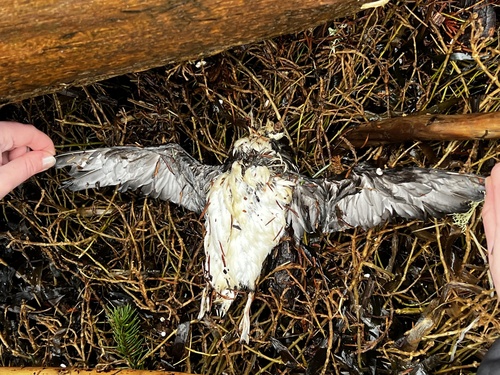 Marbled Murrelet
In breve
The most reliable field mark to separate Rhinoceros Auklet from Marbled Murrelet is bill structure: the auklet has a thick, deep orange-brown bill with a prominent 'horn' in breeding adults, while the murrelet has a slender, black bill. In flight or on the water, the auklet appears bulkier and larger, with a pale belly and dark upperparts, whereas the murrelet is smaller, chunkier, and shows a more delicate, pointed look. Breeding plumage can cause confusion, as both become darker and more mottled, but the auklet's white facial plumes and horn are unique. Immature and non-breeding birds are best separated by overall size, bill shape, and facial pattern. Always check for the auklet's horn in season, but be aware it is absent in non-breeding birds.
Consigli di identificazione
- Bill shape and color: Rhinoceros Auklet always has a thick, deep, orange-brown bill (with a horn in breeding adults), while Marbled Murrelet has a slender, black bill. This is reliable at all ages and seasons.
- Bill horn: Only breeding adult Rhinoceros Auklets show the horn-like projection on the bill. If present, ID is certain. Absence of horn does not rule out auklet outside breeding season.
- Facial plumes: Breeding Rhinoceros Auklet has white plumes above the eye and behind the bill; Marbled Murrelet never shows these. In non-breeding season, auklet loses plumes.
- Facial pattern (non-breeding): Marbled Murrelet in winter has a white neck collar and white underparts with a black crown and nape. Rhinoceros Auklet lacks the white collar and has a more contrasting dark above/pale below pattern.
- Overall size and bulk: Rhinoceros Auklet is much larger and bulkier than Marbled Murrelet. If seen together, the difference is obvious; alone, look for a more robust, less delicate appearance in the auklet.
- Body shape: Marbled Murrelet is compact and chunky, with a short neck and tail; Rhinoceros Auklet is longer-bodied and heavier-set.
- Plumage in breeding season: Marbled Murrelet is mottled brown all over in breeding plumage, lacking the auklet's white facial plumes and horn. Rhinoceros Auklet remains dark above and pale below, with white plumes and horn.
- Plumage in non-breeding season: Both are darker above and paler below, but Marbled Murrelet has a white neck collar and more extensive white on the face; auklet does not.
- Habitat context: A bird seen flying into or out of a forest, or far inland, is almost certainly a Marbled Murrelet. Auklets are strictly coastal and marine.
- Nesting behavior: If observed at a burrow or cave, especially on a coastal slope, it is likely Rhinoceros Auklet. Marbled Murrelet never uses burrows.
- Feeding behavior: Rhinoceros Auklet carries multiple fish in its bill (like puffins), while Marbled Murrelet carries only one fish at a time.
- Flight style: Auklet is a poor flier and may appear labored on takeoff; murrelet is more agile and direct in flight, especially when flying inland.
- Sex and age: No strong sexual dimorphism in either species; horn and plumes in auklet only in breeding adults. Juveniles and immatures are best separated by bill shape and size.
- Pitfalls: In poor light or at distance, the auklet's horn and plumes may be missed; always check bill thickness and overall size. Breeding murrelets may appear darker and mottled, but never show white facial plumes or a horn.
- When in doubt: Focus on bill structure (thick and deep vs. slender and short), presence or absence of horn/plumes, and overall size. Habitat and behavior can provide strong supporting clues.
Taglia
Rhinoceros Auklet is substantially heavier (483 g) and overall larger than Marbled Murrelet, which is described as a small, chunky auk. The auklet's size is obvious in direct comparison or with experience, appearing more robust and less delicate than the murrelet. The murrelet is notably smaller and lighter, with a more compact build and shorter overall length. Bill size also reflects this difference: the auklet's bill is thick and deep, while the murrelet's is slender and short.
Piumaggio
-
Juvenile/immature/first-winter: No specific upperwing pattern differences are described for these ages in either species. Separation relies on structure and bill shape at all ages.
-
Adult breeding: Rhinoceros Auklet adults have dark upperparts and pale underparts, with distinctive white plumes above the eyes and behind the bill, and a horn-like projection on the bill (present only in breeding adults). Marbled Murrelet in breeding plumage is mottled brown overall, lacking white facial plumes and horn. The murrelet's face and body are more uniformly mottled brown, while the auklet maintains a contrasting pale belly and dark back.
-
Adult non-breeding: Rhinoceros Auklet loses the horn and facial plumes; still shows a thick, deep bill and contrasting dark above/pale below pattern. Marbled Murrelet in non-breeding plumage is white below with a black crown, nape, wings, and back, and a white neck collar (not present in the auklet). The murrelet's bill remains slender and black.
Comportamento
Rhinoceros Auklet is a poor flier, often seen taking off from sloped ground or water with effort, and tends to nest in burrows or natural cavities. It is monogamous and highly social at colonies. Marbled Murrelet is more agile in flight, often seen flying inland at dusk or dawn to nest in old-growth forests, sometimes far from the coast. The murrelet does not nest in colonies or burrows, but singly on large, mossy branches or on the ground in northern areas. Feeding behavior differs: auklet carries multiple fish in its bill, murrelet carries a single fish at a time.
Habitat
Rhinoceros Auklet nests in coastal burrows or caves, usually on islands or coastal slopes, and is almost always seen at sea or near nesting colonies. Marbled Murrelet is unique among alcids for nesting in old-growth forests, sometimes up to 80 km inland, or on the ground in the far north; at sea, it is found in nearshore waters, often close to forested coastlines. Seeing a bird inland or in forested habitat strongly favors Marbled Murrelet.
Rhinoceros Auklet · Marbled Murrelet · I miei uccelli difficili