

Pale-bellied Hermit vs Piro piro fulvo
Phaethornis anthophilus contro Calidris subruficollis
Fai un quiz con Pale-bellied Hermit e Piro piro fulvo
 Pale-bellied Hermit
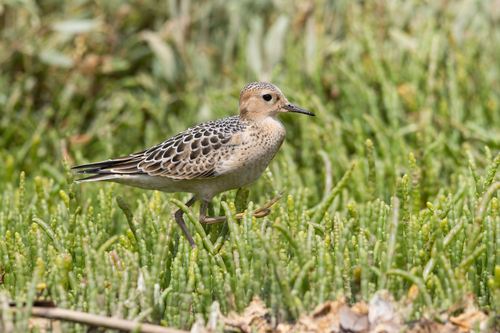 Piro piro fulvo
In breve
The most reliable way to separate Pale-bellied Hermit from Buff-breasted Sandpiper is by overall structure and bill shape: the hermit is a small, slim hummingbird with a long, nearly straight or decurved bill, while the sandpiper is a compact shorebird with a short, straight bill and yellow legs. In flight or at rest, the hermit shows dark green upperparts and pale gray underparts, with a distinctive black facial mask and buffy supercilium, whereas the sandpiper is brown above and buff below, lacking any facial mask. Juvenile Buff-breasted Sandpipers look similar to adults but may be paler below; Pale-bellied Hermit does not have age-specific wing patterns that would confuse with the sandpiper. Habitat is also a strong clue: hermits are found in forested areas of northern South America, while Buff-breasted Sandpipers are long-distance migrants of open grasslands and tundra.
Consigli di identificazione
- Bill shape and length: Pale-bellied Hermit has a long, slender bill (almost straight in males, decurved in females), while Buff-breasted Sandpiper has a short, straight bill. This is the quickest way to separate them at any age or season.
- Leg color and length: Buff-breasted Sandpiper has conspicuous yellow legs that are long and visible when walking or standing. Pale-bellied Hermit has much shorter, less visible legs (as typical for hummingbirds).
- Facial pattern: The hermit shows a bold black mask with a buffy supercilium and mostly white throat, which is never present in Buff-breasted Sandpiper. The sandpiper's face is plain buff without a mask or strong supercilium.
- Plumage color: Hermit is dark green to olive above and pale gray below, while Buff-breasted Sandpiper is brown above and buff below. No overlap in these color schemes.
- Underparts: Hermit has light gray underparts; sandpiper has buff underparts. Juvenile sandpipers may be paler but never gray.
- Upperparts: Hermit upperparts are greenish; sandpiper is brown. No confusion here.
- Size and structure: Hermit is much smaller, more slender, and lighter than the sandpiper. Sandpiper is bulkier, with a more horizontal stance.
- Flight style: Hermit hovers and darts rapidly; sandpiper flies with steady, direct wingbeats and does not hover.
- Perched posture: Hermit perches upright, often on thin twigs; sandpiper stands or walks on the ground with a horizontal body.
- Habitat: Hermit is found in forested or edge habitats in northern South America; sandpiper in open grasslands, tundra, or short-grass fields, especially during migration.
- Wing pattern in flight: No similar age-specific marks; sandpiper may show white underwings during display, hermit does not.
- Sexual dimorphism: Hermit females have a more decurved bill, but both sexes are structurally distinct from sandpiper. Sandpiper males are slightly larger but otherwise similar to females.
- Juvenile confusion: Juvenile Buff-breasted Sandpiper is paler below but still buff, not gray, and never shows a facial mask. Hermit juveniles do not resemble sandpipers at any age.
- Behavior: Hermit feeds at flowers, often hovering; sandpiper picks food from the ground and is rarely seen near flowers.
- Context: If seen in a forest or at a flower, expect hermit; if in open grassland or tundra, expect sandpiper.
Taglia
Pale-bellied Hermit is much smaller and lighter than Buff-breasted Sandpiper. The hermit weighs about 5.9 g [wikidata], with a length of about 13 cm [wikipedia], and is a typical hummingbird in size and build. Buff-breasted Sandpiper, while not given a precise mass here, is a small shorebird but still substantially larger and heavier than any hummingbird, with a more robust body and longer legs. In the field, the sandpiper will appear bulkier and longer-legged, and will never hover like a hummingbird.
Piumaggio
No confusion is likely in wing pattern at any age: Pale-bellied Hermit has dark green to olive upperparts and light gray underparts, with a black mask and buffy supercilium, plus a mostly white throat. Its wing and tail feathers are typical of hermits, lacking any sandpiper-like markings. Buff-breasted Sandpiper is brown above and buff below in all plumages, with a buff face and underparts, short bill, and yellow legs. Juveniles are paler on the rear underparts but otherwise similar to adults. The sandpiper never shows a facial mask or supercilium like the hermit. In flight, the sandpiper may show white underwings during display, but this is not a feature of the hermit. There are no shared or confusing age-specific wing patterns between these two species.
Comportamento
Pale-bellied Hermit is a typical hummingbird: it hovers to feed at flowers, moves rapidly with a darting flight, and is rarely seen walking or perching for long. Buff-breasted Sandpiper is a shorebird that walks or runs on the ground, picking food by sight, and is often seen in open areas such as grasslands or tundra. It does not hover and is often described as tame, sometimes allowing close approach. The sandpiper's display includes raising its wings to show white undersides, a behavior not seen in hermits.
Habitat
Pale-bellied Hermit is found in forested regions of Colombia, Panama, and Venezuela, typically in humid lowland forests or forest edges. Buff-breasted Sandpiper breeds in the open arctic tundra of North America and migrates through grasslands, often stopping in short-grass habitats like airfields or golf courses, and winters in the pampas of South America. The two species do not overlap in typical habitat: hermits are birds of dense vegetation, while Buff-breasted Sandpipers are birds of open ground.
Pale-bellied Hermit · Piro piro fulvo · I miei uccelli difficili