

Mauritius Kestrel vs Aplomado Falcon
Falco punctatus contro Falco femoralis
Fai un quiz con Mauritius Kestrel e Aplomado Falcon
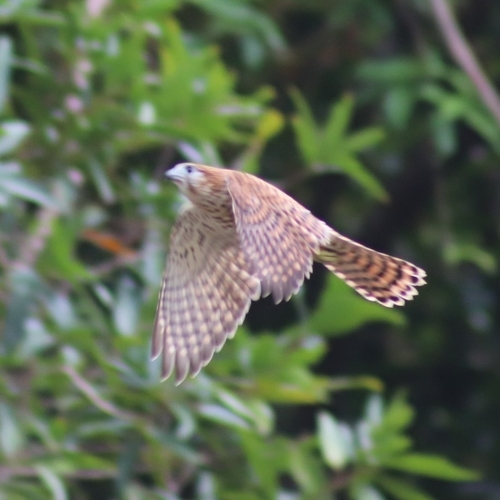 Mauritius Kestrel
 Aplomado Falcon
In breve
The most reliable field mark between Mauritius Kestrel and Aplomado Falcon is overall structure and wing shape: Mauritius Kestrel is a compact, short-winged, and rounded falcon, while Aplomado Falcon is long-winged, long-tailed, and much more slender. In flight, Aplomado shows a strikingly long, banded tail and pointed wings, while Mauritius Kestrel has broad, rounded wings and a shorter tail. Adult and juvenile plumages are also distinct: Aplomado Falcons have bold black, white, and cinnamon patterns, including a strong facial mask and black belly band, while Mauritius Kestrel is plainer and lacks such crisp contrasts. Habitat is a strong clue: Mauritius Kestrel is restricted to forested ravines of Mauritius, while Aplomado Falcon is a bird of open country in the Americas. Size is also a factor, with Aplomado Falcon being nearly twice as heavy and much longer-winged.
Consigli di identificazione
- Wing and tail shape in flight: Aplomado Falcon has long, pointed wings and a long, banded tail; Mauritius Kestrel has short, rounded wings and a short tail. This is the single best mark in all ages.
- Overall structure: Aplomado is slender and elongated, both perched and in flight; Mauritius Kestrel is compact, with a broad-chested, short-winged look.
- Facial pattern: Adult and juvenile Aplomado Falcons show a bold black-and-white face with a strong moustache and white supercilium; Mauritius Kestrel lacks this, showing a much plainer face.
- Belly and breast pattern: Aplomado has a black belly band and cinnamon underparts; Mauritius Kestrel lacks a black belly band and is generally plainer below.
- Tail pattern: Aplomado's tail is black with narrow white or grey bars and a white tip; Mauritius Kestrel's tail is shorter and less distinctly barred.
- Upperwing in flight: Aplomado's wings are long and pointed, with a dark blue-grey tone in adults; Mauritius Kestrel's wings are rounded and lack strong color contrast.
- Juvenile plumage: Juvenile Aplomado is similar to adult but duller, with buffy white areas and paler cinnamon; Mauritius Kestrel juveniles do not show the bold face or belly band, remaining overall plain.
- Sex differences: Both species show females larger than males, but this is not a reliable field mark.
- Perched posture: Aplomado often appears upright and elongated; Mauritius Kestrel is more hunched and compact.
- Habitat: Mauritius Kestrel is only in forested ravines and cliffs on Mauritius; Aplomado is in open country or urban areas in the Americas.
- Behavior: Aplomado soars, hunts on the wing, and may be seen in pairs; Mauritius Kestrel hunts from perches and makes short flights.
- Size: Aplomado is nearly twice as heavy and much longer-winged; use this if seen side-by-side or with familiar species.
- Bill and feet color: Aplomado has yellow or yellow-orange cere, eye-ring, and feet; Mauritius Kestrel's soft part colors are less distinctive in the field.
- Confusion risk: If you see a falcon with a bold face mask, black belly band, and long, pointed wings, it is Aplomado; if you see a compact, plain falcon with rounded wings, it is Mauritius Kestrel.
- Pitfalls: Immature Aplomado can look dull, but still shows the long wings, long tail, and facial pattern. Mauritius Kestrel never shows the Aplomado's structure or bold patterning.
Taglia
Aplomado Falcon is substantially larger and heavier than Mauritius Kestrel. Aplomado averages 333.5 g in body mass, with a length of 30–40 cm and a wingspan around 90 cm, making it a long, slender falcon. Mauritius Kestrel is much smaller and stockier, averaging 169.5 g, with a length of 26–30.5 cm and a wingspan of about 45 cm. In the field, Aplomado's long, pointed wings and long tail are obvious, while Mauritius Kestrel appears compact and short-winged.
Piumaggio
Juvenile Aplomado Falcons are similar to adults but duller: their upperparts and belly band are blackish brown, chest is streaked, and the white areas are buffy. Adults have a bold black-and-white face, white throat, black belly band, and cinnamon underparts, with a black tail barred white. Mauritius Kestrel of all ages lacks these bold contrasts: it is generally plainer, with no strong face pattern, no black belly band, and no cinnamon belly. The Mauritius Kestrel's wings are rounded, not pointed, and its tail is shorter and less distinctly barred. These differences are visible in both perched and flying birds, but especially in flight, where Aplomado's long, pointed wings and long, banded tail stand out against the Mauritius Kestrel's compact, rounded-winged shape.
Comportamento
Aplomado Falcon is often seen soaring or hunting in open areas, sometimes in pairs, and may follow large mammals or fires to flush prey. It is agile and fast, often hunting on the wing. Mauritius Kestrel is more secretive, typically hunting from a perch or with short, direct flights in forested ravines and cliffs. Its flight is less buoyant and more fluttery due to its short, rounded wings. These behavioral differences are most apparent in open country, where Aplomado is active and conspicuous, versus the Mauritius Kestrel's preference for dense forest and edge.
Habitat
Mauritius Kestrel is strictly limited to the forests, cliffs, and ravines of southwestern Mauritius and is never found outside this habitat. Aplomado Falcon is a bird of open habitats: dry grasslands, savannas, marshes, and even urban areas in South America. It is never found in dense forest. Thus, habitat alone is often enough to separate them unless seen in captivity or vagrancy.
Mauritius Kestrel · Aplomado Falcon · I miei uccelli difficili