

Black-winged Ground Dove vs West Peruvian Dove
Metriopelia melanoptera contro Zenaida meloda
Fai un quiz con Black-winged Ground Dove e West Peruvian Dove
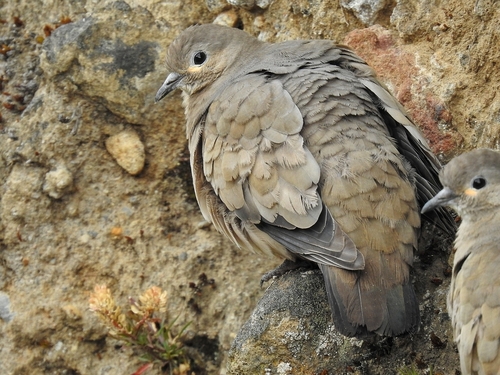 Black-winged Ground Dove
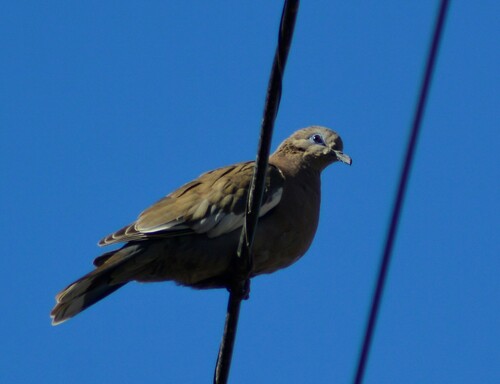 West Peruvian Dove
In breve
The most reliable field mark between Black-winged Ground Dove and West Peruvian Dove is the prominent white wing band of the West Peruvian Dove, seen as a bold white crescent both at rest and especially in flight, which is absent in Black-winged Ground Dove. Juveniles of both species are duller, but the West Peruvian Dove's white wing band is still evident, while Black-winged Ground Dove juveniles lack any strong white wing pattern and show buff-edged feathers. Structurally, West Peruvian Dove is larger and bulkier, with a stouter bill and a broad white tail corner in flight. Both species can show pinkish tones below, but the West Peruvian Dove is much larger and has a distinctive blue eye ring in adults. Habitat and elevation can help, but overlap is possible, so rely on wing and tail pattern first.
Consigli di identificazione
- White wing band (all ages): West Peruvian Dove always shows a bold white band across the wing, visible as a crescent at rest and a strong flash in flight. Black-winged Ground Dove never shows a bold white wing band—only a pale edge and some pale gray on the closed wing.
- Tail pattern in flight: West Peruvian Dove has broad white corners on the tail and gray tips, obvious in flight. Black-winged Ground Dove lacks these white tail corners.
- Juvenile upperwing: Juvenile West Peruvian Dove retains the white wing band, while Black-winged Ground Dove juveniles have buff-edged feathers and no strong white in the wing.
- Size and structure: West Peruvian Dove is much larger and bulkier, with a stouter bill and longer tail. Black-winged Ground Dove is smaller, more compact, and lighter.
- Bill: West Peruvian Dove has a noticeably stouter bill, especially compared to the finer bill of Black-winged Ground Dove.
- Eye ring: Adult West Peruvian Dove has a bright indigo to violet-blue bare eye ring, while Black-winged Ground Dove's eye color and bare skin are variable and never as bright blue.
- Leg color: West Peruvian Dove adults have red legs and feet; juveniles are brownish-pink. Black-winged Ground Dove's leg color is not described as diagnostic.
- Underparts color: Both can show pinkish tones below, but West Peruvian Dove's underparts are warm gray with pink-red to pinkish tinge, while Black-winged Ground Dove males are fawn-pink (females duller, less pink).
- Face and neck: West Peruvian Dove has a buff face and neck fading to gray on the chest; Black-winged Ground Dove has a whitish throat and gray flanks.
- Habitat context: If seen in high-elevation puna, páramo, or near Polylepis woodland, especially above 2,000 m, suspect Black-winged Ground Dove. In lowland, foothill, urban, or agricultural settings, West Peruvian Dove is more likely, but beware of range expansion.
- Behavior: Black-winged Ground Dove is more likely to be in small flocks in open grassy or shrubby areas near treeline; West Peruvian Dove is often in larger groups and adapts well to disturbed habitats.
- Vocalizations: West Peruvian Dove's song is a low, rhythmic coo repeated for several seconds; Black-winged Ground Dove gives higher-pitched, shorter double notes. Use voice only if you are familiar with both.
- Sex differences: Black-winged Ground Dove females are duller and less pink below; West Peruvian Dove sexes are similar.
- Seasonal movement: Black-winged Ground Dove may descend to lower elevations in winter, so do not rely solely on altitude out of breeding season.
- Pitfalls: Immature doves can be confusing, but the white wing band and tail corners of West Peruvian Dove are reliable at all ages; absence of these marks points to Black-winged Ground Dove.
Taglia
West Peruvian Dove is substantially larger and heavier: adults are 25–33 cm long and weigh around 216 g, while Black-winged Ground Dove is 21–23 cm and about 105 g. In the field, West Peruvian Dove appears bulkier and longer, with a stouter bill and longer tail. Black-winged Ground Dove is more compact and lighter overall. Size alone is not always reliable at a distance, but the difference is notable when seen together or with experience.
Piumaggio
- Juveniles: West Peruvian Dove juveniles are paler than adults but still show the white wing band and broad white tail corners in flight; their legs are brownish-pink and the blue eye ring is absent. Black-winged Ground Dove juveniles lack any strong white in the wing, have buff-edged feathers, and no pink tinge below.
- Adults: West Peruvian Dove adults have brownish-gray upperparts, a buff face and neck, warm gray underparts with pinkish tinge, and a bold white wing band visible at rest and in flight. Their tail is tipped with gray and has broad white corners. The eye ring is bright indigo to violet-blue and legs/feet are red. Black-winged Ground Dove adults are grayish or earth brown above (males with faint pink tinge, females duller), whitish throat, fawn-pink underparts, and a closed wing with a white edge and some pale gray, but never a bold white band. Eye color and bare skin around the eye are variable. The tail lacks the broad white corners of West Peruvian Dove.
- Sexes: Both species are similar between sexes, but Black-winged Ground Dove females are duller and less pink below.
Comportamento
Both species feed on the ground, but Black-winged Ground Dove is more often seen in small flocks in open grassy areas near treeline, while West Peruvian Dove is an adaptable colonizer, often found in more urban, agricultural, or disturbed habitats as well as open country. West Peruvian Dove is expanding its range and is more likely to be seen in human-modified environments, sometimes in larger groups. Black-winged Ground Dove tends to roost in Polylepis woodland or Puya stands and is less likely to be found in urban settings.
Habitat
Black-winged Ground Dove is a high Andean species, typically found in grassy areas near treeline, puna, or páramo, and roosts in Polylepis woodland or Puya colonies. It is mostly resident at elevations between 2,000–4,400 m (sometimes 900–4,900 m in Chile), descending in winter. West Peruvian Dove is a lowland to foothill species of the Pacific coast and adjacent valleys, but is expanding into new areas, including urban and agricultural zones, and can cross the Andes into western and central Argentina. While their ranges can overlap in some Andean valleys, Black-winged Ground Dove is more tied to higher, less disturbed habitats, while West Peruvian Dove is common in lower, more human-influenced areas.
Voce
Black-winged Ground Dove gives a series of relatively high-pitched, double notes ('rrree-up...rrree-up...'), and a short 'piu' call. West Peruvian Dove has a low-pitched, rhythmic, monotonous cooing ('Who.. huLOO..hu..huLOO..hu..huLOO') and a coo-coo-LEE call, with a vocal range between 377–566 Hz. West Peruvian Dove's song is lower, more drawn-out, and repeated for longer periods, while Black-winged Ground Dove's is higher and shorter. Vocalizations are helpful if heard well, but overlap in dove vocalizations can cause confusion.
Black-winged Ground Dove · West Peruvian Dove · I miei uccelli difficili