

Canard à queue pointue vs Sarcelle des Andes
Anas georgica contre Anas andium
Faire un quiz avec Canard à queue pointue et Sarcelle des Andes
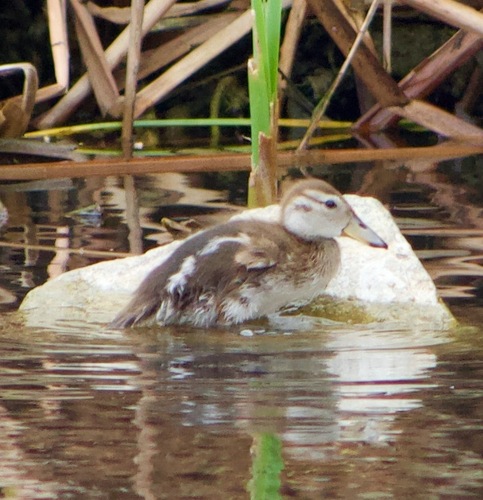 Canard à queue pointue
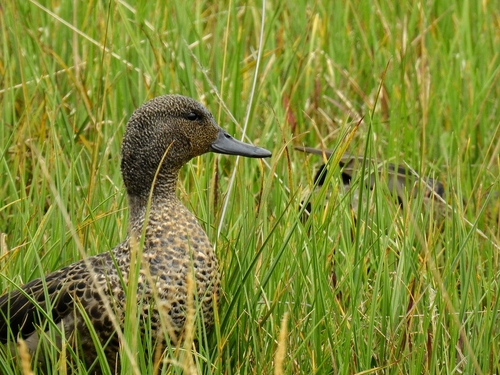 Sarcelle des Andes
En bref
The most reliable field mark to separate Yellow-billed Pintail from Andean Teal is bill color and pattern: Yellow-billed Pintail shows a bright yellow bill with a black tip and a distinct black stripe down the center, while Andean Teal lacks this combination. In addition, Yellow-billed Pintail is distinctly larger and longer-tailed, with a pointed tail and a more elongated body shape, whereas Andean Teal is smaller and more compact. In flight or at rest, Yellow-billed Pintail's upperwing is grayish-brown with blackish-green secondaries, while Andean Teal lacks these specific contrasts. Both species can occur in high Andean wetlands, but Andean Teal is restricted to the northern Andes, while Yellow-billed Pintail has a broader South American range. Flock size and social behavior can also help: pintail is less likely to form large groups than the teal.
Conseils d’identification
- Bill color and pattern: Yellow-billed Pintail has a bright yellow bill with a black tip and a prominent black stripe down the center. Andean Teal lacks this pattern—its bill is never as bright or as distinctly marked. This is the single most reliable mark at any age or season.
- Size and structure: Pintail is much larger and longer-necked, with a noticeably pointed tail. Andean Teal is compact, short-tailed, and smaller overall. When seen together, the difference is obvious; alone, look for the stretched vs. squat silhouette.
- Tail shape: The pintail's tail is brownish and pointed, extending well beyond the body, especially in flight or when swimming. Andean Teal's tail is shorter and less pointed.
- Upperwing pattern: Yellow-billed Pintail shows a grayish-brown upperwing with blackish-green secondaries. While not as bold as in some ducks, this contrast is absent in Andean Teal, which lacks the blackish-green secondary panel.
- Body plumage: Pintail is buff-brown with black spots of varying size over the body, and a brown head and neck. Andean Teal is more uniform and lacks the strong spotting and contrast.
- Group size and behavior: Pintail is less likely to be seen in large flocks, often alone or in small groups. Andean Teal may gather in larger numbers. If you see a large, tight group of small ducks, Andean Teal is more likely.
- Range and habitat: Andean Teal is restricted to high-elevation wetlands in the northern Andes (Colombia, Venezuela, Ecuador). Yellow-billed Pintail is much more widespread, including lowlands and southern South America. Location can help, but beware of overlap in the Andes.
- Flight profile: In flight, pintail appears elongated with a long neck and tail, while Andean Teal is compact and quick-flapping. Watch for the pointed tail trailing behind the pintail.
- Sex and age: No strong sexual dimorphism or age-specific marks are described for either species, so rely on structure and bill pattern for all individuals.
- Confusion with other species: Pintail is sometimes confused with yellow-billed teal (not Andean Teal), but the yellow bill with black markings and larger size separate it from both teals.
- When marks fail: In poor light or at great distance, size and bill color may be hard to judge. Try to get a side view of the bill and tail, and note flocking behavior and habitat.
- Plumage pitfalls: Both species are generally brownish, but only pintail shows the combination of buff-brown with black spots and a yellow-black bill. Avoid relying solely on overall brown coloration.
- Seasonal variation: No major seasonal plumage changes are described for either species; marks are reliable year-round.
- Voice: No diagnostic vocal differences are described in the available notes; do not rely on calls for separation.
- Summary check: If you see a large, long-tailed duck with a yellow bill marked black, it's a Yellow-billed Pintail. If the duck is small, compact, and lacks a yellow bill, it's an Andean Teal.
Taille
Yellow-billed Pintail is noticeably larger and longer-bodied than Andean Teal. The pintail has a more elongated, pointed tail and a bigger, longer neck, giving it a stretched appearance both on water and in flight. Andean Teal is much smaller, with a compact, short-tailed silhouette typical of true teals. This size difference is obvious when both are seen together, but can be harder to judge alone or at a distance.
Plumage
No age-specific upperwing patterns are described for either species, but adults and immatures can be separated by overall coloration and wing details. Yellow-billed Pintail has a brownish, pointed tail, grayish-brown upperwing, and blackish-green secondaries. Its body is buff-brown with black spots, and the head and neck are brown. The bill is yellow with a black tip and a black central stripe—this is unique among the two. Andean Teal, by contrast, lacks the yellow bill and has a more uniform, compact appearance, with no mention of the blackish-green secondaries or pointed tail. Juvenile and immature-specific marks are not detailed, so rely on overall structure and bill pattern for all ages.
Comportement
Yellow-billed Pintail tends to be less social, not forming large flocks, while Andean Teal may be seen in groups, especially in suitable habitat. In flight, pintail shows a more elongated, streamlined profile due to its longer tail and neck, while Andean Teal appears more compact and quick-flapping. Both species dabble, but the pintail's behavior is often more solitary or in small parties.
Habitat
Both species occur in Andean wetlands, but their ranges and habitat preferences differ. Andean Teal is restricted to highland lakes and marshes in Colombia, Venezuela, and Ecuador. Yellow-billed Pintail is more widespread, found from high-elevation lakes to lowland rivers and coasts across much of South America, including the Falklands and South Georgia. If you are outside the northern Andes, Andean Teal is unlikely.
Canard à queue pointue · Sarcelle des Andes · Mes oiseaux difficiles