

Moucherolle huppé vs Moucherolle ocré
Mitrephanes phaeocercus contre Contopus ochraceus
Faire un quiz avec Moucherolle huppé et Moucherolle ocré
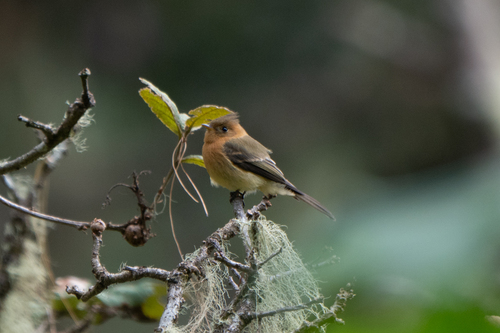 Moucherolle huppé
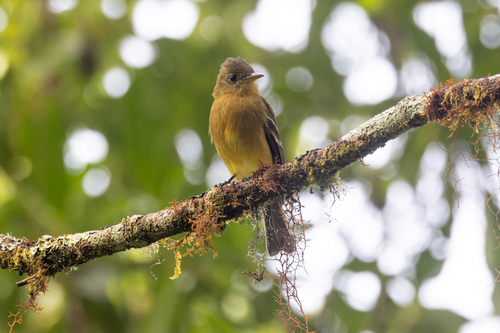 Moucherolle ocré
En bref
The most reliable field mark between Tufted Flycatcher and Ochraceous Pewee is size: Ochraceous Pewee is much larger and bulkier, with a noticeably longer body and heavier bill. Both species have crests and similar upright, sallying behavior, but Tufted Flycatcher is compact and richly colored, especially below, while Ochraceous Pewee is lankier with duller, more olive plumage. Juvenile wing patterns are not strongly distinctive, so focus on overall structure, face pattern, and underpart color. In perched or flight views, the Tufted Flycatcher’s bright ochre-cinnamon underparts and small size stand out against the Pewee’s muted olive and buff tones.
Conseils d’identification
- Size is the fastest separator: Ochraceous Pewee is much larger and heavier than Tufted Flycatcher. If the bird seems small and dainty, favor Tufted; if it looks big and chunky for a flycatcher, suspect Pewee. This works for all ages and seasons.
- Crest shape and prominence: Both have crests, but Tufted Flycatcher’s is more pointed and erect, giving a spiky look. Ochraceous Pewee’s crest is spiky but less sharply pointed.
- Underpart color: Tufted Flycatcher has rich ochre to cinnamon throat and breast, with ochre-yellow belly—very warm and saturated. Ochraceous Pewee’s underparts are duller: pale yellow throat, olive-washed breast/flanks, and buffy yellow belly. The Pewee never looks as bright or cinnamon-toned below.
- Face pattern: Tufted Flycatcher shows a thin buff-white eye-ring and a pale spot above the lores, set on a cinnamon face. Ochraceous Pewee’s face is more uniform olive, lacking the strong eye-ring and cinnamon tones.
- Upperparts: Tufted Flycatcher’s upperparts are brownish with olive tinge; Ochraceous Pewee is more uniformly olive above, with a darker olive crown and crest.
- Wing bars: Both species have two pale wing bars, but Tufted Flycatcher’s are buff and more contrasting, while Ochraceous Pewee’s are thinner, ochre or olive-buff, and less distinct. Juvenile Pewees have brighter ochre wing bars, but this is subtle in the field.
- Tail: Both have dusky tails, but Ochraceous Pewee’s is slightly notched; Tufted Flycatcher’s is straight.
- Bill: Both have black maxilla and orange-yellow mandible, but the Pewee’s bill is broader and heavier, matching its overall bulk.
- Perch height and context: Tufted Flycatcher is usually seen at mid-levels inside forest, rarely at the very top or edge. Ochraceous Pewee prefers high, exposed perches at forest edge or canopy.
- Behavior with flocks: Tufted Flycatcher is solitary or in pairs, rarely with mixed flocks. Ochraceous Pewee may join mixed-species flocks passing through.
- Posture: Tufted Flycatcher is compact and upright, often looking short-necked. Ochraceous Pewee is more elongated and upright, sometimes appearing lanky.
- Juvenile marks: Both juveniles have brighter wing bars, but this is not a strong separator. Focus on structure and underpart color for young birds.
- Seasonal plumage wear: Ochraceous Pewee’s plumage becomes duller and more faded with wear, making it even less contrasting than Tufted Flycatcher.
- Range (if outside Costa Rica/Panama): Only Tufted Flycatcher occurs north of Costa Rica or south to Ecuador; Ochraceous Pewee is limited to Costa Rica and Panama.
- Sex is not helpful: Both species are sexually monomorphic—males and females look alike.
Taille
Ochraceous Pewee is substantially larger: 16.5–18 cm long and about 23 g, compared to Tufted Flycatcher’s 12–13.5 cm and 8.5 g. The Pewee’s size is obvious in the field—its body is longer, bulkier, and its bill is broader and more robust. Tufted Flycatcher appears petite and compact, often described as 'dainty' by comparison. When seen together or with familiar species, this size gap is a quick separator.
Plumage
Juvenile plumage is not strongly diagnostic between these two: both have brighter wing bars as immatures, but the Pewee’s juvenile wing bars are ochre and more prominent, while the Tufted Flycatcher’s are cinnamon-buff edged. For all ages, Tufted Flycatcher shows a brown-olive crown with a pointed crest, a thin buff-white eye-ring, and a rich ochre to cinnamon throat and breast, with ochre-yellow belly. Its face is distinctly cinnamon, and the wing bars are buff. Ochraceous Pewee, in contrast, has a darker brownish-olive crown and crest, a more uniform olive head and upperparts, and a pale yellow throat with olive-washed breast and flanks, and a buffy yellow belly. Its wing bars are thinner and more ochre or olive-buff, and the overall effect is much duller and less contrasting. Both have dusky tails, but the Pewee’s is slightly notched. Bill color is similar: black maxilla and orange-yellow mandible.
Comportement
Both species sally for insects from exposed perches and return to the same spot, often shivering their tails or wings on landing. However, Tufted Flycatcher typically forages at mid-levels within the forest and is usually alone or in pairs, rarely joining mixed flocks. Ochraceous Pewee prefers higher, more exposed perches near treetops or forest edges and may join mixed-species flocks as they pass through. The Pewee’s larger size and more upright, elongated posture can be noticeable, especially when perched high.
Habitat
Tufted Flycatcher ranges from Mexico to Ecuador, but in Costa Rica and Panama (where both occur), it is more often found inside forest at mid-levels. Ochraceous Pewee is restricted to Costa Rica and Panama and is more likely at forest edge or in tall trees near clearings, often higher up. If you see a small flycatcher deep inside forest mid-story, Tufted Flycatcher is more likely; a larger flycatcher high at the edge or canopy could be Ochraceous Pewee.
Moucherolle huppé · Moucherolle ocré · Mes oiseaux difficiles