

Puffin des Sargasses vs Frégate superbe
Puffinus lherminieri contre Fregata magnificens
Faire un quiz avec Puffin des Sargasses et Frégate superbe
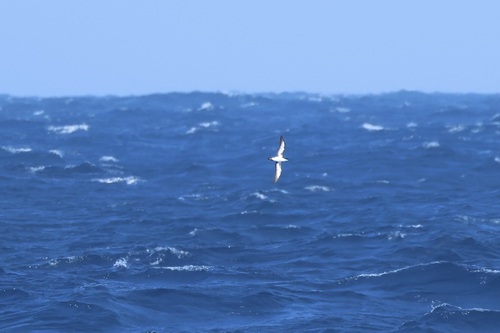 Puffin des Sargasses
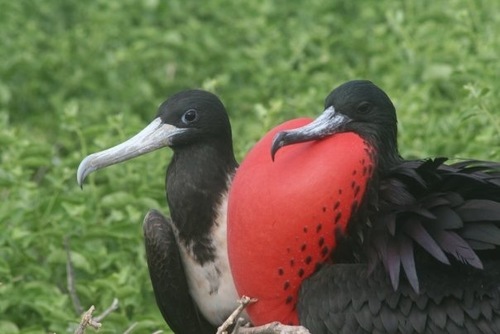 Frégate superbe
En bref
The most reliable separation between Sargasso Shearwater and Magnificent Frigatebird is overall structure and flight silhouette: Sargasso Shearwater is a compact, small-bodied seabird with relatively short wings and a straight-edged tail, while Magnificent Frigatebird is enormous, with extremely long, angular wings and a deeply forked tail. Immature plumages are not easily confused, as young frigatebirds have a white head and underparts, unlike any shearwater. In flight, frigatebirds soar and glide with almost no flapping, whereas shearwaters use rapid, stiff wingbeats interspersed with glides. Even at a distance, the sheer size and shape difference is unmistakable, but confusion can occur when only a quick or distant view is obtained, especially if the frigatebird is high overhead and the observer is expecting a shearwater.
Conseils d’identification
- Size and Proportion: Magnificent Frigatebird is vastly larger than Sargasso Shearwater—nearly three times the length and wingspan. Even distant birds will show this difference if other seabirds are present for scale.
- Wing Shape: Frigatebird wings are extremely long, narrow, and angular, forming a distinctive 'M' shape in flight. Shearwater wings are shorter, more paddle-shaped, and never as angular.
- Tail Shape: Frigatebird has a long, deeply forked tail, often held closed to appear pointed or open to show the fork. Shearwater has a short, straight-edged tail with no fork.
- Flight Style: Frigatebirds soar and glide effortlessly, rarely flapping, often high above the water or land. Shearwaters fly close to the water with rapid, stiff wingbeats and short glides.
- Plumage—Juvenile/Immature: Immature frigatebirds have a white head and underparts, sometimes with a diamond-shaped belly patch—never seen in any shearwater. All Sargasso Shearwaters are dark above, white below, with a white face only below the eye.
- Plumage—Adult Male: Male frigatebird is all-black with a red throat pouch (breeding), while shearwater is blackish-brown above, white below, and lacks any red or iridescence.
- Plumage—Adult Female: Female frigatebird is black with a white breast and lower neck sides, and a blue eye-ring. Shearwater's white extends across the entire underparts and face below the eye, with no blue eye-ring.
- Bill: Frigatebird has a long, slender, hooked bill. Shearwater's bill is shorter, stouter, and straight with a slight hook at the tip.
- Feet: Frigatebird feet are not visible in flight; shearwater feet are dull pink with black wash and toenails, but rarely seen unless the bird is on the water.
- Perched/Posture: Frigatebirds rarely perch except in breeding colonies or on ships; shearwaters may rest on the water or land. If seen sitting on water, it is a shearwater.
- Context: Frigatebirds are often seen soaring high or over land; shearwaters are almost always close to the sea surface.
- Vocalization: Not useful for separation at sea—both are silent in flight.
- Habitat: Both can occur in the same general region, but only shearwaters are seen sitting on the water; frigatebirds are always airborne unless at a nest or roost.
- Pitfalls: Distant, high-flying frigatebirds may appear smaller than they are and could be mistaken for a shearwater if seen only briefly. Always check for the forked tail and angular wings.
- Season/Age: No seasonal plumage changes in shearwater; frigatebird males show red throat pouch only in breeding season. Juvenile frigatebirds are most likely to cause confusion, but their white head and underparts are unique.
Taille
Sargasso Shearwater is a small seabird, 30–33 cm in length with a wingspan of 64–72 cm and weighing 150–230 g [wikipedia]. In stark contrast, Magnificent Frigatebird is one of the largest seabirds, measuring 89–114 cm in length, with a wingspan of 217–244 cm and weighing 1.1–1.59 kg [wikipedia]. The frigatebird is nearly three times the length and has a wingspan more than three times that of the shearwater. Even at a distance, the frigatebird's size is striking, especially when seen with other seabirds for scale.
Plumage
- Juvenile/Immature: Immature Magnificent Frigatebirds are distinctive, with a white head and underparts, and in juveniles, a diamond-shaped white belly patch. No Sargasso Shearwater age class shows this pattern; all ages are dark above and white below, with the head white only below the eye [wikipedia].
- Adult: Adult Sargasso Shearwater is blackish-brown above, white below, with a clean demarcation and white undertail coverts. Magnificent Frigatebird adult males are all-black with a red gular sac (breeding), while females are black with a white breast and lower neck sides, and a blue eye-ring. The female's white is restricted to the breast and lower neck, not the entire underparts as in shearwater. The male's plumage is entirely dark except for the red throat pouch in breeding season.
- Wings in Flight: Shearwater wings are relatively short and broad for their size, with dark upperparts and mostly dark underwing coverts except for white bases. Frigatebird wings are extremely long, narrow, and angular, with a uniform dark appearance in males and a brown band in females. No shearwater shows the deeply forked tail or the long, pointed wings of a frigatebird.
Comportement
Sargasso Shearwater flies with rapid, stiff wingbeats interspersed with glides, usually low over the water. It may dive or plunge for food. Magnificent Frigatebird is a master of soaring, rarely flapping, often seen high in the sky or effortlessly gliding above the ocean for hours. Frigatebirds never land on water, while shearwaters routinely do. Frigatebirds may harass other birds to steal food (kleptoparasitism), a behavior not seen in shearwaters.
Habitat
Both species occur over tropical and subtropical Atlantic waters, but Sargasso Shearwater is usually seen close to the water surface, often in pelagic or offshore zones, and breeds on Caribbean islands [wikipedia]. Magnificent Frigatebird is most often seen soaring high above the sea or coastlines, sometimes far inland, and breeds on remote islands but is much more visible in the airspace above the ocean or land [wikipedia]. Shearwaters are almost never seen soaring at great height, while frigatebirds are rarely seen sitting on the water.
Voix
Neither species is vocal in flight. Sargasso Shearwater makes twittering and mewing calls at night in breeding colonies, but these are rarely heard at sea [wikipedia]. Magnificent Frigatebird is silent in flight, with only rattling calls at the nest [wikipedia]. Vocalizations are not useful for field separation at sea.
Puffin des Sargasses · Frégate superbe · Mes oiseaux difficiles