

Gélinotte huppée vs Tétras du Canada
Bonasa umbellus contre Canachites canadensis
Faire un quiz avec Gélinotte huppée et Tétras du Canada
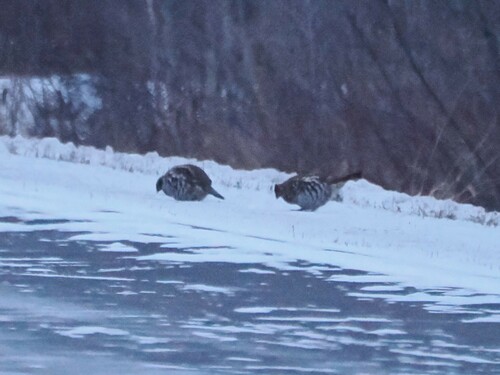 Gélinotte huppée
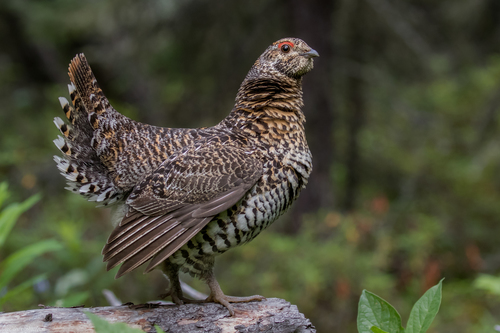 Tétras du Canada
En bref
The most reliable field mark to separate Ruffed Grouse from Spruce Grouse is the tail pattern: Ruffed Grouse shows a broad black subterminal band near the tail tip (with a pale tip), while Spruce Grouse has a dark tail with a narrow pale band at the very end. In flight or perched, Ruffed Grouse often appears chunkier and more variegated, with a crest and ruffs at the neck, while Spruce Grouse is more uniformly patterned and lacks the crest. Females and immatures are especially confusing, but the tail pattern remains a key difference. Males of Spruce Grouse have a distinctive red eyebrow comb, absent in Ruffed Grouse. Both species overlap in range and can occur in similar northern forests, but their habitat preferences and subtle structural differences can help clinch the ID.
Conseils d’identification
- Tail Pattern (all ages/sexes): Ruffed Grouse shows a broad black band near the tip of the tail with a pale tip; Spruce Grouse has a mostly dark tail with a narrow pale band at the very end. This is the most reliable field mark, especially in flight or when the tail is fanned.
- Crest and Ruffs (adults): Ruffed Grouse has a crest on the head and ruffs on the neck that can be raised; Spruce Grouse lacks these features and does not raise its crown feathers when alarmed.
- Red Eyebrow Comb (adult males): Spruce Grouse males have a prominent red eyebrow comb above the eye, absent in Ruffed Grouse. Females and immatures lack this feature.
- Plumage Tone (all ages): Ruffed Grouse is more variegated, with barring and mottling, and comes in grey and brown morphs. Spruce Grouse is more uniform, with males mostly grey above and black below, females mottled brown or grey.
- Underparts (adults): Ruffed Grouse (especially grey morph) has lighter, barred underparts with more white; Spruce Grouse males are black below with white spots, females are barred but less white overall.
- Sexing by Tail Band (adults): Male Ruffed Grouse usually have an unbroken tail band, females often a broken one, but this is not fully reliable. Spruce Grouse sexing relies on the red eyebrow comb.
- Behavior (all ages): Ruffed Grouse is more terrestrial, explodes noisily from cover, and may burrow in snow. Spruce Grouse is more arboreal, often perching in conifers, and is generally tamer and quieter.
- Display (males): Ruffed Grouse drums (deep, accelerating thumps); Spruce Grouse (Franklinii) males perform a wing-clap display (two sharp claps). Listen for these in spring.
- Habitat (all ages): Ruffed Grouse prefers mixed/deciduous forests with dense undergrowth; Spruce Grouse is tied to coniferous boreal forests. Use habitat as a strong supporting clue.
- Head Shape (all ages): Ruffed Grouse has a more peaked head profile due to the crest; Spruce Grouse has a rounder head.
- Flight Jizz (all ages): Ruffed Grouse appears chunkier and bursts from cover with loud wingbeats; Spruce Grouse is more likely to flush quietly or remain perched.
- Rump Feather Dots (adults, in hand): Ruffed Grouse females have rump feathers with a single white dot; males have more than one. Not field-usable but diagnostic in hand.
- Morphs (all ages): Both species have grey and brown morphs, but Ruffed Grouse's morphs are more extreme and variable, with more white in the grey morph and a conspicuously grey tail in the brown morph.
- Juvenile/Immature Confusion: For young birds, focus on the tail pattern and overall jizz, as plumage is otherwise very similar.
- Local Abundance: In overlapping areas, check eBird or local reports—Spruce Grouse is much more likely in dense boreal conifers, Ruffed Grouse in mixed woods.
Taille
Ruffed Grouse is slightly larger on average, measuring 40–50 cm in length with a wingspan of 50–64 cm and weighing 450–750 g. Spruce Grouse is a bit smaller and more compact, at 38–43 cm long, wingspan 55–57 cm, and males 550–650 g, females 450–550 g. In the field, size alone is not a strong separator, but Ruffed Grouse may look bulkier and more robust, especially when fluffed up.
Plumage
- Juvenile/Immature/Adult Females: The tail pattern is the most diagnostic mark: Ruffed Grouse shows a broad black band near the tip of the tail with a pale tip, while Spruce Grouse has a mostly dark tail with a narrow pale band at the very end. This contrast works for all ages and both sexes.
- Adults: Ruffed Grouse is more variegated, with barring and mottling, and comes in grey and brown morphs. The throat is often paler, and the underparts are barred with more white in the grey morph. Spruce Grouse males are mostly grey above and black below, with white spots on the sides and a prominent red eyebrow comb. Females and immatures of Spruce Grouse are mottled brown or grey with barred underparts, resembling female Ruffed Grouse but with the tail pattern difference.
- Crest and Ruffs: Ruffed Grouse has a crest on the head and ruffs on the neck (both sexes), which can be raised; Spruce Grouse lacks these features and does not raise its crown feathers when alarmed.
- Sexing: Both Ruffed Grouse sexes are similar, but males tend to have unbroken tail bands, while females often have a broken band (not always reliable). In Spruce Grouse, only males have the red eyebrow comb.
Comportement
Ruffed Grouse spends most of its time on the ground, often exploding into noisy flight when startled, and can burrow into snow in winter. Its signature display is the non-vocal 'drumming' (rapid wing beats). Spruce Grouse is more arboreal, often perching and moving about in conifer trees, and is generally quieter and less likely to flush noisily. Males of the Franklin’s subspecies perform a wing-clap display at the end of a short flight, producing two sharp claps. Spruce Grouse is sometimes called 'fool hen' for its tameness, often allowing close approach.
Habitat
Ruffed Grouse is widespread in deciduous and mixed forests, especially with dense undergrowth, and ranges from the Appalachians across Canada to Alaska. Spruce Grouse is closely tied to coniferous boreal forests (taiga) and is more arboreal, often found in spruce, pine, or fir-dominated habitats. Where ranges overlap, habitat preference can be a strong clue: dense conifer stands favor Spruce Grouse, while mixed or deciduous woods favor Ruffed Grouse.
Voix
Ruffed Grouse is famous for its nonvocal drumming display, a deep, accelerating thumping sound made by wing beats. Spruce Grouse is generally silent but can produce calls to warn of predators or maintain brood cohesion. The Franklin’s subspecies of Spruce Grouse has a distinctive wing-clap display, two sharp claps audible at a distance. Ruffed Grouse does not produce wing claps.
Gélinotte huppée · Tétras du Canada · Mes oiseaux difficiles