

Moucherolle pie vs Moucherolle à dos noir
Fluvicola pica contre Fluvicola albiventer
Faire un quiz avec Moucherolle pie et Moucherolle à dos noir
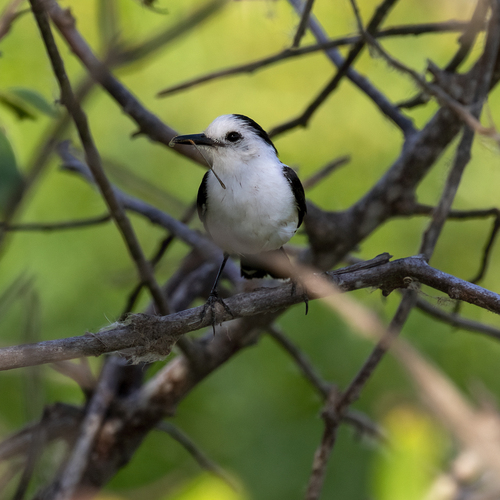 Moucherolle pie
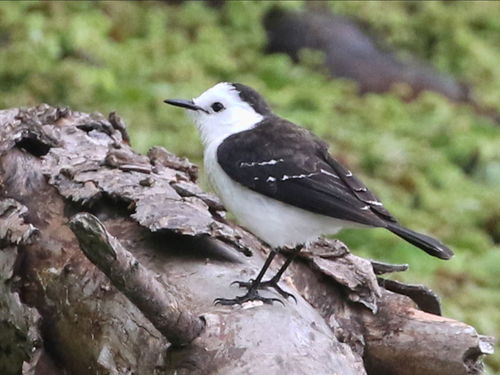 Moucherolle à dos noir
En bref
The most reliable field mark to separate Pied Water-Tyrant from Black-backed Water-Tyrant is the pattern on the back and wings: Pied Water-Tyrant (especially females and juveniles) shows a mottled black-and-white or brownish back, while Black-backed Water-Tyrant always has a solid black back with a crisp white rump band and two thin white wingbars. In flight or at rest, look for the wingbars and the extent of black on the back. Juvenile Pied Water-Tyrants are browner where adults are black, but still lack the solid black back and clear wingbars of Black-backed. Both species are active, white-bellied flycatchers near water, but their upperpart patterns and subtle differences in tail and wing markings are key. Size is similar, but Black-backed is slightly larger and bulkier.
Conseils d’identification
- Back pattern is key: Black-backed Water-Tyrant always shows a solid black back with a crisp, thin white rump band; Pied Water-Tyrant has a mottled black-and-white (or brownish in females/juveniles) back with no clear rump band. This is the fastest separator at any age.
- Wingbars vs plain wings: Black-backed has two thin, clear white wingbars on otherwise black wings; Pied has plain black wings with only small white tips on the tertials—never wingbars. This is especially visible in flight or when perched with wings folded.
- Juvenile/female confusion: Juvenile and female Pied Water-Tyrants are brownish on the hindcrown, nape, and back, not black. Black-backed of all ages/sexes is always solid black above (except for the white rump band). If you see brown tones, it's Pied.
- Tail pattern: Both have black tails with some white, but Black-backed shows variable white tips and edges, while Pied has only small white tips. The tail pattern is subtle and best used as supporting evidence.
- Rump band: Only Black-backed shows a thin, crisp white band across the rump; Pied lacks this feature entirely.
- Size and shape: Black-backed is slightly larger and more robust, but this is a minor difference and not reliable unless directly compared.
- Sexual dimorphism: Pied shows some sexual dimorphism (females browner above), while Black-backed is identical in both sexes. If you see a pair and both are equally black above, it's Black-backed.
- Jizz and behavior: Both are active and flick their tails, but this is not a reliable separator. Both may fan or cock the tail while foraging.
- Bill and legs: Both have black, sharply hooked bills and black legs/feet—these features do not separate them.
- Underparts: Both are entirely white below; do not use underparts for separation.
- Iris color: Both have dark irises; not a separator.
- Habitat and range: If outside the overlap zone (northern South America for Pied, southern for Black-backed), range can help. In Brazil and Peru, both may occur together, so do not rely on range alone.
- Perched vs flight views: In flight, Black-backed's white wingbars and rump band are especially obvious; Pied appears plainer above with only small white tertial tips and no rump band.
- Season: No major seasonal plumage differences are described for either species; focus on age and sex differences in Pied.
- Voice: No diagnostic vocal differences are provided in the sources; do not rely on voice for separation.
Taille
Pied Water-Tyrant is slightly smaller, at 12.5–13.5 cm and 11–16 g, while Black-backed Water-Tyrant is 13–14 cm and likely a bit heavier (precise mass not given, but described as medium-sized vs small). In the field, this difference is subtle and not usually diagnostic unless both are side by side, but Black-backed may look a bit more robust overall.
Plumage
Juveniles and females of Pied Water-Tyrant are key pitfalls: they show brownish or mottled black-and-white on the hindcrown, nape, and back, lacking the solid black of Black-backed. Adult Pied males are mostly white with a black hindcrown/nape, mottled black-and-white back, black wings with small white tertial tips, and a black tail with small white tips. Black-backed Water-Tyrant of all ages and sexes (no sexual dimorphism) has a solid black hindcrown, nape, and back, a thin white band across the rump, black wings with two thin white wingbars, and a black tail with variable white tips and edges. Both have white underparts, dark eyes, and black bills and legs. In flight, Black-backed's white wingbars and rump band are distinctive, while Pied shows plainer black wings with only small white tertial tips and no wingbars. Juvenile Pieds are browner where adults are black, but still lack the crisp wingbars and white rump of Black-backed.
Comportement
Both species are active and often flick or fan their tails while foraging near water. Pied Water-Tyrant is described as 'active and perky,' frequently flicking its tail up and down and sometimes spreading it. Black-backed Water-Tyrant also cocks and fans its tail while foraging, and males perform aerial courtship displays. Behavior is similar enough that it is not a strong separator.
Habitat
Both species are found near water—ponds, marshes, and riversides—but their ranges overlap only in parts of Brazil and Peru. Pied Water-Tyrant is more northern (Brazil, Colombia, Venezuela, Trinidad, etc.), while Black-backed is more southern (Argentina, Bolivia, Paraguay, Uruguay, Brazil, Peru). If you are outside the overlap zone, range can help, but in Brazil and Peru both may occur. Both species forage on or near the ground and on floating/emergent vegetation.
Moucherolle pie · Moucherolle à dos noir · Mes oiseaux difficiles