

Tisserin intermédiaire vs Tisserin vitellin
Ploceus intermedius contre Ploceus vitellinus
Faire un quiz avec Tisserin intermédiaire et Tisserin vitellin
 Tisserin intermédiaire
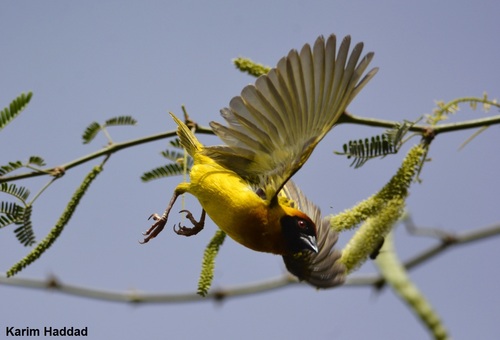 Tisserin vitellin
En bref
Separating Lesser Masked-Weaver from Vitelline Masked-Weaver in the field is challenging, especially outside the breeding season or with immatures, as both are yellow weavers with black facial masks and overlapping ranges in eastern Africa. The most reliable difference is geographic: Lesser Masked-Weaver is found mainly in eastern, south-eastern, and southern Africa, while Vitelline Masked-Weaver is more common in western, central, and eastern Africa. Structural and plumage differences are subtle and not well documented in the available sources, so context and range are often the best clues. Both species are colonial nesters and may occur in mixed flocks, increasing confusion. Use a combination of location, subtle plumage cues (when available), and context for the best chance of correct identification.
Conseils d’identification
- Geographic range is the most reliable separator: If you are in southern Africa, Lesser Masked-Weaver is the default. In western or central Africa, Vitelline Masked-Weaver is far more likely. In eastern Africa, both occur, so use additional clues.
- Colony context: Lesser Masked-Weaver often nests in large colonies with Village Weaver and sometimes Red-billed Buffalo Weaver. If you see mixed colonies with these species, Lesser Masked-Weaver is a strong candidate, but not exclusive.
- Facial mask in breeding males: Both species have a black facial mask in breeding plumage, but the sources do not provide details on differences in mask shape or extent. Do not rely on mask details unless you have local experience or a field guide with region-specific illustrations.
- Yellow coloration: Both species are yellow overall, and no consistent difference in shade or intensity is documented in the sources. Do not use yellow tone as a primary separator.
- Immature and non-breeding birds: No distinctive juvenile or first-winter wing or body plumage differences are described. Both species are likely to be indistinguishable at these ages without detailed local knowledge.
- Size and structure: Both are medium-sized weavers with no documented structural differences in bill, tail, or wing shape. Size is not a safe field mark.
- Nest association: If you observe the species nesting in close proximity to Village Weaver or Red-billed Buffalo Weaver, Lesser Masked-Weaver is more likely, but this is not exclusive.
- Habitat: Both species use similar habitats—open country, savanna, and areas near water. Habitat is not diagnostic except at the extremes of their ranges.
- Voice: No vocal differences are documented in the sources. Do not use song or call for separation.
- Mixed flocks: Both species may occur in mixed weaver flocks, especially in eastern Africa. Be cautious of assuming a single species in a colony.
- Season: During the non-breeding season, both species lose the bright mask and become even harder to separate. Use location and context as your main clues.
- Pitfalls: Over-reliance on facial mask shape or yellow tone is risky without local experience or detailed field guides. Expect overlap and be honest about uncertainty.
- When in doubt: In areas of range overlap, it may not be possible to identify every individual in the field without close study or capture. Record as "masked weaver sp." if uncertain.
- Consult local field guides: If you are birding in an area where both species occur, a region-specific field guide may illustrate subtle differences not covered in these notes.
- Photograph for later review: If possible, take photos for later comparison with local experts or detailed guides, especially for birds in non-breeding or immature plumage.
Taille
Only Lesser Masked-Weaver has a documented adult body mass (22.0 g [wikidata]); no measurement is available for Vitelline Masked-Weaver, but both are typical medium-sized weavers and likely overlap in size. In the field, size is not a reliable separator between these two species.
Plumage
No age-specific or flight-specific upperwing pattern differences are documented in the sources for either species. Both have the classic weaver look: yellow body, black facial mask in breeding males, and similar non-breeding and immature plumages. Without detailed notes on juvenile or immature wing patterns, plumage separation relies on subtle differences in the extent and shade of the black mask and yellow tones, which are not detailed in the available sources. Both species can show similar variation in mask size and yellow coloration, making visual separation extremely difficult, especially outside of adult breeding plumage.
Comportement
Both species are highly social, nesting in large colonies and sometimes associating with other weaver species. Lesser Masked-Weaver is noted for nesting alongside Village Weaver and Red-billed Buffalo Weaver, but this is not a unique behavior. Foraging and flight behavior are typical for weavers and not diagnostic between these two species.
Habitat
Lesser Masked-Weaver is found in eastern, south-eastern, and southern Africa, while Vitelline Masked-Weaver occurs in western, central, and eastern Africa. Their ranges overlap in eastern Africa, but Vitelline is absent from the southernmost regions. Both species use similar habitats—open country, savanna, and areas near water—so habitat alone is not diagnostic where ranges overlap. However, in southern Africa, a masked weaver is more likely to be Lesser Masked-Weaver.
Tisserin intermédiaire · Tisserin vitellin · Mes oiseaux difficiles