

Pouillot d'Ogilvie-Grant vs Bouscarle à pattes claires
Phylloscopus ogilviegranti contre Hemitesia pallidipes
Faire un quiz avec Pouillot d'Ogilvie-Grant et Bouscarle à pattes claires
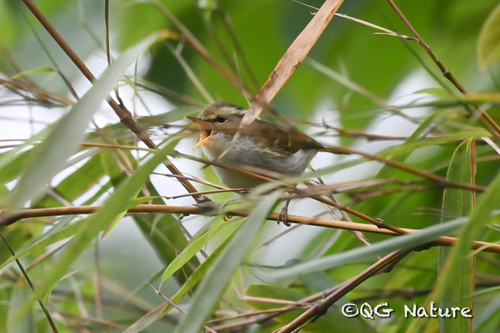 Pouillot d'Ogilvie-Grant
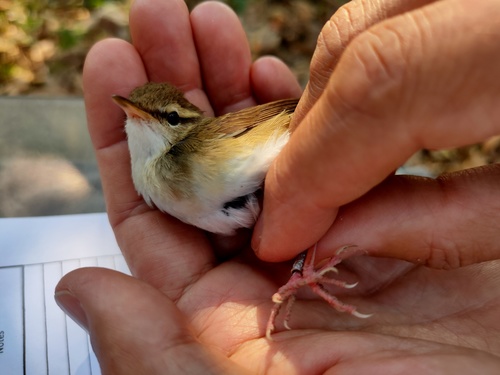 Bouscarle à pattes claires
En bref
The most reliable way to separate Kloss's Leaf Warbler from Pale-footed Bush Warbler is by overall structure and behavior: Kloss's is a typical leaf warbler, active and often in the canopy, while Pale-footed Bush Warbler is a skulking, ground-hugging species of dense undergrowth. If you see a small, greenish warbler flitting through leaves above eye level, it's likely Kloss's; a brownish bird creeping low in bamboo or grass is almost certainly Pale-footed Bush Warbler. There are no distinctive age-specific wing patterns described for either species, so focus on structure, behavior, and habitat. Plumage differences are subtle but supportable if you get a good look.
Conseils d’identification
- Habitat is a major clue: Kloss's Leaf Warbler is almost always in trees or tall shrubs, while Pale-footed Bush Warbler sticks to dense, low vegetation—especially bamboo or tall grass.
- Behavioral jizz: Kloss's is active, restless, and often joins mixed flocks; Pale-footed Bush Warbler is skulking, solitary, and rarely leaves cover.
- Supercilium (eyebrow line): Kloss's Leaf Warbler usually shows a pale, well-defined supercilium, especially in fresh plumage. Pale-footed Bush Warbler has a faint or absent supercilium, giving it a plainer face.
- Wingbars: Kloss's Leaf Warbler often shows two pale wingbars (though sometimes faint), a classic Phylloscopus mark. Pale-footed Bush Warbler lacks wingbars entirely—wings are plain brown.
- Upperparts color: Kloss's is greenish above, sometimes with a yellowish tinge; Pale-footed Bush Warbler is uniformly brown above.
- Underparts: Kloss's is pale below, sometimes with a yellowish wash; Pale-footed Bush Warbler is off-white or buffy below, but with less contrast than Kloss's.
- Tail shape and length: Kloss's has a longer, slimmer tail, often flicked or wagged. Pale-footed Bush Warbler's tail is shorter and more rounded, and not flicked as often.
- Bill structure: Kloss's has a fine, pointed bill typical of leaf warblers. Pale-footed Bush Warbler's bill is slightly stubbier and more robust, though this is subtle.
- Flight style: Kloss's is agile and quick in flight, often moving between branches; Pale-footed Bush Warbler flies weakly and rarely leaves cover.
- Association with mixed flocks: Kloss's often joins mixed-species flocks; Pale-footed Bush Warbler is usually alone or with its mate.
- Voice (if heard): Not described in the notes, but generally, Phylloscopus warblers have high, thin calls, while bush warblers give harsher, scolding notes.
- Seasonal context: Both species occur in overlapping regions, but check local status—Pale-footed Bush Warbler is more likely in foothill bamboo/grass, Kloss's in forested areas at a range of elevations.
- Sex and age: No strong sexual dimorphism or age-related plumage differences are described for either species, so marks above apply year-round.
- **If you see a bird foraging above head height, especially with wingbars and a supercilium, it's almost certainly Kloss's. If it's creeping in bamboo or grass, plain brown, and lacks wingbars, it's Pale-footed Bush Warbler.
- When in doubt, habitat and behavior are your best tools—plumage differences are subtle but consistent if seen well.
Taille
Both species are small warblers, but Kloss's Leaf Warbler is a typical Phylloscopus in size and build: slim, with a relatively longer tail and more delicate appearance. Pale-footed Bush Warbler is chunkier and rounder, with a shorter tail and a more compact, almost wren-like look. In hand, Pale-footed Bush Warbler is slightly heavier and bulkier, but this is subtle in the field.
Plumage
No distinctive juvenile or immature wing patterns are described for either species. Kloss's Leaf Warbler shows typical leaf warbler plumage: greenish upperparts, pale underparts, and often a yellowish or whitish supercilium (eyebrow line), with two pale wingbars that can be faint but are usually visible at close range. Pale-footed Bush Warbler, in contrast, is plain brown above and paler below, with little or no supercilium and lacking wingbars entirely. The bush warbler's plumage is overall more uniform and lacks the contrasting marks of Kloss's. These differences apply to all ages and seasons, as both species are not strongly sexually dimorphic and do not show dramatic seasonal changes.
Comportement
Kloss's Leaf Warbler is active, restless, and often forages in the mid- to upper canopy, frequently flicking its wings and tail. It joins mixed-species flocks and is rarely seen on or near the ground. Pale-footed Bush Warbler is secretive and prefers to stay low, creeping through dense grass, bamboo, or undergrowth, often remaining hidden. It is much less likely to be seen in open view or above waist height. Flight is weak and low for the bush warbler, while Kloss's is more agile and direct.
Habitat
Kloss's Leaf Warbler is found in a range of forest types from lowland to montane, but always favors wooded habitats, including broadleaf and mixed forests. It is usually seen in trees or tall shrubs. Pale-footed Bush Warbler, on the other hand, is a specialist of dense, low vegetation—especially bamboo, tall grass, or scrubby undergrowth—often in foothills and lower montane zones. If you are in thick, grassy or bamboo-dominated habitat, expect Pale-footed Bush Warbler; in more open or arboreal forest, Kloss's is much more likely.
Pouillot d'Ogilvie-Grant · Bouscarle à pattes claires · Mes oiseaux difficiles