

Dryade à queue fourchue vs Barbican promépic
Thalurania furcata contre Trachyphonus vaillantii
Faire un quiz avec Dryade à queue fourchue et Barbican promépic
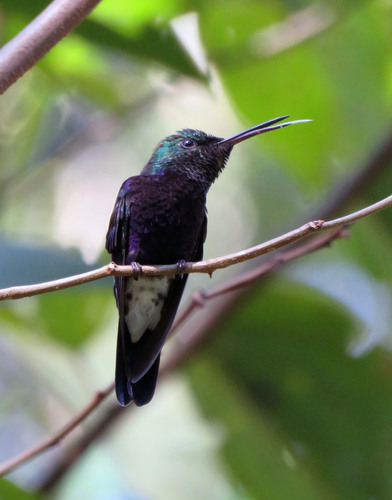 Dryade à queue fourchue
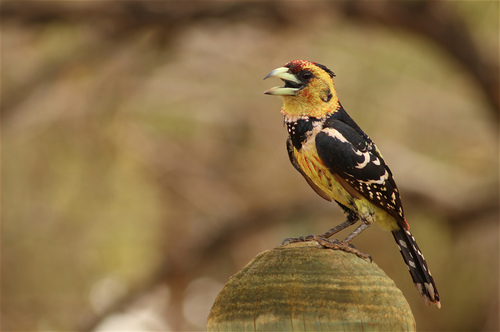 Barbican promépic
En bref
The most reliable field mark to separate Fork-tailed Woodnymph from Crested Barbet is overall structure and coloration: the woodnymph is a slender, small hummingbird with a straight black bill and iridescent green-violet plumage, while the barbet is a chunky, thick-billed bird with a boldly patterned yellow, red, black, and white body and a small black crest. No age-specific wing or flight pattern confusion is likely, as the two differ dramatically in both shape and plumage at all ages. If seen in flight, the woodnymph’s forked blue-black tail and rapid, hovering flight contrast sharply with the barbet’s short, bounding hops and reluctance to fly. Habitat and behavior also help: woodnymphs are nectar feeders often hovering at flowers, while barbets forage on the ground or perch openly, calling loudly.
Conseils d’identification
- Structure is the quickest separator: Fork-tailed Woodnymph is a tiny, slim hummingbird with a straight, medium-length black bill; Crested Barbet is a chunky, thickset bird with a massive, conical bill and a small black crest. This difference is obvious at any distance.
- Tail shape: Woodnymph has a deeply forked, blue-black tail (especially obvious in males); barbet’s tail is short, square-tipped, and not forked.
- Flight style: Woodnymphs hover and dart rapidly, rarely perching for long; barbets bounce on the ground or perch, flying only short distances and never hovering.
- Bill color and shape: Woodnymph’s bill is slender and black; barbet’s is thick, heavy, and pale (color not specified, but always much stouter).
- Plumage texture: Woodnymphs are iridescent green/violet (males) or bright green above/pale below (females); barbets are boldly patterned with yellow, red, black, and white, with a speckled face and belly and a broad black neck band.
- Crest: Only Crested Barbet has a small black crest; woodnymphs never show a crest.
- Face pattern: Barbet’s face is speckled yellow and red with a black crest; woodnymph’s face is plain green or bronze-green, sometimes with a glittering gorget (male).
- Underparts: Woodnymph males have a violet belly; females are pale gray below. Barbet’s belly is yellow with red speckles, never plain or iridescent.
- Wing pattern: Barbet’s wings are black with white specks; woodnymph’s wings are plain dark, with no white or speckling.
- Juvenile confusion: Even juvenile woodnymphs are greenish above and lack any patchy or speckled pattern; juvenile barbets are always boldly patterned.
- Voice: Persistent trilling calls are unique to Crested Barbet; woodnymphs are mostly silent or give thin, high calls.
- Habitat and range: Woodnymphs are Neotropical (South America); barbets are Afrotropical (sub-Saharan Africa). If you know your location, this is usually decisive.
- Feeding behavior: Woodnymphs visit flowers for nectar, often hovering; barbets feed on the ground or in trees, eating insects, fruit, and eggs.
- Perching behavior: Woodnymphs perch briefly and lightly; barbets often perch in the open, calling, or bounce on the ground.
- Pitfalls: There is no realistic risk of confusing these species in the field except in a photo quiz or collection, due to their radically different structure, behavior, and range.
Taille
Fork-tailed Woodnymphs are much smaller and lighter, with males measuring 9.5–12.9 cm and females 8–10.7 cm in length, weighing 3–6 g. In contrast, Crested Barbets are noticeably larger and bulkier (exact measurements not provided, but they are robust, thickset birds). The woodnymph’s body is delicate and streamlined, suited for agile hovering, while the barbet is stout with a large head and thick bill, built for perching and ground foraging.
Plumage
There is no overlap in wing or flight pattern between these species at any age. Fork-tailed Woodnymph males are metallic green above with a violet belly, a forked blue-black tail, and glittering green throat; females are bright green above with pale gray underparts and a tail with white-tipped outer feathers. Juveniles are duller but still greenish above. Crested Barbets, at all ages, are boldly marked with a speckled yellow and red face, black crest, yellow belly with red speckles, black wings with white spots, and a broad black neck band. The barbet’s plumage is patchy and variegated, never iridescent or uniform green. The woodnymph’s coloration is smooth and iridescent, never patchy or speckled.
Comportement
Fork-tailed Woodnymphs forage for nectar by hovering at flowers at all levels, sometimes defending flower patches or trap-lining. They are agile, almost always seen in flight or briefly perched. Crested Barbets are terrestrial or perch openly, bouncing on the ground or calling from exposed branches. Barbets are aggressive toward other birds, often chasing them, and are reluctant fliers, usually flying only short distances. Their feeding includes insects, fruit, and eggs, not nectar.
Habitat
Fork-tailed Woodnymphs are found in a wide range of habitats across most of mainland South America (except Chile and Uruguay), typically in areas with abundant flowering plants. Crested Barbets are restricted to sub-Saharan Africa, inhabiting forests, savannahs, gardens, woodland thickets, and watercourses. Thus, geographic range is a strong separator: these species do not overlap in the wild.
Voix
Fork-tailed Woodnymphs are generally quiet or give high-pitched, thin calls typical of hummingbirds (not detailed in the notes). Crested Barbets are very vocal, producing a loud, distinctive trill that can continue for long periods. If you hear a persistent trill, it is diagnostic for Crested Barbet.
Dryade à queue fourchue · Barbican promépic · Mes oiseaux difficiles