

Traquet noir et blanc vs Traquet de Finsch
Oenanthe melanoleuca contre Oenanthe finschii
Faire un quiz avec Traquet noir et blanc et Traquet de Finsch
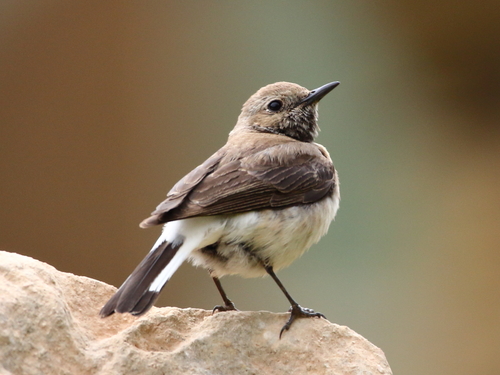 Traquet noir et blanc
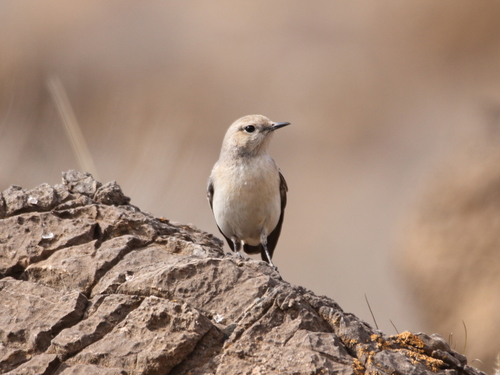 Traquet de Finsch
En bref
The most reliable field mark between Eastern Black-eared Wheatear and Finsch's Wheatear is the tail pattern: both show a white tail with a black terminal band, but Finsch’s has a uniformly broad black tip forming a crisp inverted T, while Eastern Black-eared’s black is less broad and the white often extends further up the tail. Adult males of both species are strikingly black-and-white, but Finsch’s has a more sharply contrasting, clean white crown and belly with a solid black face and throat, while Eastern Black-eared is slightly buff-tinged and less sharply marked. Females are trickier, but Eastern Black-eared is colder and duller overall, while Finsch’s is browner above and dirtier white below. Both can be confused in autumn and winter, but subtle differences in upperpart color and tail pattern remain useful. Structure and size are similar, but Finsch’s is slightly heavier and longer-winged.
Conseils d’identification
- Tail pattern is key: Finsch’s Wheatear has a uniformly broad black terminal band on the tail forming a crisp inverted T, visible in flight and when perched. Eastern Black-eared Wheatear’s tail is also white with black at the tip, but the black is less broad and the white often extends further up the tail, making the T less crisp. This works for all ages and sexes.
- Male head and throat: In breeding plumage, male Finsch’s has a clean white crown and central back with a solid black face and throat. Eastern Black-eared males are whiter above than Western Black-eared, but usually show a buff tinge and the black mask reaches just above the bill base. Black-throated forms of Eastern Black-eared have more extensive and sharply demarcated black on the throat and face than Finsch’s.
- Upperpart color: Eastern Black-eared males are less buff-tinted and more black-and-white than Western Black-eared, but still often show a slight buff wash, especially outside peak breeding. Finsch’s is always clean white above in adult males.
- Female plumage: Females are best separated by tone: Eastern Black-eared is colder and duller overall, with a whiter lower back; Finsch’s is browner above and dirty white below. Both can be subtle, so rely on tail pattern as well.
- Seasonal change: In autumn and winter, both species become buffier, but Eastern Black-eared remains colder and greyer, while Finsch’s is browner and dirtier. Tail pattern remains reliable year-round.
- Face pattern: The black mask of Eastern Black-eared male reaches just above the bill base; in Finsch’s, the black face is solid and extends through the throat in a more uniform block.
- Throat color: Eastern Black-eared can show either black or white throats (with black-throated birds showing more extensive black than Finsch’s). Finsch’s always has a black throat in adult males.
- Back and upper tail coverts: Both species have white backs and upper tail coverts, but Eastern Black-eared’s white can be tinged buff, especially outside breeding.
- Structure: Finsch’s is described as more elegant, with longer wings and legs, but this is subtle and not always apparent in the field.
- Size: Finsch’s averages slightly heavier and longer-winged, but this is not a reliable field mark unless birds are side by side.
- Wing color: Both have black wings, but Finsch’s black is more sharply defined against the white body, while Eastern Black-eared’s black wings may contrast less if the white is buff-tinged.
- Voice: Finsch’s gives a whistled 'tsit' and a song of clear notes with crackling; Eastern Black-eared’s voice is not described here, so do not rely on vocalization for separation.
- Pitfalls: Beware autumn and winter birds, when both species become buffier and less contrasting. Focus on tail pattern and overall coldness (Eastern Black-eared) versus brownness (Finsch’s).
Taille
Both species are medium-sized wheatears, but Finsch’s Wheatear is marginally heavier (average body mass around 27.5g [wikidata]) and has a slightly longer wingspan (25–27 cm). Eastern Black-eared Wheatear’s mass is not specified, but both are close in size and length (Finsch’s at 14 cm long). In the field, size differences are subtle and rarely diagnostic at a distance.
Plumage
-
Juvenile/immature plumages: No explicit age-specific upperwing or flight marks are described for either species in the sources, so tail pattern and overall color remain the best clues for all ages.
-
Adult males (breeding): Finsch’s Wheatear shows a strikingly clean white crown, central back, and belly, with a solid black face, throat, and wings. The tail is white with a broad, even black terminal band forming a crisp inverted T. Eastern Black-eared Wheatear males are also black-and-white but usually have a buff tinge to the white areas, especially on the upperparts and underparts, and the black mask reaches just above the bill base. Black-throated forms have more extensive and abruptly demarcated black on the throat and face than Finsch’s.
-
Females: Eastern Black-eared is colder and duller overall, with less contrast and a whiter lower back; Finsch’s is browner above and dirty white below, but both share a similar tail pattern. Seasonal changes are less marked in females, but Eastern Black-eared females are always less warm-toned than Finsch’s.
-
Non-breeding/Autumn: Both species become buffier, but Eastern Black-eared retains a colder, greyer look, while Finsch’s remains browner and dirtier below. The tail pattern remains a key difference year-round.
Comportement
Both species are typical upright, ground-feeding wheatears, often perching on rocks or low shrubs. Finsch’s is described as elegant, with long wings and legs, and may appear slightly more elongated or upright. No major behavioral differences are noted in the sources for field separation.
Voix
Finsch’s Wheatear gives a whistled 'tsit' call and a song of clear notes mixed with whistles and crackling. No vocal details are provided for Eastern Black-eared Wheatear in the sources, so voice is not a reliable separator here.
Traquet noir et blanc · Traquet de Finsch · Mes oiseaux difficiles