

Courvite à double collier vs Moinelette à oreillons blancs
Smutsornis africanus contre Eremopterix leucotis
Faire un quiz avec Courvite à double collier et Moinelette à oreillons blancs
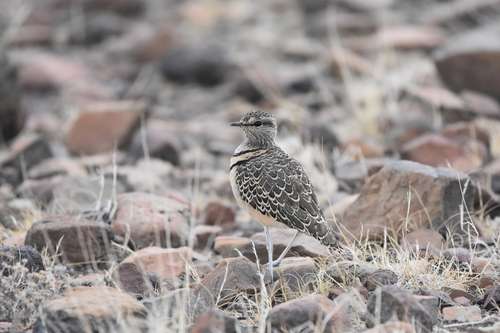 Courvite à double collier
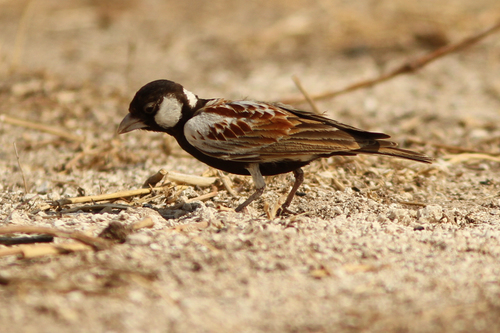 Moinelette à oreillons blancs
En bref
The most reliable field mark between Double-banded Courser and Chestnut-backed Sparrow-Lark is overall structure and plumage contrast: coursers are tall, upright, long-legged birds with sandy, streaked upperparts and a distinctive double breast band, while sparrow-larks are small, squat, thick-billed, and show either a striking black-and-white (male) or streaky buff-and-chestnut (female/juvenile) plumage. Immature birds of both species are streaked and can be confusing, but the courser always appears longer-legged and more upright, with a pale, streaked crown and a bold facial stripe. In flight or on the ground, note the courser’s sandy tones and white-edged wing coverts versus the lark’s chestnut upperparts and, in males, bold black underparts. Habitat overlap is possible, but coursers prefer stony, open semi-desert, while sparrow-larks are more often in grassy or recently burned areas.
Conseils d’identification
- Leg length and stance: Courser always stands tall and upright on long, pale legs; sparrow-lark is squat and low to the ground with short legs. This is reliable at any age or sex.
- Bill shape: Courser has a short, slender, blackish bill; sparrow-lark has a thick, conical, grey bill typical of seed-eating larks.
- Crown and facial pattern (all ages): Courser shows a pale, streaked crown and a narrow black stripe from bill through eye to nape. Sparrow-lark lacks this; males have a black head with white patches, females/juveniles are streaked but lack the courser’s facial stripe.
- Upperparts color: Courser is sandy brown with dark-centred feathers and broad pale edges; sparrow-lark is chestnut above, with males showing rich rufous and females/juveniles more mottled chestnut.
- Underparts (adult males): Courser is pale buff/white with dark flecking and double breast band; male sparrow-lark is solid black below. This is a quick separator for adult males.
- Underparts (females/juveniles): Courser is pale with some flecking, sparrow-lark is heavily streaked buff-white.
- Breast band: Courser has a double black breast band (sometimes hard to see at distance or in poor light); sparrow-lark never shows any breast band.
- Nape patch: Male sparrow-lark has a brilliant white nape and post-ocular patch; courser does not.
- Wing coverts: Courser’s wing coverts are sandy brown with broad white/buff edges; sparrow-lark’s are chestnut with some dark streaking.
- Flight jizz: Courser appears long-winged and buoyant in flight, with sandy tones; sparrow-lark is more fluttery and compact, with chestnut upperwings and (in males) black underparts visible.
- Group size: Courser is usually solitary or in pairs; sparrow-lark often in small groups or mixed flocks.
- Habitat context: In stony, gravelly semi-desert with sparse grass, expect courser; in open grassland, burned fields, or disturbed open ground, sparrow-lark is more likely.
- Feeding behavior: Courser runs and pauses, then darts after insects; sparrow-lark shuffles or hops, often picking at seeds as well as insects.
- Juvenile confusion: Both can be streaky and buff, but check for courser’s upright stance, pale crown, and facial stripe versus sparrow-lark’s chestnut upperparts and lack of strong facial markings.
- Voice: Not diagnostic from available sources; rely on structure and plumage.
Taille
Double-banded Courser is significantly larger and leggier than Chestnut-backed Sparrow-Lark. The sparrow-lark is a small bird (body mass ~13.2g [wikidata]), about 11 cm in length, and appears compact and squat, with a thick bill and short legs. The courser is much taller, with long, pale legs and a more upright, elongated stance. Even at a distance, the courser’s long-legged silhouette stands out against the lark’s low, ground-hugging profile.
Plumage
- Juvenile/immature birds: Both species can be streaky and buff, but the courser juvenile shows a pale, streaked crown, a narrow black stripe through the eye, and sandy brown upperparts with white or buff edging to the wing coverts. The sparrow-lark juvenile is more uniformly chestnut above with heavy streaking, and lacks the courser’s facial pattern and pale crown.
- Adult males: Courser males (and females) have sandy upperparts, a pale streaked crown, and a distinctive double black breast band (not always visible at distance), with buff or white underparts flecked with brown. Male sparrow-larks are unmistakable with solid black underparts and head, brilliant white nape and post-ocular patches, and rich chestnut upperparts.
- Adult females: Female coursers resemble males but are less contrasting; they retain the pale crown and facial stripe. Female sparrow-larks are drab, with heavily streaked buff-white underparts and head, a white nape collar, and chestnut, mottled upperparts. They lack the courser’s upright stance and facial markings.
- In flight: Courser shows sandy tones and white/buff-edged coverts; sparrow-lark shows chestnut upperwings and, in males, black underparts visible even in flight.
Comportement
Double-banded Courser moves with a quick, upright run, often pausing to stand tall and scan, then darting after insects. Its long legs and upright posture are distinctive. Chestnut-backed Sparrow-Lark shuffles or hops along the ground, often in small groups, and appears much more compact and low to the ground. Sparrow-larks are often seen in mixed flocks and may be more active in recently burned or disturbed areas, while coursers are solitary or in pairs, and less likely to join mixed-species flocks.
Habitat
Both species favor open, dry habitats, but with subtle differences. Double-banded Courser prefers flat, stony or gravelly semi-desert with sparse tufty grass or thorn scrub. It is typical of firm, sandy soils and avoids lush grassland. Chestnut-backed Sparrow-Lark is more often found in open grassland, arid savanna, and especially in recently burned areas or open fields, sometimes on gravel plains. Overlap can occur, but coursers are more tied to stony semi-desert, while sparrow-larks exploit a wider range of open, disturbed habitats.
Courvite à double collier · Moinelette à oreillons blancs · Mes oiseaux difficiles