

Todirostre familier vs Tyranneau à ventre jaune
Todirostrum cinereum contre Ornithion semiflavum
Faire un quiz avec Todirostre familier et Tyranneau à ventre jaune
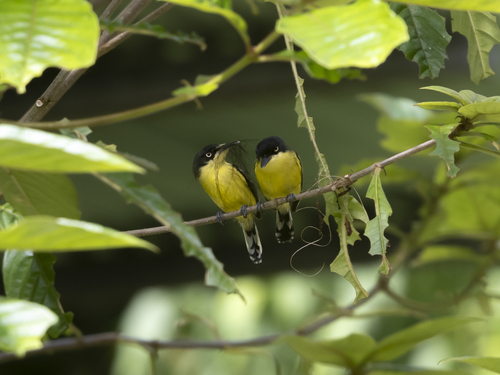 Todirostre familier
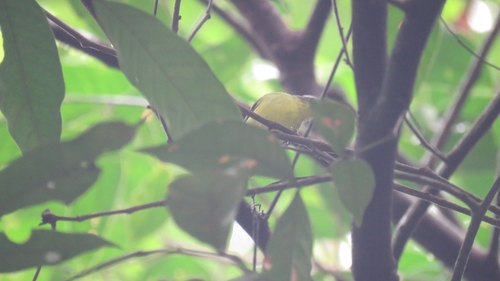 Tyranneau à ventre jaune
En bref
The most reliable field mark to separate Common Tody-Flycatcher from Yellow-bellied Tyrannulet is the striking head pattern: Tody-Flycatcher shows a glossy black forecrown and lores (males) or grayish head (females), while Yellow-bellied Tyrannulet has a pale white forehead, lores, and supercilium contrasting with a slate-gray crown and olive face. Both species are tiny, yellow-bellied flycatchers, but Tody-Flycatcher has a noticeably larger, flatter, and straighter bill, and a more contrasting black-and-yellow wing pattern with two distinct wing bars. In juveniles, Tody-Flycatcher shows a buffy tinge to the wing bars and a darker crown, while Tyrannulet juveniles have a brownish crown and paler yellow below. Structure and head pattern are key, especially in perched birds.
Conseils d’identification
- Head Pattern (All Ages): Look for the Tody-Flycatcher's glossy black forecrown and lores (males) or grayish head (females). Tyrannulet always shows a white forehead, lores, and supercilium against a slate-gray crown and olive face, creating a pale 'mask' effect.
- Bill Shape: Tody-Flycatcher has a long, flat, straight bill (all ages), often appearing oversized for its tiny body. Tyrannulet's bill is shorter, pointed, and arched on the maxilla, never as flat or broad.
- Wing Bars: Tody-Flycatcher (all ages) shows two distinct yellow wing bars on black wings, with yellow edges to the flight feathers. Tyrannulet lacks strong wing bars, with dusky olive wings and only faint pale edges.
- Tail Pattern: Tody-Flycatcher has a black tail with white tips on the outer feathers, visible when spread. Tyrannulet's tail is uniformly dusky olive, lacking white tips.
- Juvenile Plumage: Juvenile Tody-Flycatchers have a dark gray crown and cheeks, buffy-tinged yellow wing bars, and a dark iris. Juvenile Tyrannulets have a brownish crown and upperparts, paler yellow below, and no strong wing bars.
- Underparts: Both have bright yellow bellies, but Tyrannulet often shows faint olive streaks on the breast and flanks, while Tody-Flycatcher is clean yellow below.
- Back Color: Tody-Flycatcher has a slate-gray upper back grading to dark olive, while Tyrannulet is bright olive above throughout.
- Eye Color: Adult Tody-Flycatchers have a yellowish to white iris, while Tyrannulet's iris is brown (all ages).
- Leg Color: Both have grayish legs, not a useful separator.
- Sex Differences: Only Tody-Flycatcher is sexually dimorphic in head color and bill (females have a paler mandible and grayer head); Tyrannulet sexes are identical.
- Behavior: Tody-Flycatcher is often seen actively hopping, tail cocked and wagging. Tyrannulet is less animated and lacks this jizz.
- Vocalizations: If you hear dry 'trrr-trrr' trills or rapid 'tic' notes, it's Tody-Flycatcher. Tyrannulet's voice is not distinctive in these notes.
- Geographic Range: If in South America outside Central America, it's almost certainly Tody-Flycatcher. In Central America, both occur, so rely on plumage and structure.
- Perched vs. In-Flight: Tody-Flycatcher's wing bars and tail pattern are visible perched and in flight; Tyrannulet's lack of wing bars and uniform tail are consistent.
- Pitfalls: Beware of dull or juvenile Tody-Flycatchers, which may show less contrast but still have the structural bill and wing bar differences. Tyrannulet never shows a black or glossy head, strong wing bars, or white tail tips.
Taille
Both species are extremely small flycatchers, but Common Tody-Flycatcher is slightly longer (8.8–10.2 cm) and can be lighter (4–8 g), while Yellow-bellied Tyrannulet is 8–9 cm and 7–8 g. In practice, size overlap is considerable, but Tody-Flycatcher may appear more compact and big-headed, with a proportionally longer, flatter bill. Tyrannulet is more evenly proportioned, with a pointed bill.
Plumage
- Juveniles: Tody-Flycatcher juveniles have a dark gray crown and cheeks, buffy-tinged yellow wing bars, and paler yellow underparts. Tyrannulet juveniles show a brownish crown and upperparts, with paler yellow below, but lack the strong wing bars and have less contrast in the face.
- Adults: Male Tody-Flycatchers have a glossy black forecrown and lores, slate-gray hindcrown and nape, and a dark olive back. Their wings are black with yellow edges and two bold yellow wing bars. Females are similar but with a grayer head and a paler mandible. Tyrannulet adults have a slate-gray crown, but a white forehead, lores, and supercilium, with a bright olive back and dusky olive wings and tail. Their underparts are bright yellow with faint olive streaks on the breast and flanks, and they lack strong wing bars. Both sexes look alike in Tyrannulet.
- Tail: Tody-Flycatcher has a black tail with white tips on the outer feathers, while Tyrannulet's tail is dusky olive throughout.
Comportement
Tody-Flycatcher is very active and often seen hopping sideways along branches, tail cocked and wagging, foraging mostly low in dense vegetation but sometimes higher. It often forages in pairs or small groups, rarely in mixed flocks. Tyrannulet behavior is less described in the notes, but it is generally less conspicuous and lacks the tail-wagging jizz of Tody-Flycatcher. Both species are gleaners, but Tody-Flycatcher's constant motion and cocked tail are distinctive.
Habitat
Both species overlap in Central America and southern Mexico, but Tody-Flycatcher ranges much farther south into nearly all of South America (except Chile and Uruguay), while Tyrannulet is restricted to Central America. Both use forest edges and second growth, but Tody-Flycatcher is more widespread and can be found in a wider range of habitats.
Voix
Tody-Flycatcher gives a series of low, dry trills ('trrr-trrr'), various high 'tic' notes, and a very high 'weet-widiwi' phrase, often repeating 'tic' notes rapidly at dawn. Bill snaps are audible during prey capture. Tyrannulet's voice is not described in the notes, so vocalizations are not a reliable separator unless Tody-Flycatcher's distinctive trills or bill snaps are heard.
Todirostre familier · Tyranneau à ventre jaune · Mes oiseaux difficiles