

Motmot à bec large vs Habia à couronne rouge
Electron platyrhynchum contre Habia rubica
Faire un quiz avec Motmot à bec large et Habia à couronne rouge
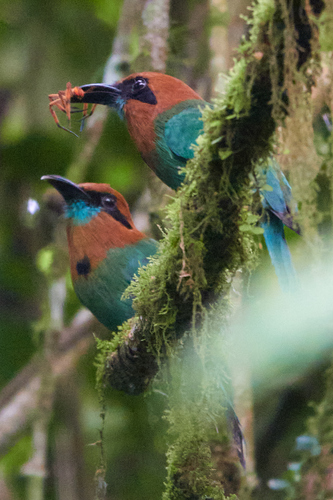 Motmot à bec large
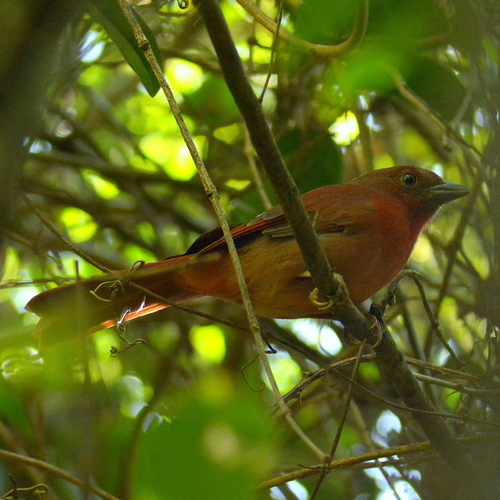 Habia à couronne rouge
En bref
The most reliable field mark separating Broad-billed Motmot from Red-crowned Ant-Tanager is the motmot’s long, racquet-tipped tail and broad, flattened bill, which are never seen on the ant-tanager. Immature motmots may show duller colors and a blue-green eye-stripe, but still retain the distinctive tail shape. In contrast, the ant-tanager lacks any tail racquets and has a much slimmer, more typical passerine bill. Motmots perch upright and motionless, while ant-tanagers are more active and often found in small groups. If you see a bird with a cinnamon head, check for the unique tail and bill structure before relying on color alone.
Conseils d’identification
- Tail shape is diagnostic: Broad-billed Motmot has a long tail with two central racquet-tipped feathers, visible in all but rare plain-tailed subspecies and even in juveniles. Red-crowned Ant-Tanager never shows racquet tips; its tail is short and even.
- Bill structure: Motmot’s bill is broad, flattened, and black with serrated edges and a keel; ant-tanager’s bill is slim, conical, and typical of a songbird. This is visible even at a distance with good binoculars.
- Perched jizz: Motmots perch upright and motionless, often alone or in pairs, while ant-tanagers are more active, moving in small groups.
- Plumage – head and chest: Both can appear rufous-headed, but motmot has a large black patch on the chest and cheeks, and a blue-green chin. Ant-tanager males may show a red crown patch (not always visible), but never the motmot’s black facial/chest patches.
- Juvenile marks: Young motmots are duller and darker, with a blue-green eye-stripe and some white on the bill, but still show the long tail and broad bill. Juvenile ant-tanagers lack these features entirely.
- Upperparts and underparts: Motmot’s upperparts are cinnamon-rufous, grading to greenish and then bluish below. Ant-tanager is generally duller, with no blue-green chin or black chest patch.
- Size and bulk: Motmot is almost twice as heavy and appears longer due to its tail. Ant-tanager is more compact and lighter.
- Habitat context: Motmot prefers dense, humid forest interiors; ant-tanager is more likely in open woodland, edges, or secondary growth, and often in groups.
- Behavior at rest: Motmot sits quietly for long periods; ant-tanager is restless and social.
- Vocalizations: If heard, motmot’s nasal "cwaah" at dawn is distinctive; ant-tanager’s calls are not detailed here.
- Feeding behavior: Motmot hunts by sallying from a perch and does not eat fruit; ant-tanager forages more actively and may follow ant swarms.
- Sexual dimorphism: Motmot sexes look alike; ant-tanager males may show a red crown, but this is not always visible and is absent in females/immatures.
- Bill color: Motmot’s bill is always black (with some white in juveniles); ant-tanager’s bill is paler and more typical of a cardinalid.
- Facial pattern: Motmot has a black cheek/auricular patch; ant-tanager lacks this feature.
- When in doubt: If you see a rufous-headed bird with a long, odd-shaped tail and a broad bill, it is a motmot. If the bird is smaller, with a normal tail and bill, and especially if in a group, it is an ant-tanager.
Taille
Broad-billed Motmot is significantly heavier (62g vs 32.5g) and longer (about 12 inches/30 cm) than Red-crowned Ant-Tanager, which is a medium-sized songbird. The motmot’s size is accentuated by its long tail, especially the elongated racquet-tipped central feathers. The ant-tanager is more compact, with a typical songbird silhouette and much shorter tail. In the field, the motmot will appear bulkier and more elongated, especially when perched.
Plumage
Juvenile Broad-billed Motmots are duller and darker than adults, with a blue-green streak over the eye and some white on the bill, but even young birds show the long, racquet-tipped tail (except for the rare plain-tailed subspecies). Adults have a cinnamon-rufous head, neck, and chest, with a large black patch on the chest and cheeks, and greenish to bluish underparts. The bill is broad, black, and flattened. Red-crowned Ant-Tanager, by contrast, does not have racquet-tipped tail feathers at any age, and its bill is slender and conical. Males have a red crown patch (not always visible), while females and immatures are duller, but never show the motmot’s combination of black facial/chest patches and blue-green chin. Both species can appear rufous-headed, but only the motmot has the striking tail and bill structure.
Comportement
Broad-billed Motmots are typically seen singly or in pairs, sitting quietly and upright for long periods, scanning for prey before sallying out and returning to the same perch. They are generally sedentary and unobtrusive. Red-crowned Ant-Tanagers are more active, often in small groups, and move about in the lower to mid-levels of the forest, sometimes following ant swarms. Their foraging is more restless and social compared to the motmot’s solitary and still demeanor.
Habitat
Both species occur in Central and South American forests, but Broad-billed Motmot is more strictly associated with dense, humid forest interiors and edges, often near water or in shady ravines. Red-crowned Ant-Tanager is found in a wider range of wooded habitats, including secondary growth, forest edges, and sometimes more open areas. If the bird is in deep, undisturbed forest and perched motionless, motmot is more likely; if it is in a group in more open woodland, ant-tanager is favored.
Voix
Broad-billed Motmot’s main song is a nasal, repeated "cwaah" given at dawn, sometimes in duets, and a quieter series of "tuk" notes that can develop into a rattle. Red-crowned Ant-Tanager’s vocalizations are not described in the provided notes, so voice is less reliable for separation unless the motmot’s distinctive dawn song is heard.
Motmot à bec large · Habia à couronne rouge · Mes oiseaux difficiles