

Étourneau à cou noir vs Étourneau siamois
Gracupica nigricollis contre Gracupica floweri
Faire un quiz avec Étourneau à cou noir et Étourneau siamois
 Étourneau à cou noir
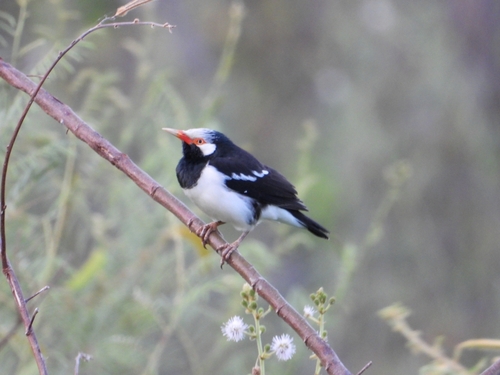 Étourneau siamois
En bref
The most reliable field mark between Black-collared Starling and Siamese Pied Starling is the extensive yellow bare skin around the eye in Black-collared, versus the more limited red-orange facial skin in Siamese Pied. Both have black-and-white plumage with a black collar, but Black-collared Starling is noticeably larger and bulkier, with a strikingly white head and more robust jizz. Juveniles of Black-collared Starling are browner and lack a full collar, which can cause confusion, but the overall size and facial skin color remain key. In the field, focus on facial skin color, head pattern, and overall size to separate these two, especially in mixed flocks or urban habitats.
Conseils d’identification
- Facial Skin Color and Extent: Black-collared Starling has a large, bright yellow bare patch around the eye, which is diagnostic at all ages. Siamese Pied Starling has a red-orange bare patch that is less extensive. This is the single most reliable field mark.
- Head Color and Pattern: Black-collared Starling shows a strikingly white head in adults, contrasting sharply with the black collar. Siamese Pied Starling's head is also white but often less pure, with more white streaking on the forehead and less contrast overall.
- Size and Structure: Black-collared Starling is much larger and bulkier, with a heavier bill and more robust body. Siamese Pied Starling is smaller, slimmer, and more delicate in build. Size is especially apparent when both species are present.
- Collar: Both species have a black collar, but in juvenile Black-collared Starling the collar is absent or incomplete, replaced by streaking. This can cause confusion with Siamese Pied Starling, but the facial skin color and size still separate them.
- Wing and Tail Pattern: In flight, Black-collared Starling shows more extensive white on the wings and tail, with white-tipped flight feathers and entirely white primary coverts. Siamese Pied Starling has white in the wings but less extensive and less bold.
- Juvenile Plumage: Juvenile Black-collared Starlings are browner with streaked neck and breast, and lack a full collar. The yellow facial skin is still present, helping separate them from Siamese Pied Starling juveniles.
- Bill and Legs: Black-collared Starling has a black bill and pale grey legs. Bill color is less distinctive in Siamese Pied Starling but generally similar; focus on facial skin and head pattern instead.
- Vocalizations: Black-collared Starling is much more vocal, with a wide range of loud, varied calls and songs. If you hear a complex, loud, and varied song, especially with chest-puffing display, suspect Black-collared Starling.
- Habitat and Range: If in southern China, Taiwan, Malaysia, or Singapore, you are almost certainly seeing Black-collared Starling. In southern Myanmar, Thailand, or Laos, both species are possible; use field marks carefully.
- Behavior: Black-collared Starling is more conspicuous, often foraging in the open and associating with livestock. Siamese Pied Starling is more retiring and less robust in behavior.
- Sex Differences: Both species show little or no sexual dimorphism in plumage or size, so all field marks apply to both sexes.
- Pitfalls: Immature Black-collared Starlings lacking a full collar can be mistaken for Siamese Pied Starling, but the yellow facial skin and larger size remain reliable. Always check for these features in young birds.
- Perched vs. Flight Views: In flight, focus on the extent of white in the wings and tail (more in Black-collared Starling). When perched, the facial skin and head color are most useful.
- Mixed Flocks: In areas of overlap, both species may occur together. Compare individuals directly for size, head pattern, and facial skin color.
- Seasonality: No strong seasonal plumage differences are described for either species, so these marks are reliable year-round.
Taille
Black-collared Starling is substantially larger, measuring 26–30 cm in length, and appears bulkier with a heavier build. Siamese Pied Starling is smaller and more slender, with a less imposing presence. This size difference is often apparent when both species are seen together or compared to common urban birds. Both sexes are similar in size within each species.
Plumage
- Adults: Black-collared Starling shows a bright white head with a bold black collar and extensive yellow bare skin around the eye. The back, wings, and mantle are dark brown to almost black, with prominent white tips on the tail and flight feathers, and the primary coverts are entirely white. Underparts are white with a possible grey-brown wash. Siamese Pied Starling also has black-and-white plumage and a black collar, but the facial skin is red-orange and less extensive, and the white on the head is less pure and less extensive, with more white streaking on the forehead.
- Juveniles: Juvenile Black-collared Starlings are browner overall, with streaked neck and breast, and show an eye-patch but lack a full collar. Juvenile Siamese Pied Starling details are not specified, but expect less contrast and less extensive facial skin.
- Flight/wing pattern: Both species have white in the wings and tail, but Black-collared Starling's white is more extensive and the bird appears more boldly patterned in flight. No unique upperwing marks for Siamese Pied Starling are described.
Comportement
Black-collared Starling is often seen foraging on the ground, sometimes around livestock, and is very vocal and conspicuous. It may be found in pairs or small groups, often in open or semi-open habitats. Siamese Pied Starling shares similar foraging habits but is generally less robust in movement and presence. Both species are social, but Black-collared Starling's larger size and louder vocalizations make it stand out in mixed flocks.
Habitat
Black-collared Starling occupies a wider range, found in southern China, most of mainland Southeast Asia, and introduced to Taiwan, Malaysia, and Singapore. It frequents grasslands, dry forests, and human settlements, adapting well to urban and rural environments. Siamese Pied Starling is more restricted to southern Myanmar, Thailand, and Laos, and is typically found in similar open habitats but with a more limited range. Overlap is possible in parts of Thailand and Laos, so careful attention to field marks is needed in these areas.
Voix
Black-collared Starling is notably vocal, producing a variety of shrill, harsh, and melodious calls, including a jay-like 'kraak kraak,' a whistling 'prrü,' and a 'pü-pü-pü-pü.' Its song is loud and complex, often delivered with the bird puffing out its chest. No specific vocalizations are described for Siamese Pied Starling in the sources, but it is likely less varied and less loud than Black-collared Starling. In the field, Black-collared Starling's vocal presence can help confirm identification.
Étourneau à cou noir · Étourneau siamois · Mes oiseaux difficiles