

Bulbul demi-deuil vs Bulbul cap-noir
Microtarsus melanoleucos contre Microtarsus melanocephalos
Faire un quiz avec Bulbul demi-deuil et Bulbul cap-noir
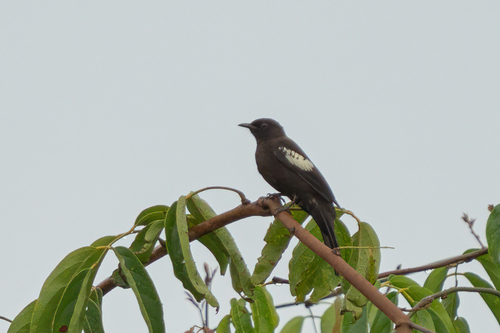 Bulbul demi-deuil
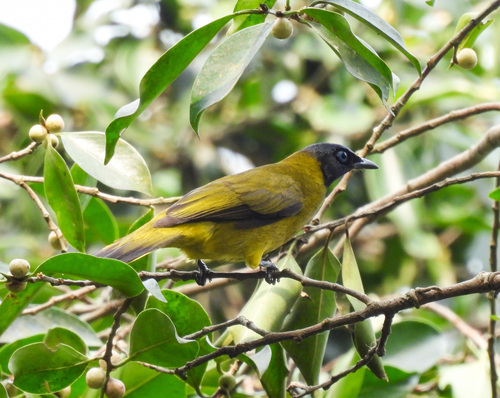 Bulbul cap-noir
En bref
The most reliable way to separate Black-and-white Bulbul from Black-headed Bulbul is by overall plumage: Black-and-white Bulbul is boldly patterned in black and white, while Black-headed Bulbul is mainly olive-yellow with a glossy black head and a broad yellow tip to the tail. Juveniles and immatures of Black-headed Bulbul may lack the full blue eye and glossy head, but never show the striking black-and-white contrast of Black-and-white Bulbul. Both species are similar in size and occur in overlapping forest habitats in Southeast Asia, so careful attention to plumage is essential. Structural differences are subtle, and habitat alone is not diagnostic.
Conseils d’identification
- Overall plumage is the fastest check: Black-and-white Bulbul is boldly black and white, with sharp contrast between the black head/upperparts and white underparts. Black-headed Bulbul is mainly olive-yellow with a glossy black head and a broad yellow tail tip.
- Head pattern: Black-and-white Bulbul has a black head that merges into black upperparts, set off by white below. Black-headed Bulbul has a glossy bluish-black head, but the rest of the body is olive-yellow or grey (in rare morphs), never white.
- Tail tip: Look for the broad yellow tip to the tail on Black-headed Bulbul—this is present in all ages and is absent in Black-and-white Bulbul.
- Body color: Black-and-white Bulbul never shows olive-yellow or grey tones; its coloration is always stark black and white. Black-headed Bulbul never shows the black-and-white contrast, even in juveniles or rare morphs.
- Juvenile/immature confusion: Young Black-headed Bulbuls may lack the adult's blue eye and glossy head, but their body is still olive-yellow or grey, not black-and-white. Juvenile Black-and-white Bulbul is still black and white.
- Flight views: No distinctive wing or upperwing patterns are described for either species, so rely on overall body and tail color in flight.
- Crest: Black-headed Bulbul never shows a crest, but this is not diagnostic against Black-and-white Bulbul, which also lacks a crest.
- Eye color: Black-headed Bulbul adults have blue eyes, but this is not reliable in juveniles and is not a safe separator in the field.
- Size and structure: Both species are similar in size and shape; do not use size as a separator.
- Habitat: Both occur in similar forest habitats in Southeast Asia; do not rely on habitat alone.
- Flock size: Black-headed Bulbul often occurs in small flocks; this is not diagnostic, but may help with context.
- Rare morphs: The rare grey morph of Black-headed Bulbul replaces olive-yellow with grey, but still lacks any black-and-white contrast and retains the yellow tail tip.
- Bill and jizz: No distinctive differences are noted in bill shape or overall structure.
- Voice: No vocal differences are described in the notes; do not use voice for separation.
- Pitfalls: The main pitfall is assuming any dark-headed bulbul is Black-headed Bulbul; always check for the yellow tail tip and olive-yellow or grey body. If the bird is sharply black and white, it is Black-and-white Bulbul.
Taille
Both species are similar in size, with Black-headed Bulbul measuring 16–18 cm in length and weighing 20–30 g [wikipedia]. No specific size data is available for Black-and-white Bulbul, but there is no indication of a significant difference between the two. Size is not a reliable field mark for separation.
Plumage
Plumage is the primary field mark: Black-and-white Bulbul of all ages shows a bold black-and-white pattern, with sharp contrast between the black head and upperparts and the white underparts and lower body. This striking pattern is unique among bulbuls in the region. In contrast, Black-headed Bulbul is mainly olive-yellow with a glossy bluish-black head and a broad yellow tip to the tail. The head is solidly dark, but the rest of the body is never black-and-white; instead, it is greenish-yellow or, rarely, grey in the uncommon grey morph. Juvenile Black-headed Bulbuls may lack the full blue eye and glossy head, but still do not show black-and-white contrast. The yellow tail tip is a key mark for Black-headed Bulbul of all ages. No age-specific wing or upperwing patterns are described for either species, so focus on overall body and tail coloration.
Comportement
Black-headed Bulbul often occurs in small flocks of 6–8 birds and feeds mainly on fruit and berries, sometimes insects. There is no specific behavioral information for Black-and-white Bulbul in the notes, and no behavioral differences are highlighted as diagnostic between the two. Both are typical forest bulbuls and may be seen foraging in the canopy or subcanopy.
Habitat
Both species inhabit forested areas in Southeast Asia. Black-and-white Bulbul is found on the Malay Peninsula, Sumatra, and Borneo in subtropical or tropical moist lowland and montane forests. Black-headed Bulbul ranges more broadly across southeastern Asia in forest habitats. Since their ranges overlap and both prefer similar forest types, habitat is not a reliable separator in the field.
Bulbul demi-deuil · Bulbul cap-noir · Mes oiseaux difficiles