

Chevêchette du Cap vs Chouette africaine
Glaucidium capense contre Strix woodfordii
Faire un quiz avec Chevêchette du Cap et Chouette africaine
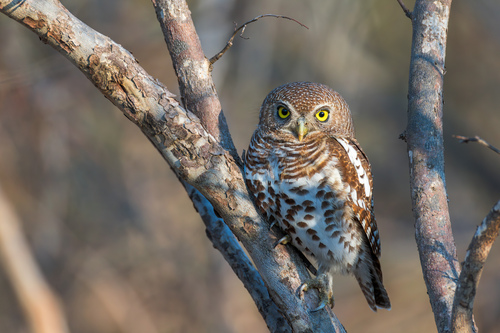 Chevêchette du Cap
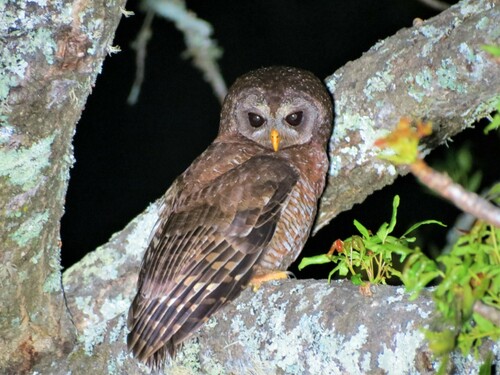 Chouette africaine
En bref
The most reliable way to separate African Barred Owlet from African Wood-Owl is by size and structure: the owlet is much smaller and more compact, while the wood-owl is medium-sized with a rounded Strix head and large dark eyes. In perched or flight views, look for the owlet’s fine barring and white-spotted wing coverts, versus the wood-owl’s overall richer brown plumage and bold white belly barring. Juvenile wood-owls are paler rufous, which can cause confusion, but their size and facial structure remain distinctive. Both species can occur in wooded habitats, so careful attention to these features is essential.
Conseils d’identification
- Size is the quickest check: African Barred Owlet is much smaller and more compact than African Wood-Owl, which is medium-sized and bulky. If you see two owls together and one is nearly twice the size, the larger is the wood-owl.
- Head and facial structure: Wood-owl has a large, rounded Strix head with big, dark eyes and prominent white eyebrows, giving it a classic 'owl face.' The owlet’s head is smaller, with a narrower white eyebrow and yellow eyes.
- Plumage on upperparts: Barred Owlet is greyish brown with fine buff bars and a white stripe across the shoulder and wing (from scapulars and coverts). Wood-owl is rich brown with white spots on the head and lacks the owlet’s white wing stripe.
- Underparts pattern: Owlet has a finely barred brown chest and white breast/flanks with brown spots. Wood-owl has a white belly with bold brown barring, and paler underparts overall.
- Bill and eye color: Owlet has a dull greenish-yellow bill and yellow eyes; wood-owl has a prominent yellow beak and large, dark eyes.
- Juvenile confusion: Juvenile wood-owls are paler rufous, but still show the large Strix head and dark eyes. Juvenile owlets resemble adults but may be even more finely barred.
- Flight views: In flight, the owlet’s small size and white wing stripe (across the shoulder) can be visible; wood-owl is much larger and lacks this feature.
- Perched behavior: Owlet often perches in the open during the day; wood-owl roosts high in dense cover and is rarely seen by day.
- Activity period: Owlet is partly diurnal and may be active or calling at dawn and dusk; wood-owl is strictly nocturnal, calling only after dark.
- Voice: If you hear a classic three-part Strix hooting duet at night, it is wood-owl. Owlet’s call is less well described here, but both sexes call at dusk/dawn.
- Habitat overlap: Both can occur in woodland, but wood-owl prefers denser forest; do not rely on habitat alone.
- Mobbed by small birds: If you see an owl being mobbed by passerines in daylight, it is more likely the owlet.
- Legs and feet: Both have yellow legs and feet, not a strong separator.
- Tail and wing shape: Owlet has a proportionally shorter tail and wings; wood-owl’s wings are broader and tail longer in proportion to its size.
- Overall impression ('jizz'): Owlet is compact, active, and alert; wood-owl is bulkier, more ponderous, and has a classic 'owl' silhouette.
Taille
African Barred Owlet is a truly small owl, about 17 cm in length and with a much lighter build (no mass given, but clearly much less than the wood-owl). African Wood-Owl is medium-sized for an African owl, measuring 30.5–35 cm in length and weighing around 299 g as an adult. In the field, the wood-owl appears nearly twice as large as the owlet, with a bulkier body, broader wings, and a much larger, rounded head. This size difference is usually obvious even at a distance or in poor light.
Plumage
Juvenile and immature plumages are most likely to cause confusion. Juvenile African Wood-Owls are paler rufous overall, but still show the large, rounded Strix head and dark eyes. Adult African Barred Owlets are greyish brown above with fine buff bars and a narrow white eyebrow, and show a distinctive white stripe across the shoulder and wing (formed by the white outer webs and dark tips of the scapulars and greater coverts). Their underparts are white with brown spots and fine barring on the chest. In contrast, adult African Wood-Owls have a generally rich brown plumage with paler underparts, a white belly with brown barring, and a dark brown head with white spots and prominent white eyebrows. The wood-owl’s face is dominated by large dark eyes and a yellow beak, while the owlet’s eyes and bill are yellowish but less striking. The wood-owl’s underparts barring is bolder and more extensive, while the owlet’s is finer and more spotty. In flight, the owlet’s smaller size and white wing stripe may be visible; the wood-owl lacks this feature.
Comportement
African Barred Owlet is partly diurnal and often seen perched openly during the day, scanning for prey or being mobbed by small birds. It may hunt in short sallies from exposed perches. African Wood-Owl, in contrast, is strictly nocturnal, roosting high in dense cover during the day, usually singly or in pairs, and only becoming active after dusk. You are unlikely to see a wood-owl perched in the open during daylight. Both species nest in tree cavities, but the owlet is more likely to be detected by its daytime activity.
Habitat
Both species inhabit wooded areas across much of sub-Saharan Africa, and their ranges overlap in many regions. African Barred Owlet is found in a variety of wooded habitats, including open woodland and forest edge, while African Wood-Owl is more strictly associated with denser forests and mature woodland. However, habitat alone is not diagnostic where ranges overlap, so always confirm with structural and plumage features.
Voix
African Barred Owlet calls mainly at dusk and dawn, with both sexes calling to proclaim territory, but details of its call are not provided here. African Wood-Owl has a distinctive song: a duet of rapid, clear hoots from the male and higher, more leisurely hoots from the female, often in a three-part rhythm (WHU-hu, WHU-hu-hu, hu-hu). The wood-owl’s call is loud, far-carrying, and usually heard after dusk. If you hear a classic Strix hooting duet at night, it is almost certainly African Wood-Owl.
Chevêchette du Cap · Chouette africaine · Mes oiseaux difficiles