

Ermitaño Gorjiestriado vs Colibrí Hada Occidental
Phaethornis striigularis frente a Heliothryx barroti
Juega un quiz con Ermitaño Gorjiestriado y Colibrí Hada Occidental
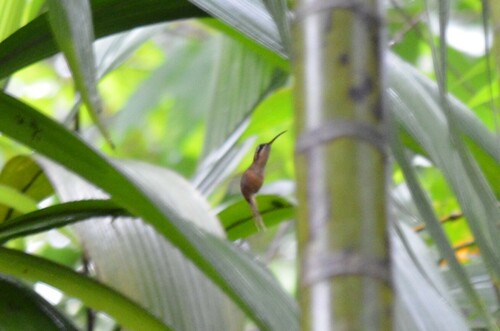 Ermitaño Gorjiestriado
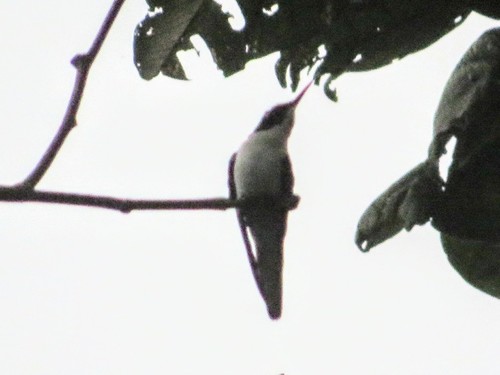 Colibrí Hada Occidental
En breve
The most reliable field mark to separate Stripe-throated Hermit from Purple-crowned Fairy is overall structure and face pattern: the hermit is a small, drab, long-billed hummingbird with a strong black-and-white facial mask and faintly streaked throat, while the fairy is a larger, slender, short-billed species with a striking white belly, emerald upperparts, and (in males) a metallic violet crown. Juvenile Purple-crowned Fairies show cinnamon-edged upperparts and sparse dusky spots below, unlike any hermit. In flight or perched, the fairy’s long, pointed, white-edged tail and pure white underparts stand out, while the hermit’s tail is shorter, more rounded, and tipped ochraceous or whitish. Bill shape (long, decurved in hermit vs short, straight in fairy) is a key separator at all ages. Both species have a dark eye-stripe, but only the hermit has a strong malar and supercilium. Sexes are similar in the hermit, but fairy males have a vivid violet crown.
Consejos de identificación
- Bill shape and length: Stripe-throated Hermit has a long, strongly decurved bill with a yellowish base to the lower mandible; Purple-crowned Fairy has a short, straight, all-black bill. This is the most consistent structural separator at all ages and sexes.
- Tail shape and pattern: The fairy’s tail is long, pointed, and sharply patterned with blue-black central feathers and white outer feathers; the hermit’s tail is shorter, more rounded, and tipped whitish to ochraceous (never with bold white outers). Tail pattern is especially clear in flight or when the bird fans its tail.
- Underparts color: Stripe-throated Hermit has buff flanks and a pale greyish-brown throat and belly, often with faint dark streaks on the throat; Purple-crowned Fairy has pure white underparts with no buff or brown wash in adults. Immature fairies may show sparse dusky spots on the white throat and breast, but never the streaked or brownish look of the hermit.
- Facial pattern: Hermit shows a strong black mask bordered above by a whitish-buff supercilium and below by a whitish-buff malar stripe, giving a three-part face; fairy has a black eye-stripe but lacks the bold supercilium and malar, and the face is cleaner and whiter below the eye.
- Crown color (males): Male Purple-crowned Fairy has a metallic violet forecrown and a violet spot behind the eye; Stripe-throated Hermit never shows violet on the head. Female fairy has a green crown, lacking violet, but still differs from the hermit’s dull green crown.
- Upperparts: Hermit is dull iridescent green above with a pale rufous rump; fairy is bright emerald green above with no rufous rump. Juvenile hermits have a pale rufous back, while immature fairies have cinnamon-edged upperparts.
- Size and jizz: The fairy is larger, more slender, and longer-tailed, often appearing more elongated in flight or perched. The hermit is smaller, compact, and has a more hunched posture.
- Flight style: Hermits tend to fly low and direct, often close to vegetation; fairies may forage higher and appear more buoyant or agile in the mid-story and canopy.
- Juvenile/immature marks: Juvenile hermits have a pale rufous back; immature fairies have cinnamon fringes on upperparts and sparse dusky spots on the white throat and breast. These age-specific marks are diagnostic if seen well.
- Throat pattern: Hermit’s throat is pale greyish-brown with faint dark streaks (sometimes hard to see); fairy’s throat is pure white in adults, with only sparse dusky spots in immatures.
- Bill base color: Hermit shows yellow at the base of the lower mandible; fairy’s bill is entirely black.
- Tail tip color: Hermit’s tail is tipped whitish to ochraceous (never pure white outer feathers); fairy’s tail has white outer feathers and blue-black central feathers.
- Vocalizations: If you hear a high-pitched, squeaky, monotonous song from a lek, suspect Stripe-throated Hermit. Fairy’s song is not described here.
- Habitat context: In dense understory or low forest, hermit is more likely; in mid-story or canopy, especially at forest edge, fairy is more likely.
- Sex differences: Hermit sexes are virtually identical; fairy males have a violet crown, females have a green crown and less facial black, but both differ from hermit’s facial pattern.
Tamaño
Stripe-throated Hermit is significantly smaller and lighter (9–10 cm, 2–3 g) than Purple-crowned Fairy (9–13 cm, about 5.5 g). While their minimum lengths overlap, the fairy is usually noticeably longer and almost twice as heavy. The fairy is also more slender and elongated in appearance, with a longer, more pointed tail. The hermit is compact, with a shorter, more rounded tail and a proportionally longer, decurved bill.
Plumaje
Juvenile and immature birds are best separated by upperpart and underpart pattern: young Stripe-throated Hermits have a pale rufous back, while immature Purple-crowned Fairies show cinnamon fringes on the upperparts and sparse dusky spots on the white throat and breast. In adults, the hermit is dull green above with a pale rufous rump, buff flanks, and a pale grey-brown throat with faint dark streaks; the fairy is bright emerald green above, pure white below, and has a long, pointed tail with blue-black central feathers and white outers. The hermit’s face has a black mask bordered by a whitish supercilium and malar, while the fairy’s face has a black eye-stripe but lacks the strong malar and supercilium. Male Purple-crowned Fairies have a metallic violet forecrown and a violet spot behind the eye, absent in hermits. The hermit’s tail is tipped whitish to ochraceous, while the fairy’s tail is sharply patterned with white outer feathers.
Comportamiento
Stripe-throated Hermit is typically solitary but males may gather in leks to sing. It forages low to mid-level, often in the understory. Purple-crowned Fairy is more likely to be seen in the mid-story and canopy, sometimes coming lower at forest edges. The fairy is not highly territorial but is notably aggressive, often confronting other hummingbirds. It forages by hovering and gleaning, and may rob nectar by piercing flowers. The hermit’s foraging is more typical of hermits, with less aggression and more solitary behavior.
Hábitat
Both species occur in Central America and northwestern South America, but their microhabitat preferences differ. Stripe-throated Hermit favors low to mid-level forest understory and edges, while Purple-crowned Fairy is more often in the mid-story and canopy, especially at forest edges. The fairy may be seen higher in the forest strata than the hermit. Both can occur in similar regions, but the hermit is more tied to dense, lower vegetation.
Voz
Stripe-throated Hermit males sing a high-pitched, squeaky, monotonous song, easily overheard at leks. The Purple-crowned Fairy’s vocalizations are not described in the provided notes. Thus, a persistent, high, squeaky song in the area may point to a hermit, especially if heard from a lek.
Ermitaño Gorjiestriado · Colibrí Hada Occidental · Mis aves difíciles