

Golondrina Sureña vs Golondrina Parda
Progne elegans frente a Progne tapera
Juega un quiz con Golondrina Sureña y Golondrina Parda
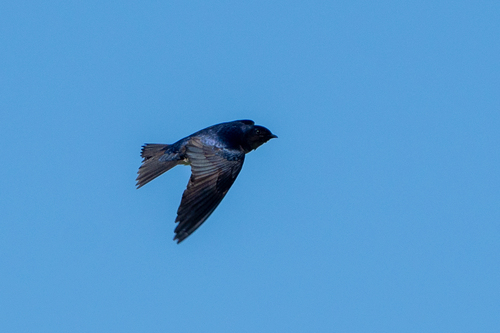 Golondrina Sureña
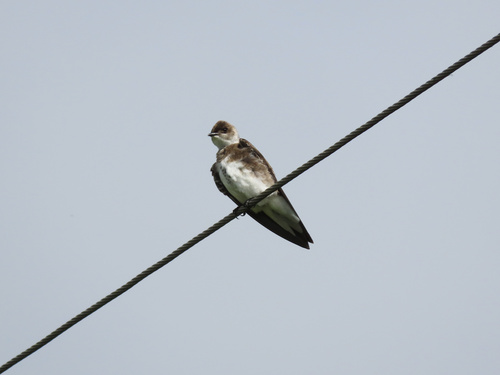 Golondrina Parda
En breve
The best field mark to separate Southern Martin from Brown-chested Martin is overall color: adult male Southern Martins are glossy steel-blue above, while Brown-chested Martins of all ages are sandy brown above with a white throat and a brown breast band. Females and juveniles of Southern Martin are duller blue above with dusky brown underparts and a scaly look, still never sandy brown. Brown-chested Martin is smaller, paler below, and shows a less deeply forked tail. Juvenile Brown-chested Martins have a more squared tail and a grey-brown wash on the throat, while Southern Martin juveniles resemble dull adult females but are never sandy brown. Both species can be seen in open areas, but Southern Martin is heavier and bulkier.
Consejos de identificación
- Adult male Southern Martin is glossy steel-blue above and blackish on wings/tail; Brown-chested Martin is always sandy brown above, never blue. This is the most reliable mark for adult males.
- Female and juvenile Southern Martins are duller steel-blue above with dusky brown underparts and a scaly appearance; they are never sandy brown. Brown-chested Martins of all ages are sandy brown above with white underparts and a brown breast band.
- Juvenile Brown-chested Martin has a more squared tail and a grey-brown wash on the throat; Southern Martin juveniles have a deeply forked tail and lack the sandy brown tones.
- Tail shape is a strong clue: Southern Martin of all ages shows a deeply forked tail, while Brown-chested Martin's tail is only slightly forked (and more squared in juveniles).
- Underparts: Brown-chested Martin has a white chin and throat with a brown breast band (sometimes indistinct), while Southern Martin females and juveniles have dusky brown underparts with pale feather edges, giving a scaly look.
- Southern Martin is bulkier and heavier (51 g vs. 30–40 g), and slightly longer (17–20 cm vs. 16–18 cm), but this is subtle unless seen side by side.
- Brown-chested Martin's wings and tail are darker brown than its sandy brown upperparts; Southern Martin's wings/tail are blackish, contrasting with blue upperparts in males.
- Brown-chested Martin's breast band is a key mark; Southern Martin never shows a true breast band.
- If you hear a harsh, guttural, rolling trill or a dry, buzzy call, you are likely hearing Brown-chested Martin; Southern Martin's voice is not described here.
- Both species can be found in open country, near water, or even urban areas, so habitat is not a reliable separator.
- Sexes are similar in Brown-chested Martin, but Southern Martin is sexually dimorphic: only males are glossy blue.
- Brown-chested Martin may forage lower and in smaller groups, but this is not a strong field mark.
- If you see a martin with a sandy brown back and a white throat, it is Brown-chested Martin; if the back is blue (even dull), it is Southern Martin.
- Juvenile Brown-chested Martin's grey-brown throat wash is unique; Southern Martin juveniles never show this.
- In flight, focus on tail depth and overall color: deep fork and blue gloss (Southern), shallow fork and sandy brown (Brown-chested).
Tamaño
Southern Martin is the larger and heavier species, with a body mass of about 51 g, compared to Brown-chested Martin's 30–40 g. Southern Martin measures 17–20 cm in length, while Brown-chested Martin is slightly smaller at 16–18 cm. In the field, Southern Martin appears bulkier and more robust, with a deeper forked tail, whereas Brown-chested Martin is more slender and has a shallower fork in the tail. These differences may be subtle at a distance but become more apparent with prolonged views or when the two species are side by side.
Plumaje
- Juveniles: Juvenile Southern Martins resemble adult females: dull steel-blue above, dusky brown below with pale feather edges creating a scaly effect, and white undertail coverts with dusky streaks. Juvenile Brown-chested Martins have sandy brown upperparts, a white throat with a grey-brown wash on the sides, and a more squared tail than adults.
- Adult males: Southern Martin males are glossy steel-blue above with blackish wings and tail, never brown. Brown-chested Martin adults (both sexes) are sandy brown above, with a white chin and throat, and a brown breast band. Their tail is only slightly forked and darker brown than the upperparts.
- Adult females: Female Southern Martins are duller steel-blue above (never sandy brown), with dusky brown underparts and a scaly look; Brown-chested Martin females are not separable from males and share the sandy brown and white pattern.
- Tail: Southern Martin of all ages has a deeply forked tail, while Brown-chested Martin's tail is only slightly forked (and juvenile Brown-chested Martin's tail is more squared).
Comportamiento
Both species are aerial insectivores, often seen flying over open areas, water, or fields. Brown-chested Martin often forages singly or in small flocks, flying fast and low over vegetation and water, but can also fly higher when feeding on swarming insects. Southern Martin's behavior is less specifically described, but as a Progne martin, it is likely to be seen in similar open habitats, sometimes near human structures. No major behavioral differences are noted that are diagnostic in the field.
Hábitat
Both species are widespread across South America, with Southern Martin absent from Colombia, Guyana, and Venezuela, and Brown-chested Martin absent from Chile. Both can occur as vagrants outside their main range. Southern Martin breeds in cavities in banks, cliffs, trees, and buildings, while Brown-chested Martin is often found in open country, near water, and sometimes in urban areas. Habitat overlap is extensive, so context is not a reliable separator.
Voz
Only Brown-chested Martin's voice is described: its song is harsh and guttural, with liquid, rolling, descending trills (e.g., trr-tee-tuk-TEEERRR), and its calls are a dry, buzzy 'djzeut' and a more musical 'dureet'. Southern Martin's vocalizations are not described in the available notes, so voice is only useful if Brown-chested Martin's distinctive calls are heard.