

Columbina Colorada vs Tortolita Azulada
Columbina talpacoti frente a Claravis pretiosa
Juega un quiz con Columbina Colorada y Tortolita Azulada
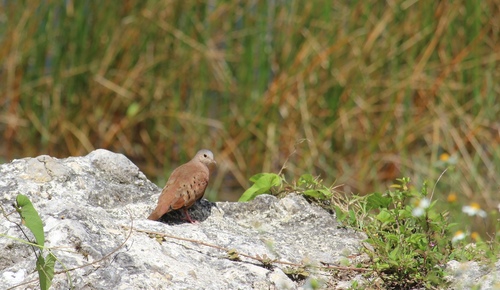 Columbina Colorada
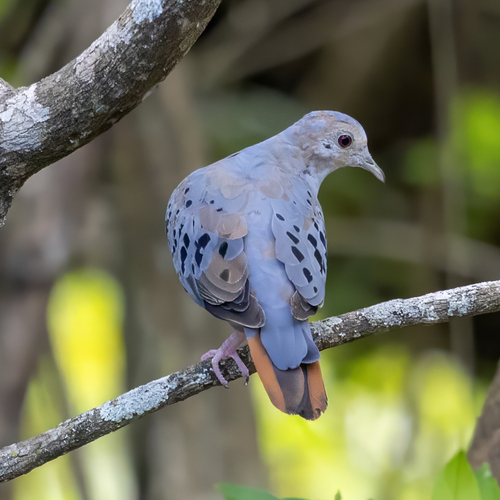 Tortolita Azulada
En breve
The most reliable field mark between Ruddy Ground Dove and Blue Ground Dove is the color and pattern of the wing spots: Ruddy Ground Dove (all ages/sexes) shows black spots on the wing coverts, while Blue Ground Dove has chestnut-brown spots (female/immature) or bold black spots often forming bands (male). Adult males are easily separated by overall color—Ruddy is rich rufous with a pale gray head, Blue is blue-grey throughout. Females and immatures are trickier, but Blue Ground Dove females have a chestnut rump and tail, and chestnut (not black) wing spots. Blue Ground Dove is also noticeably larger and bulkier. In flight or perched, focus on wing spot color and overall size for the quickest separation.
Consejos de identificación
- Wing spot color (all ages): Ruddy Ground Dove always shows black spots on the wing coverts; Blue Ground Dove has chestnut-brown spots (female/immature) or bold black spots (male) that may form bands. This is the fastest field mark, especially in flight or perched birds with wings exposed.
- Overall size and bulk: Blue Ground Dove is significantly larger and heavier. If two similar doves are together, the bulkier one is likely Blue.
- Adult male coloration: Ruddy Ground Dove males are rich rufous above with a pale gray head; Blue Ground Dove males are blue-grey throughout with a paler face. This is a strong separator in good light.
- Female/immature upperparts: Female Ruddy Ground Dove is plain brown overall, with little contrast between head and body. Female Blue Ground Dove has a grey-brown head/neck/breast, rufous-brown back, and a contrasting chestnut rump and tail.
- Tail color and shape: Blue Ground Dove females show a chestnut rump and tail; Ruddy Ground Dove has a short tail with black edges, lacking chestnut tones.
- Underwing color (female Blue): Female Blue Ground Dove shows pale blue-grey underwings and belly, unlike the uniformly brownish underparts of Ruddy Ground Dove.
- Juvenile scaling: Young Blue Ground Doves have ruddy scaling on the back; Ruddy Ground Dove juveniles do not.
- Iris and bare parts: Blue Ground Dove has a red or yellow iris and green eyering; Ruddy Ground Dove's bare parts are less distinctive in the field.
- Aggression and behavior: Ruddy Ground Dove is often seen displaying or fighting with raised wings, especially among males. This behavior is less noted in Blue Ground Dove.
- Habitat context: In urban parks, gardens, or city centers, Ruddy Ground Dove is more likely. In woodland edges or less disturbed open areas, Blue Ground Dove is more probable.
- Flight style: Both species have fast, direct flight, but Blue Ground Dove may appear heavier in flight due to its size.
- Sexual dimorphism: Both species show sexual differences, but the contrast is sharper in Ruddy Ground Dove (male rufous, female brown) than in Blue Ground Dove (male blue-grey, female brown/blue-grey mix).
- Group association: Ruddy Ground Dove often feeds in groups, sometimes with feral pigeons; Blue Ground Dove is less likely to be seen in large urban flocks.
- Wing display: When sunbathing or displaying, Ruddy Ground Dove may show a large area of black underwing feathers, which can be a clue if observed.
- Pitfall—female confusion: Female/immature Blue Ground Dove can be mistaken for female Ruddy Ground Dove, but focus on the chestnut (not black) wing spots and the chestnut rump/tail to avoid this mix-up.
Tamaño
Blue Ground Dove is distinctly larger and heavier: average body mass is about 69 g versus 46.5 g for Ruddy Ground Dove [wikidata]. Blue Ground Dove is also longer (20 cm) compared to Ruddy Ground Dove (17 cm). In the field, Blue Ground Dove appears bulkier and more robust, while Ruddy Ground Dove is noticeably smaller and more delicate.
Plumaje
-
Juvenile/immature and female comparison: Both species have brownish females and immatures, but Ruddy Ground Dove always shows black spots on the wing coverts, while Blue Ground Dove females/immatures have chestnut-brown spots. Blue Ground Dove females also show a rufous-brown back with a contrasting chestnut rump and tail, and a pale blue-grey belly and underwings. Young Blue Ground Doves have ruddy scaling on the back, which is absent in Ruddy Ground Dove.
-
Adult males: Ruddy Ground Dove males are rich rufous above with a pale gray head and black-spotted wing coverts; underparts are paler brown. Blue Ground Dove males are blue-grey above and below, with blackish flight feathers and outer tail, and bold black spots (often forming bands) on the wings. The face is paler grey-white in Blue Ground Dove males.
-
In flight: Both species show spotted wings, but the spot color is diagnostic: black in Ruddy, chestnut or black (depending on sex) in Blue. Blue Ground Dove males may show more extensive and banded spotting. The tail of Blue Ground Dove is longer and has chestnut tones (female), while Ruddy Ground Dove has a short tail with black edges.
Comportamiento
Both species are ground-foraging doves, but Ruddy Ground Dove is more aggressive and territorial, especially among males, often seen displaying or fighting with raised wings. Blue Ground Dove is less described in terms of aggression, but both can be seen feeding on the ground in open areas. Ruddy Ground Dove is often more approachable and tolerant of human presence, especially in urban settings.
Hábitat
Ruddy Ground Dove is highly adaptable and common in open country, farmland, and urban areas, often feeding alongside feral pigeons. It thrives in disturbed habitats and has expanded with deforestation and urbanization. Blue Ground Dove also occurs in open and semi-open areas but is less associated with urban environments and more likely in forest edges, clearings, and woodland. Where both occur, Ruddy Ground Dove is more likely in city parks and gardens, while Blue Ground Dove prefers less disturbed, more wooded habitats.
Voz
Ruddy Ground Dove has a soft, cur-WOO cooing call. No distinctive vocalization is provided for Blue Ground Dove in the sources, so voice is not a reliable separator here.