

Camachuelo Picogrueso vs Piquituerto Aliblanco
Pinicola enucleator frente a Loxia leucoptera
Juega un quiz con Camachuelo Picogrueso y Piquituerto Aliblanco
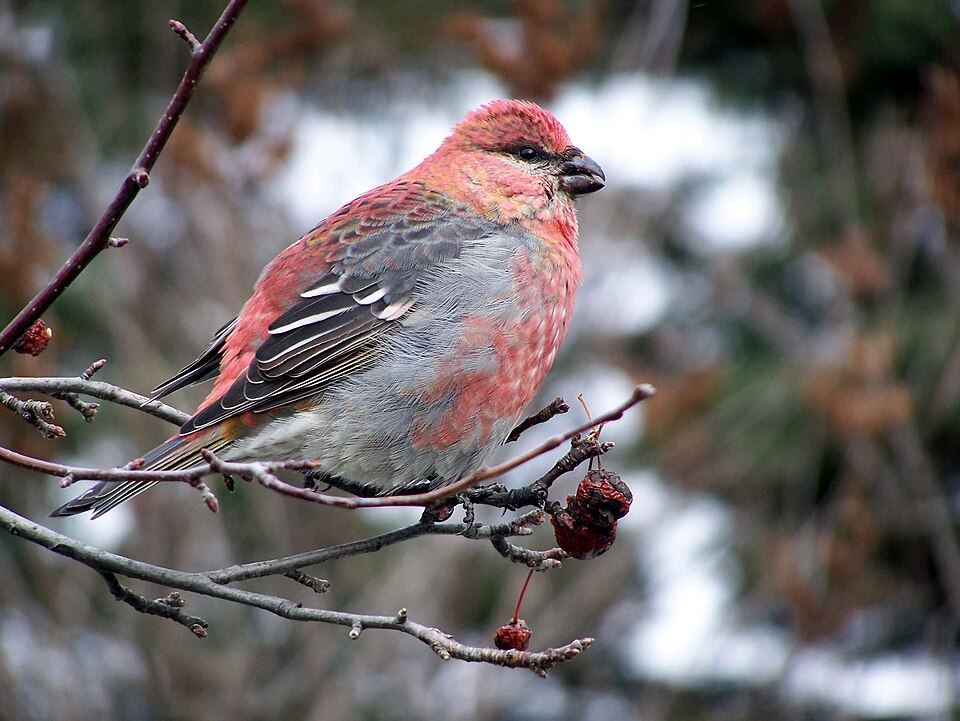 Camachuelo Picogrueso
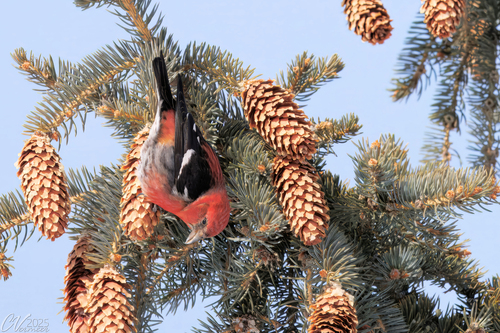 Piquituerto Aliblanco
En breve
The most reliable field mark between Pine Grosbeak and Two-barred Crossbill is the presence of bold white wingbars on the Two-barred Crossbill, visible on all ages and especially striking in flight; Pine Grosbeak also has wingbars, but they are less prominent and the overall wing pattern is plainer. Structurally, Pine Grosbeak is much larger and bulkier with a thick, straight conical bill, while Two-barred Crossbill is smaller, slimmer, and has a distinctive crossed bill. Adult males of both species can be red, but Pine Grosbeak males are rose-red and larger, while Two-barred Crossbill males are smaller and raspberry-red with a more contrasting wing pattern. Females and immatures of both species are yellowish or olive, but Pine Grosbeak is always much bulkier and lacks the crossbill's white wingbars. If you see a large, slow-moving, bullfinch-like finch with a plain wing and thick bill, it's a Pine Grosbeak; a smaller, active, sharp-billed bird with two white wingbars is a Two-barred Crossbill.
Consejos de identificación
- White wingbars: Two-barred Crossbill of all ages and sexes shows two bold white wingbars and white tertial tips, visible both perched and in flight. Pine Grosbeak has white wingbars, but they are less bold and lack the crisp tertial tips; overall, the wing is much plainer.
- Bill shape: Pine Grosbeak has a thick, straight, conical bill; Two-barred Crossbill has a slender, crossed bill. The crossbill's unique bill shape is diagnostic at close range but can be hard to see at distance or in poor light.
- Size and structure: Pine Grosbeak is much larger and bulkier, with a heavy body, large head, and long tail. Two-barred Crossbill is smaller, slimmer, and more active, with a shorter tail and smaller head.
- Adult male color: Pine Grosbeak males are rose-red with a uniform wash over head, back, and rump. Two-barred Crossbill males are raspberry-red, often brighter and more pinkish, with stronger contrast between the red body and blackish wings/wingbars.
- Female/immature color: Both species can show yellowish or olive tones in females and immatures, but Pine Grosbeak is always bulkier and lacks the crossbill's white wingbars. Two-barred Crossbill females are greenish-yellow above but always show the wingbars.
- Wing pattern in flight: Two-barred Crossbill's white wingbars and tertial tips are obvious in flight, making a strong contrast with the blackish wing. Pine Grosbeak's wing is more uniform, with less contrast.
- Tail: Both have forked tails, but Pine Grosbeak's is longer and more robust; this is subtle and best used in combination with other marks.
- Behavior: Pine Grosbeak is slow, tame, and often sits upright for long periods. Two-barred Crossbill is active, acrobatic, and often feeds hanging from cones.
- Flock size: Two-barred Crossbill often forms large, noisy flocks, especially in irruption years. Pine Grosbeak is more often in small groups or pairs.
- Habitat: Both in conifers, but Pine Grosbeak can be found in more varied habitats in winter, including urban areas. Two-barred Crossbill is more strictly tied to conifer stands.
- Vocalizations: Pine Grosbeak gives a slow, whistled call and a short warble; Two-barred Crossbill has a higher, weaker chip call. Listen for differences if the birds are not seen well.
- Jizz: Pine Grosbeak gives a bullfinch-like impression: big, heavy, slow. Two-barred Crossbill is more like a small finch: quick, agile, and energetic.
- Pitfalls: Some Red Crossbills can show faint wingbars, but never as bold as Two-barred Crossbill. Pine Grosbeak never shows the crisp white tertial tips or the strong double wingbar.
- Age confusion: Immature Pine Grosbeaks are shaggier and plainer, lacking any strong wing pattern; immature Two-barred Crossbills always show the white wingbars.
- Sex confusion: Both species' females are duller, but structure and wing pattern remain reliable for separation.
Tamaño
Pine Grosbeak is substantially larger, measuring 20–25.5 cm in length and weighing 52–78 g (average 56.4 g) [wikipedia]. In contrast, Two-barred Crossbill is much smaller at 14.5–17 cm and 25–40 g [wikipedia]. In the field, Pine Grosbeak appears bulky and heavy-bodied, with a large head and thick, straight bill. Two-barred Crossbill is noticeably more petite, with a smaller head and a slender, crossed bill. The size difference is usually obvious if seen side-by-side or with familiar species for scale.
Plumaje
- Juveniles/immatures: Both species have less contrasting plumage when young, but Two-barred Crossbill always shows two bold white wingbars and white tertial tips, even in immature plumages. Pine Grosbeak immatures are overall shaggier and plainer, with less distinct wingbars and no white tertial tips.
- Adult males: Pine Grosbeak males are rose-red on the head, back, and rump, with black wings and tail and a large conical bill. Their wingbars are present but not as sharply defined as on the crossbill. Two-barred Crossbill males are raspberry-red on the head and upperparts, with blackish scapulars edged pink and two prominent white wingbars. Their wings also show white tertial tips, making the pattern much more striking in flight or at rest.
- Adult females: Pine Grosbeak females are olive-yellow on the head and rump, grey on the back and underparts, and lack any strong wing pattern. Two-barred Crossbill females are greenish-yellow above but always show the two white wingbars and white tertial tips.
- Bill: Pine Grosbeak has a thick, straight, conical bill; Two-barred Crossbill has a slender, crossed bill, which is diagnostic at close range.
- Tail: Both species have forked tails, but Pine Grosbeak's is longer and more robust.
Comportamiento
Pine Grosbeak is slow-moving, often feeding quietly in small groups or pairs, sometimes appearing tame and sluggish. They perch upright and move deliberately. Two-barred Crossbill is much more active, often seen in flocks, moving restlessly among conifers, and frequently hanging upside down to extract seeds. Their flight is more bounding and energetic compared to the grosbeak's slower, more direct flight.
Hábitat
Both species are associated with coniferous forests in the northern latitudes of North America and the Palearctic [wikipedia]. However, Pine Grosbeak is more likely to be found in denser, mature conifer woods and sometimes ventures into open woods or even urban areas in winter. Two-barred Crossbill is more strictly tied to conifer stands, especially spruce and larch, and is more likely to form large, wandering flocks, especially during irruptions.
Voz
Pine Grosbeak gives a whistled "pui pui pui" or "chii-vli" and a short, musical warble as its song [wikipedia]. Two-barred Crossbill has a weaker, higher-pitched chip call compared to Red Crossbill; its calls are generally sharper and more finch-like. The difference in calls can be useful if birds are not seen well, but both species can be quiet when feeding.
Camachuelo Picogrueso · Piquituerto Aliblanco · Mis aves difíciles