

Perico de las Chatham vs Perico Multicolor
Cyanoramphus forbesi frente a Platycercus eximius
Juega un quiz con Perico de las Chatham y Perico Multicolor
 Perico de las Chatham
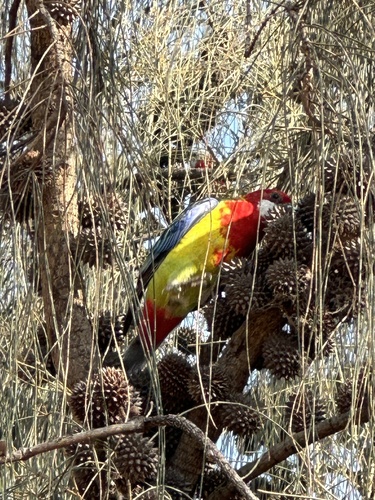 Perico Multicolor
En breve
The most reliable field mark separating Chatham Islands Parakeet from Eastern Rosella is the head and face pattern: Forbes’ Parakeet (Chatham Islands Parakeet) shows a golden-yellow forecrown and red band across the forehead, with green lores and orange-red eyes, while Eastern Rosella has a bright red head and white cheek patches. In flight or at rest, Eastern Rosella’s bold, multicolored plumage with a scalloped black-and-yellow back and blue wings is unmistakable compared to the more uniform green of Forbes’ Parakeet. Juvenile Eastern Rosellas are duller but still show the white cheek patch and underwing stripe, features never present in Forbes’ Parakeet. Structure and size also differ: Eastern Rosella is larger and stockier, with a broader tail and heavier bill. Habitat is a strong clue in New Zealand: Forbes’ Parakeet is restricted to the Chatham Islands, while Eastern Rosella is established only in parts of the main islands.
Consejos de identificación
- Head pattern: Forbes’ Parakeet always shows a golden-yellow forecrown with a red band across the forehead (not reaching the eyes), and green lores. Eastern Rosella has a bright red head and upper breast with a large, clean white cheek patch—never seen in Forbes’ Parakeet.
- Cheek color: The white cheek patch is diagnostic for Eastern Rosella of all ages and sexes. Forbes’ Parakeet always has green lores and no white on the face.
- Underwing stripe: Female and juvenile Eastern Rosellas have a pale underwing stripe visible in flight or when stretching wings. Forbes’ Parakeet never shows an underwing stripe at any age.
- Back pattern: Eastern Rosella’s back is black with yellowish or greenish scalloped margins, giving a scaly look. Forbes’ Parakeet’s back is plain green with no scalloping.
- Body color: Forbes’ Parakeet is largely bright green with some red on the sides of the rump and violet-blue outer primaries. Eastern Rosella is a patchwork of red, yellow, green, blue, and black, with a pale or bluish-green rump depending on subspecies.
- Wing color: In flight, Eastern Rosella shows blue wings and lateral tail feathers, contrasting with the green body and red head. Forbes’ Parakeet has green wings with only the outer primaries and coverts violet-blue.
- Tail: Eastern Rosella’s tail is broader and dark green, while Forbes’ Parakeet’s tail is long and more slender.
- Bill size and color: Eastern Rosella has a stouter, white bill; Forbes’ Parakeet’s bill is smaller and more delicate, with females having the smallest bills.
- Eye color: Forbes’ Parakeet has orange-red eyes, while Eastern Rosella’s irises are brown. This is subtle but can help at close range.
- Sexual dimorphism: Both species show only slight differences between sexes, but female rosellas are duller and have the underwing stripe; female Forbes’ Parakeet is just slightly smaller and duller.
- Juvenile confusion: Juvenile Eastern Rosellas are duller but still show white cheeks and underwing stripe. Juvenile Forbes’ Parakeet looks like a duller adult, with no white cheek or underwing stripe.
- Habitat: Forbes’ Parakeet is only found on the Chatham Islands, in dense forest or shrubland. Eastern Rosella is found in open habitats on New Zealand’s main islands.
- Behavior: Rosellas are often seen feeding on the ground or perched in the open, while Forbes’ Parakeet is more secretive and stays in cover.
- Flight style: Eastern Rosella’s flight is strong and direct, often showing blue wings and white cheeks. Forbes’ Parakeet’s flight is more agile and less showy.
- Location clue: If you are birding on the Chatham Islands, any parakeet is likely Forbes’ Parakeet. On the main islands, a multicolored parrot with a red head and white cheeks is Eastern Rosella.
Tamaño
Eastern Rosella is the larger and heavier of the two, reaching about 30 cm in length, while Forbes’ Parakeet is medium-sized for a parakeet but noticeably smaller and slimmer than a rosella. The rosella has a bulkier build, broader tail, and stouter bill, whereas Forbes’ Parakeet is more slender overall. Female Forbes’ Parakeet is slightly smaller than the male, but both sexes are still smaller than any Eastern Rosella. These size differences are most obvious when both species are seen together, but may be subtle at a distance or with lone birds.
Plumaje
- Juvenile/Early Age: Juvenile Eastern Rosellas are duller than adults but still show the white cheek patch and a diagnostic underwing stripe, which is never present in Forbes’ Parakeet at any age. Forbes’ Parakeet juveniles resemble adults, with green lores and a yellow forecrown, lacking any white on the face or underwing.
- Adult: Forbes’ Parakeet is bright green overall with a golden-yellow forecrown and a narrow red band across the forehead (not reaching the eyes), green lores, and some red on the sides of the rump. The outer primaries and wing coverts are violet-blue, but the wings are otherwise green. Eastern Rosella adults are much more colorful: a bright red head and upper breast, white cheek patches, yellow lower breast fading to pale green on the belly, black back feathers with yellow or greenish margins (scalloped look), blue wings, and a dark green tail. The rump color varies by subspecies but is always paler or bluish-green, never red or yellow. Female rosellas are duller but retain the same pattern; Forbes’ Parakeet females are only slightly duller and smaller than males.
- Flight: In flight, Eastern Rosella’s blue wings and white cheeks are obvious, and the underwing stripe is visible in females and juveniles. Forbes’ Parakeet in flight shows a mostly green wing with violet-blue outer primaries, lacking any bold white or blue panels or underwing stripes.
Comportamiento
Eastern Rosellas are often seen feeding on the ground or in open areas, and their flight is strong and direct with rapid wingbeats, often showing off their blue wings and white cheeks. They may perch conspicuously in trees or on wires. Forbes’ Parakeet is more secretive, usually staying in dense vegetation, and is less likely to be seen in open areas. Their flight is agile but less showy, and they often remain partially hidden when perched.
Hábitat
Forbes’ Parakeet is strictly endemic to the Chatham Islands and is not found on New Zealand’s main islands, preferring dense forest and shrubland habitats. Eastern Rosella, on the other hand, is established in the North Island (especially the northern half, Taranaki, Waikato, Hutt Valley) and some areas around Dunedin in the South Island, favoring open woodlands, parks, gardens, and farmland. If you see a parakeet in the Chatham Islands, it is almost certainly Forbes’ Parakeet; on the main islands, a multicolored parrot with a red head and white cheeks is Eastern Rosella.
Perico de las Chatham · Perico Multicolor · Mis aves difíciles