

Witwenpfeifgans vs Kronenflughuhn
Dendrocygna viduata gegen Pterocles coronatus
Ein Quiz mit Witwenpfeifgans und Kronenflughuhn spielen
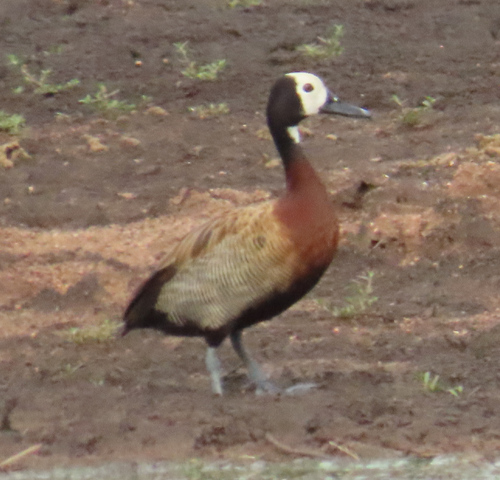 Witwenpfeifgans
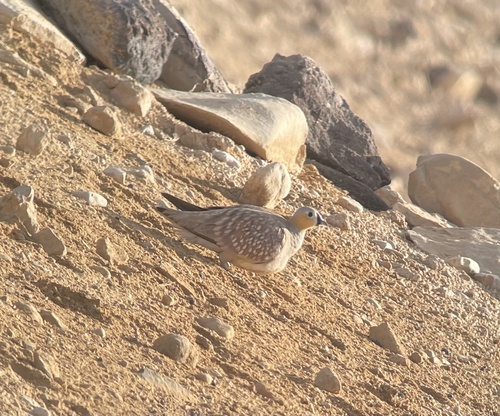 Kronenflughuhn
Kurz gesagt
The most reliable field mark to separate White-faced Whistling-Duck from Crowned Sandgrouse is the duck’s striking white face and black neck, which are never shown by sandgrouse of any age. In flight, the sandgrouse shows wholly dark flight feathers contrasting with sandy upperwings and creamy underwings, while the whistling-duck’s wings are dark overall with less contrast. Structure is also key: the whistling-duck is much heavier-bodied with a long neck and bill, while the sandgrouse is compact, short-necked, and pigeon-like. If you’re unsure, check for flocking behavior and habitat—whistling-ducks gather in large, noisy groups at wetlands, while sandgrouse are quiet, often in small groups, and strictly desert birds.
Bestimmungstipps
- White face and black neck (all ages): Only White-faced Whistling-Duck shows a clean white face and black neck; Crowned Sandgrouse never shows this, regardless of age or sex.
- Juvenile head pattern: Juvenile whistling-ducks have a duller, less contrasting white face, but still show some pale on the face and a dark neck; juvenile sandgrouse never show white on the face or neck.
- Upperwing in flight (all ages): Crowned Sandgrouse has wholly dark flight feathers sharply contrasting with sandy upperwing coverts and creamy underwing coverts—look for this contrast in any flying sandgrouse. Whistling-ducks have dark wings overall with less contrast between coverts and flight feathers.
- Body structure: Whistling-ducks are long-necked, long-legged, and heavy-bodied, with a long grey bill. Sandgrouse are compact, short-necked, and have a small, pigeon-like bill.
- Bill shape: The duck’s bill is long and grey, suited for dabbling; sandgrouse have a short, stubby bill for picking seeds.
- Plumage below: Whistling-ducks have black underparts with fine white barring on the flanks; sandgrouse have sandy or creamy underparts with dark vermiculations (never barred or black).
- Male sandgrouse mask: Adult male Crowned Sandgrouse has a black mask, but this is not as extensive as the duck’s black neck and is never combined with a white face.
- Sexes: Both whistling-duck sexes look alike; in sandgrouse, only males have a black mask, females and immatures lack it but still never show white on the face.
- Flocking behavior: Whistling-ducks are often in large, noisy flocks at wetlands; sandgrouse are in small, quiet groups in deserts.
- Habitat: Wetland = whistling-duck; stony desert = sandgrouse. If you see the bird on water, it is a whistling-duck.
- Flight posture: Whistling-ducks fly with neck outstretched; sandgrouse fly with neck retracted, appearing compact.
- Voice: Loud, three-note whistle = whistling-duck. Silence or soft calls = sandgrouse.
- Size: Whistling-duck is much heavier and bulkier than sandgrouse; if seen together, the duck will dwarf the sandgrouse.
- Regional variation: Some whistling-ducks in West Africa have more black on the face, but still show a white area; sandgrouse never shows any white.
- Common pitfalls: Immature whistling-ducks may look dull-faced, but always check for some pale on the face and a dark neck; sandgrouse never shows this combination.
Größe
White-faced Whistling-Duck is more than twice as heavy as Crowned Sandgrouse (674 g vs 300 g) [wikidata], and appears bulkier and longer-necked in the field. The sandgrouse is smaller overall, with a more compact, pigeon-like build and shorter neck. While both can seem similar in length, the duck’s mass and proportions are noticeably greater, especially when seen side by side or in mixed flocks.
Gefieder
- Juvenile/immature contrast: Juvenile White-faced Whistling-Ducks resemble adults but with a less sharply defined white face and black neck, so the facial contrast is reduced but still present. Juvenile Crowned Sandgrouse lack any white on the face or neck; instead, they show sandy tones with dark vermiculations across the breast and belly. In flight, sandgrouse of all ages have wholly dark flight feathers contrasting with sandy upperwing coverts and creamy underwing coverts—a pattern not shown by whistling-ducks.
- Adult contrast: Adult White-faced Whistling-Ducks have a bold white face, black head and neck, chestnut neck base, dark brown to black back and wings, and finely barred flanks. Crowned Sandgrouse males have a black mask, sandy upperparts, and uniform sandy or creamy underparts with dark vermiculations (females/immatures lack the mask but share the vermiculated pattern). Sandgrouse never show a white face or black neck.
- Flight views: Sandgrouse show a strong contrast between dark flight feathers and sandy upperwings, while whistling-ducks appear dark-winged overall with less contrast.
Verhalten
White-faced Whistling-Ducks are highly gregarious, often seen in large, noisy flocks (sometimes thousands) arriving at wetlands at dawn. They swim and dabble on water, and their flight is direct but with neck outstretched. Crowned Sandgrouse are more often in small groups, fly fast and low over desert terrain, and rarely if ever swim. Their flight is swift and direct, with rapid wingbeats and a compact, pigeon-like posture.
Lebensraum
White-faced Whistling-Ducks are wetland specialists, found at lakes, marshes, and flooded fields in sub-Saharan Africa and South America. They are never found in true desert. Crowned Sandgrouse are strictly birds of arid, stony deserts in North Africa and the Middle East, avoiding areas with much vegetation or open water. If you see the bird at a wetland, it is almost certainly a whistling-duck; in a barren, stony desert, it will be a sandgrouse.
Stimme
White-faced Whistling-Ducks are extremely vocal, giving a clear, three-note whistling call that carries over long distances, especially in flight and in flocks. Crowned Sandgrouse are much quieter, with no mention of distinctive calls in the notes; they do not produce loud, whistling calls and are generally silent or give soft, unobtrusive calls.