

Keilschnabel-Baumsteiger vs Mexiko-Bindenbaumsteiger
Glyphorynchus spirurus gegen Dendrocolaptes sanctithomae
Ein Quiz mit Keilschnabel-Baumsteiger und Mexiko-Bindenbaumsteiger spielen
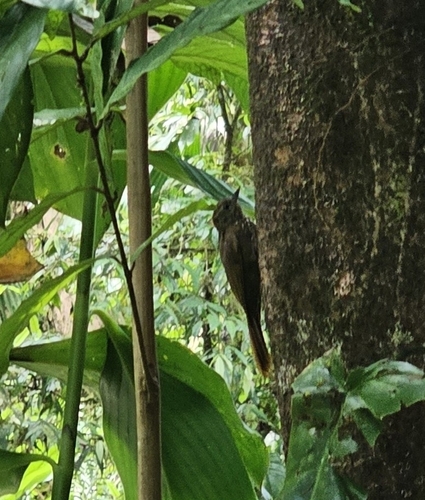 Keilschnabel-Baumsteiger
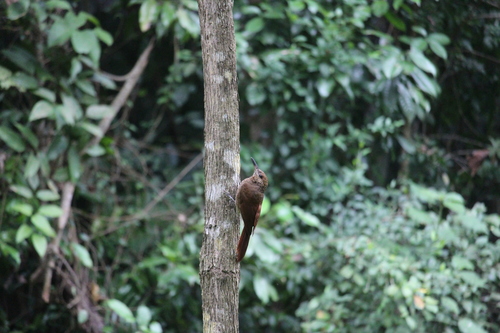 Mexiko-Bindenbaumsteiger
Kurz gesagt
The most reliable field mark between Wedge-billed Woodcreeper and Northern Barred-Woodcreeper is overall size and bill shape: the Wedge-billed is tiny with a short, distinctly wedge-shaped, upturned bill, while the Northern Barred is much larger, with a long, straight bill. In flight, the Wedge-billed often shows a pale buff band on the underside of the wing, visible in all ages, while the Northern Barred lacks this feature and instead shows strong black barring across the body and wings, especially in adults and juveniles. Perched, the Wedge-billed is compact and short-tailed, with subtle spotting and streaking below, while the Northern Barred is lanky, long-tailed, and boldly barred throughout. Confusion is most likely with juvenile or distant birds, but size and bill shape remain reliable at all ages.
Bestimmungstipps
- Size is the most immediate clue: Wedge-billed is tiny (13–16 cm), Northern Barred is large (25–29 cm). If the bird looks small even for a woodcreeper, it's almost certainly Wedge-billed.
- Bill shape is diagnostic: Wedge-billed has a short, stubby, wedge-shaped, upturned bill (almost Xenops-like); Northern Barred has a long, straight bill with a medium thickness. This is visible even in poor light or partial views.
- Flight view—underwing band: Wedge-billed of all ages shows a buff to buff-white stripe on the underside of the wing feathers, forming a pale band in flight. Northern Barred lacks this, instead showing uniform rufous-chestnut flight feathers with dusky tips and strong barring on the body and wings.
- Upperparts pattern: Wedge-billed is mostly plain brown to russet above, with a grayish forehead and subtle supercilium. Northern Barred is boldly barred black across the crown, back, and wings, with a rufescent crown and nape.
- Underparts—spotting vs barring: Wedge-billed has large round fulvous spots on the upper breast and narrow streaks below; Northern Barred is heavily barred black on golden to cinnamon-buff underparts, with barring extending from throat to belly.
- Tail color and length: Both have rufous-chestnut tails, but Wedge-billed's tail is short and square, while Northern Barred's is long and often appears wedge-shaped when spread.
- Supercilium and face: Wedge-billed has a thin buff to buff-white supercilium and a buff eyering; Northern Barred has a faint rufous supercilium, black lores, and a cinnamon-brown face with fine barring.
- Juvenile confusion: Juvenile Northern Barred has more diffuse barring below and a fully black bill, but still shows the overall large size and long bill. Juvenile Wedge-billed looks like adult but is always much smaller and shows the underwing band.
- Leg color: Both species have variable leg colors, but this is not a reliable field mark.
- Behavior at ant swarms: If the woodcreeper is following an army ant swarm, especially in pairs or small groups, suspect Northern Barred. Wedge-billed rarely follows ant swarms.
- Perching posture: Wedge-billed is compact, often clinging to thin branches or vines; Northern Barred is upright and lanky, usually on thick trunks.
- Habitat context: In disturbed or edge habitats, Wedge-billed is more likely. In mature, undisturbed humid forest, both are possible, but Northern Barred is more likely at ant swarms.
- Subspecies variation: Wedge-billed shows some variation in throat and underpart color among subspecies, but is never boldly barred. Northern Barred subspecies differ mainly in barring strength and underpart tone, but always show barring.
- Bill color in juveniles: Only juvenile Northern Barred has a fully black bill; Wedge-billed of all ages has a gray base to the mandible.
- **When in doubt, use size and bill shape first, then check for underwing band in flight and barring on underparts when perched. These marks are reliable in all seasons and ages.
Größe
Wedge-billed Woodcreeper is the smallest woodcreeper, measuring only 13–16 cm and weighing 10.5–21 g. In contrast, Northern Barred-Woodcreeper is much larger at 25–29 cm and 53–83 g. Even at a distance or in mixed flocks, the size gap is dramatic: the Northern Barred is nearly twice the length and three to four times the mass of the Wedge-billed. This difference is obvious both perched and in flight, and is the single most reliable separation point.
Gefieder
- Juvenile/immature flight views: Wedge-billed Woodcreeper (all ages) shows a distinct buff to buff-white stripe on the underside of most wing feathers, forming a pale band visible in flight. Northern Barred-Woodcreeper lacks this band; instead, both adults and juveniles show strong black barring across the body and wings, with juveniles having more diffuse barring below and redder undertail coverts.
- Adults perched: Wedge-billed is mostly plain brown above with a grayish forehead, subtle supercilium, and underparts marked by large round fulvous spots on the upper breast and narrow streaks below. The tail and lower back are cinnamon-rufous. Northern Barred is boldly patterned: cinnamon-brown face with fine barring, rufous supercilium, black lores, and rich rufescent crown and nape. The back, crown, and wings are heavily barred black; underparts are golden to cinnamon-buff with narrow, crisp black barring throughout. The tail is also rufous-chestnut.
- Bill color: Wedge-billed has a black bill with a gray base to the mandible; Northern Barred's bill is mostly blackish with paler edges and base, but juveniles have an entirely black bill.
Verhalten
Both species forage on tree trunks and branches, but Northern Barred-Woodcreeper is strongly associated with army ant swarms, often seen following them singly or in pairs. Wedge-billed Woodcreeper does not specialize on ant swarms and is more often seen alone or in mixed-species flocks, moving quickly and acrobatically along thin branches and vines. The larger Northern Barred moves more deliberately, often pausing upright on trunks. In flight, the Wedge-billed appears quick and fluttery, while the Northern Barred is heavier and more direct.
Lebensraum
Both species overlap in Central and northern South America, but Wedge-billed Woodcreeper is much more widespread, found from Mexico through much of South America in a variety of forest types, including edges and disturbed areas. Northern Barred-Woodcreeper is more restricted to mature humid forests, especially in lowlands and foothills, and is less likely in fragmented or edge habitats. In areas of overlap, Northern Barred is generally less common and more sensitive to disturbance.
Keilschnabel-Baumsteiger · Mexiko-Bindenbaumsteiger · Meine schwierigen Vögel