

Motmot

Bindenstrandläufer vs Temminckstrandläufer

Calidris himantopus gegen Calidris temminckii

Ein Quiz mit Bindenstrandläufer und Temminckstrandläufer spielen
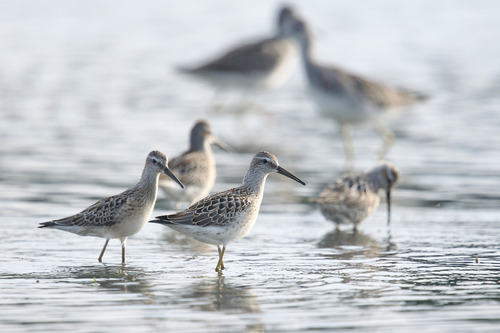
Bindenstrandläufer (Calidris himantopus) Bindenstrandläufer
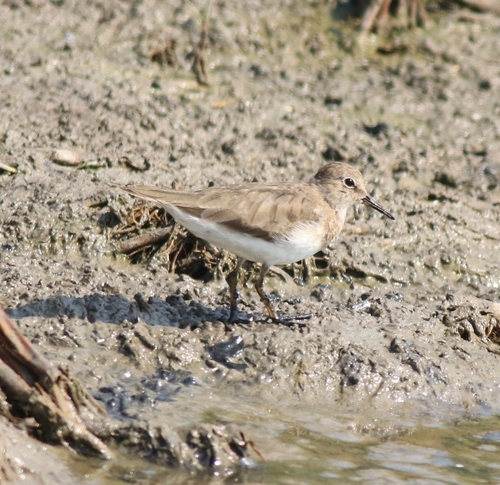
Temminckstrandläufer (Calidris temminckii) Temminckstrandläufer

Medien

Laden…

Kurz gesagt

The most reliable field mark between Stilt Sandpiper and Temminck's Stint is size and structure: Stilt Sandpiper is distinctly larger and longer-legged, with a longer, slightly downcurved bill and a more upright stance, while Temminck's Stint is much smaller, shorter-legged, and has a straight, fine bill. In flight, Stilt Sandpiper lacks a wingbar and shows a white rump, whereas Temminck's Stint is a plain, compact bird with white outer tail feathers but no strong wing pattern. Juveniles of both species can be confusing, but Stilt Sandpiper juveniles retain a strong head pattern and white supercilium, while Temminck's Stint juveniles are plainer overall. Focus on leg color, bill shape, and size for quick separation, especially at a distance.

Bestimmungstipps

  1. Size is a primary separator: Stilt Sandpiper is nearly twice the mass of Temminck's Stint and noticeably longer in the field. Use this when birds are together or when you have a good sense of scale.
  2. Leg color and length: Stilt Sandpiper has long, greenish-yellow legs that are obvious even at a distance; Temminck's Stint has much shorter, dull yellowish or brown legs, making it appear closer to the ground.
  3. Bill shape and length: Stilt Sandpiper's bill is long and only slightly downcurved, never obviously decurved; Temminck's Stint has a short, straight, fine bill. This is especially useful when birds are feeding.
  4. Head pattern (all ages): Stilt Sandpiper shows a strong white supercilium above the eye, even in juveniles and winter birds. Temminck's Stint has a much less distinct face pattern, with no strong supercilium.
  5. Underpart pattern (breeding adults): Stilt Sandpiper adults are heavily barred below with blackish bars on a white background; Temminck's Stint adults are plain white below with only a darker breast.
  6. Back and mantle (juveniles): Juvenile Stilt Sandpiper has a brownish back with white fringes and a strong head pattern; Temminck's Stint juveniles are plainer brown above and lack obvious white fringes or bold face marks.
  7. Flight pattern (all ages): Stilt Sandpiper shows a white rump and lacks a wingbar; Temminck's Stint has white outer tail feathers but otherwise plain wings, with no strong wingbar or rump patch.
  8. Leg projection in flight: Stilt Sandpiper's long legs often project beyond the tail in flight; Temminck's Stint's short legs do not.
  9. Jizz and feeding behavior: Stilt Sandpiper is upright, often wading deeper, and moves with a deliberate gait; Temminck's Stint is crouched, quick, and scurries along the water's edge.
  10. Plumage in winter: Stilt Sandpiper is gray above, white below, with a persistent white supercilium; Temminck's Stint is dull grey or brownish-grey above, white below, and lacks a strong supercilium.
  11. Association with other birds: Stilt Sandpiper may be found with larger shorebirds (e.g., yellowlegs), while Temminck's Stint is usually with other small stints or alone.
  12. Habitat preference: Stilt Sandpiper prefers shallow open water, Temminck's Stint prefers muddy or grassy margins.
  13. Bill color: Both species have dark bills, but the length and slight curve of Stilt Sandpiper's bill is a better field mark.
  14. Voice: Not diagnostic based on available notes.
  15. Pitfalls: Juvenile Stilt Sandpiper can be mistaken for stint species due to lack of barring below, but the strong head pattern, size, and leg length remain reliable. Temminck's Stint is always smaller and plainer, with a less marked face.

Größe

Stilt Sandpiper is substantially larger (18–23 cm length, 50–70 g mass, 37–42 cm wingspan) than Temminck's Stint (13.5–15 cm length, ~26 g mass). In the field, this difference is obvious when both are seen together, but even singly, Stilt Sandpiper appears long-legged and lanky, while Temminck's Stint is tiny, compact, and low to the ground. Stilt Sandpiper's bill is also proportionally longer and heavier than the fine, short bill of Temminck's Stint.

Gefieder

Juvenile and non-breeding plumage are most often confused. Stilt Sandpiper juveniles have a strong white supercilium and a brownish back with white fringes, but lack the heavy barring below seen in adults; their head pattern remains bold. Temminck's Stint juveniles are plainer, with brown upperparts and a subdued face pattern, lacking a strong supercilium. In flight, Stilt Sandpiper shows a white rump and no wingbar, while Temminck's Stint shows white outer tail feathers but otherwise plain wings. Breeding Stilt Sandpiper adults are heavily barred below with reddish-orange above and below the supercilium, while Temminck's Stint adults are mostly drab brown with some rufous or blackish mantle feathers. In winter, Stilt Sandpiper is gray above and white below with a persistent white supercilium; Temminck's Stint is dull grey or brownish-grey above and white below, with a darker breast but no strong facial markings.

Verhalten

Stilt Sandpiper typically feeds with a more upright, stalking gait, often wading deeper due to its longer legs, and may probe with its longer, slightly decurved bill. Temminck's Stint is more likely to be seen creeping along the water's edge, feeding in a crouched posture, and moving quickly with short, rapid steps. Stilt Sandpiper may associate with yellowlegs or other larger shorebirds, while Temminck's Stint is usually found with other small stints or alone.

Lebensraum

Stilt Sandpiper prefers shallow freshwater wetlands, often wading in deeper water than most small sandpipers, and is more likely to be found in North America. Temminck's Stint is an Old World species, favoring muddy margins, pools, and wet meadows, typically in Eurasia. Overlap is rare, but in vagrant situations, habitat choice can be a clue: Stilt Sandpiper is more likely in open, shallow water, Temminck's Stint on muddy edges or grassy margins.

Eine bessere Beschreibung senden

Nutze dieselben Abschnitte wie der Vergleich. Dein Text ist sofort veröffentlicht.

The most reliable field mark between Stilt Sandpiper and Temminck's Stint is size and structure: Stilt Sandpiper is distinctly larger and longer-legged, with a longer, slightly downcurved bill and a more upright stance, while Temminck's Stint is much smaller, shorter-legged, and has a straight, fine bill. In flight, Stilt Sandpiper lacks a wingbar and shows a white rump, whereas Temminck's Stint is a plain, compact bird with white outer tail feathers but no strong wing pattern. Juveniles of both species can be confusing, but Stilt Sandpiper juveniles retain a strong head pattern and white supercilium, while Temminck's Stint juveniles are plainer overall. Focus on leg color, bill shape, and size for quick separation, especially at a distance.

  1. Size is a primary separator: Stilt Sandpiper is nearly twice the mass of Temminck's Stint and noticeably longer in the field. Use this when birds are together or when you have a good sense of scale.
  2. Leg color and length: Stilt Sandpiper has long, greenish-yellow legs that are obvious even at a distance; Temminck's Stint has much shorter, dull yellowish or brown legs, making it appear closer to the ground.
  3. Bill shape and length: Stilt Sandpiper's bill is long and only slightly downcurved, never obviously decurved; Temminck's Stint has a short, straight, fine bill. This is especially useful when birds are feeding.
  4. Head pattern (all ages): Stilt Sandpiper shows a strong white supercilium above the eye, even in juveniles and winter birds. Temminck's Stint has a much less distinct face pattern, with no strong supercilium.
  5. Underpart pattern (breeding adults): Stilt Sandpiper adults are heavily barred below with blackish bars on a white background; Temminck's Stint adults are plain white below with only a darker breast.
  6. Back and mantle (juveniles): Juvenile Stilt Sandpiper has a brownish back with white fringes and a strong head pattern; Temminck's Stint juveniles are plainer brown above and lack obvious white fringes or bold face marks.
  7. Flight pattern (all ages): Stilt Sandpiper shows a white rump and lacks a wingbar; Temminck's Stint has white outer tail feathers but otherwise plain wings, with no strong wingbar or rump patch.
  8. Leg projection in flight: Stilt Sandpiper's long legs often project beyond the tail in flight; Temminck's Stint's short legs do not.
  9. Jizz and feeding behavior: Stilt Sandpiper is upright, often wading deeper, and moves with a deliberate gait; Temminck's Stint is crouched, quick, and scurries along the water's edge.
  10. Plumage in winter: Stilt Sandpiper is gray above, white below, with a persistent white supercilium; Temminck's Stint is dull grey or brownish-grey above, white below, and lacks a strong supercilium.
  11. Association with other birds: Stilt Sandpiper may be found with larger shorebirds (e.g., yellowlegs), while Temminck's Stint is usually with other small stints or alone.
  12. Habitat preference: Stilt Sandpiper prefers shallow open water, Temminck's Stint prefers muddy or grassy margins.
  13. Bill color: Both species have dark bills, but the length and slight curve of Stilt Sandpiper's bill is a better field mark.
  14. Voice: Not diagnostic based on available notes.
  15. Pitfalls: Juvenile Stilt Sandpiper can be mistaken for stint species due to lack of barring below, but the strong head pattern, size, and leg length remain reliable. Temminck's Stint is always smaller and plainer, with a less marked face.

Stilt Sandpiper is substantially larger (18–23 cm length, 50–70 g mass, 37–42 cm wingspan) than Temminck's Stint (13.5–15 cm length, ~26 g mass). In the field, this difference is obvious when both are seen together, but even singly, Stilt Sandpiper appears long-legged and lanky, while Temminck's Stint is tiny, compact, and low to the ground. Stilt Sandpiper's bill is also proportionally longer and heavier than the fine, short bill of Temminck's Stint.

Juvenile and non-breeding plumage are most often confused. Stilt Sandpiper juveniles have a strong white supercilium and a brownish back with white fringes, but lack the heavy barring below seen in adults; their head pattern remains bold. Temminck's Stint juveniles are plainer, with brown upperparts and a subdued face pattern, lacking a strong supercilium. In flight, Stilt Sandpiper shows a white rump and no wingbar, while Temminck's Stint shows white outer tail feathers but otherwise plain wings. Breeding Stilt Sandpiper adults are heavily barred below with reddish-orange above and below the supercilium, while Temminck's Stint adults are mostly drab brown with some rufous or blackish mantle feathers. In winter, Stilt Sandpiper is gray above and white below with a persistent white supercilium; Temminck's Stint is dull grey or brownish-grey above and white below, with a darker breast but no strong facial markings.

Stilt Sandpiper typically feeds with a more upright, stalking gait, often wading deeper due to its longer legs, and may probe with its longer, slightly decurved bill. Temminck's Stint is more likely to be seen creeping along the water's edge, feeding in a crouched posture, and moving quickly with short, rapid steps. Stilt Sandpiper may associate with yellowlegs or other larger shorebirds, while Temminck's Stint is usually found with other small stints or alone.

Stilt Sandpiper prefers shallow freshwater wetlands, often wading in deeper water than most small sandpipers, and is more likely to be found in North America. Temminck's Stint is an Old World species, favoring muddy margins, pools, and wet meadows, typically in Eurasia. Overlap is rare, but in vagrant situations, habitat choice can be a clue: Stilt Sandpiper is more likely in open, shallow water, Temminck's Stint on muddy edges or grassy margins.

Änderungen verwerfen?

Du hast ungespeicherte Änderungen. Wenn du jetzt gehst, gehen sie verloren.

Bindenstrandläufer · Temminckstrandläufer · Meine schwierigen Vögel