

Marmorweber vs Haubenweber
Pseudonigrita arnaudi gegen Malimbus malimbicus
Ein Quiz mit Marmorweber und Haubenweber spielen
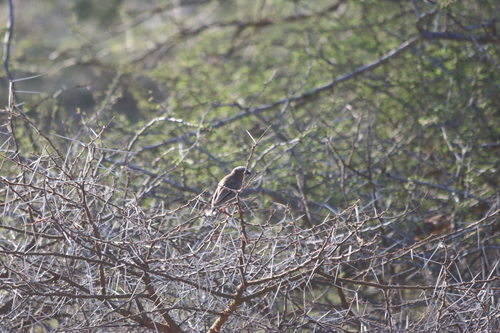 Marmorweber
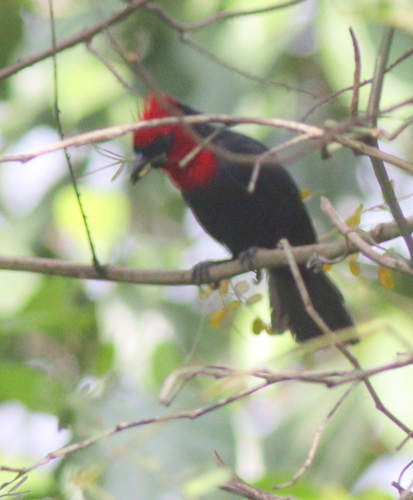 Haubenweber
Kurz gesagt
The most reliable way to separate Grey-capped Social-Weaver from Crested Malimbe is by overall coloration and crown pattern: the social-weaver is a small, sparrow-like bird with a pale grey (almost white in males) cap and a distinctive whitish eye-ring, while the malimbe is a striking rainforest weaver with a prominent crest (not present in the social-weaver) and lacks the pale cap and eye-ring. Juvenile social-weavers are duller but still show a pale cap and brown bill, unlike any malimbe. Social-weavers are found in dry, open acacia habitats, often in groups, while malimbes are restricted to dense African rainforests. If seen in flight, look for the social-weaver’s light terminal tail band and black in the wing—features not shown by the malimbe.
Bestimmungstipps
- Crown color and pattern: Grey-capped Social-Weaver always shows a pale grey (almost white in males) or light liver-colored (juveniles) cap, contrasting with the darker body. Crested Malimbe lacks any pale cap and instead shows a prominent crest—never seen in the social-weaver.
- Eye-ring: The social-weaver has a conspicuous whitish eye-ring, visible at close range. The malimbe lacks this feature.
- Bill color: Adult social-weavers have a dark grey bill, while juveniles have a brown bill. Malimbe bill color is not described here, but the combination of bill color with other marks is distinctive for social-weaver.
- Tail pattern in flight: Look for the light terminal band on the social-weaver’s tail, visible when the bird is flying or flicking its tail. The malimbe does not show this feature.
- Black in the wing: Social-weaver shows some black in the wing, especially visible in flight. This is not a feature of the malimbe.
- Crest presence: Only the malimbe has a crest; social-weaver never does. If you see a crest, it is not a social-weaver.
- Overall coloration: Social-weaver is liver-brown with a pale cap and eye-ring; malimbe is more contrasting, with a crest and no pale cap or eye-ring.
- Juvenile confusion: Even dull juvenile social-weavers retain the pale cap and brown bill, which are not matched by any age of malimbe.
- Group behavior: Social-weavers are usually in groups, often feeding together on the ground or in low bushes. Malimbes are more likely to be solitary or in pairs in the forest canopy.
- Habitat: Social-weavers are only found in open, dry acacia habitats; malimbes are restricted to dense rainforest. If you are in open country, you are almost certainly seeing a social-weaver.
- Nest type: Social-weavers build roofed nests in colonies in acacia trees. Malimbes do not use this nesting strategy.
- Leg color: Social-weaver has horn-colored legs, which may help at close range.
- Vocalizations: Listen for the social-weaver’s high-pitched, repeated squeaks, especially in groups. Malimbe calls are not described here but are unlikely to match this pattern.
- Size and jizz: Social-weaver is small, sparrow-like, and compact. Malimbe is larger, more elongated, and shows a crest.
- Sex differences: Social-weaver males and females are nearly identical, with males having a slightly paler cap. This subtle difference is not likely to cause confusion with malimbe, which is structurally and behaviorally distinct.
Größe
Grey-capped Social-Weaver is a small weaver, about 11–12 cm in length and weighing around 20 g [wikidata]. The Crested Malimbe’s mass is not provided, but as a typical malimbe, it is expected to be larger and more robust than the social-weaver. In the field, the social-weaver will appear noticeably smaller and more sparrow-like, while the malimbe is bulkier and more elongated, especially with its crest.
Gefieder
- Juvenile/immature: Grey-capped Social-Weaver juveniles are duller overall, with a brown bill and a light liver-colored cap. They retain the pale cap and eye-ring, which are not present in any age of Crested Malimbe.
- Adult: Social-weaver adults have a pale grey (almost white in males, light grey in females) crown, liver-brown body, dark grey bill, whitish eye-ring, horn-colored legs, black in the wing, and a light terminal tail band. Crested Malimbe adults are characterized by a prominent crest and lack both the pale cap and eye-ring. The malimbe’s plumage is not described in detail here, but it does not show the social-weaver’s combination of pale crown, eye-ring, and tail band.
- Flight: The social-weaver’s light terminal tail band and black in the wing are visible in flight and are not matched by the malimbe.
Verhalten
Grey-capped Social-Weavers are highly social, feeding in groups and breeding colonially in thorny acacia trees. They build roofed nests from straw and are often seen foraging together on the ground or in low vegetation. Crested Malimbes, by contrast, are typically associated with the forest canopy and are less likely to be seen in open, social groups. Their behavior is more typical of forest weavers, often foraging in pairs or small parties within dense rainforest foliage.
Lebensraum
Grey-capped Social-Weaver is found in dry, open habitats with thorny Acacia trees across East Africa (Ethiopia, Kenya, Somalia, South Sudan, Sudan, Tanzania, Uganda) [wikipedia]. It is never found in dense rainforest. Crested Malimbe is restricted to African tropical rainforests and does not occur in open or arid habitats. Thus, habitat alone is often a strong clue: any bird seen in open acacia woodland is almost certainly not a Crested Malimbe.
Stimme
Grey-capped Social-Weaver gives long series of high-pitched, piercing squeaks (tseeer-tseeer-tseeer), often in groups. No vocal description is provided for Crested Malimbe, but the social-weaver’s call is distinctive among small, open-country weavers.