

Texaskönigstyrann vs Rotschulterkardinal
Tyrannus couchii gegen Spiza americana
Ein Quiz mit Texaskönigstyrann und Rotschulterkardinal spielen
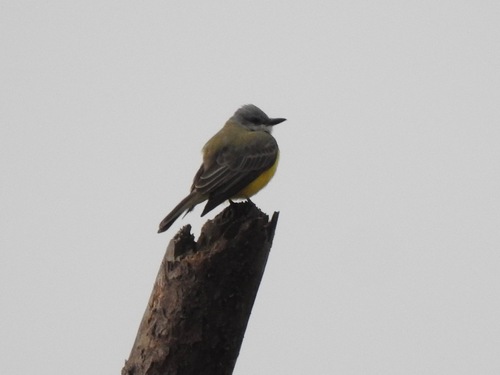 Texaskönigstyrann
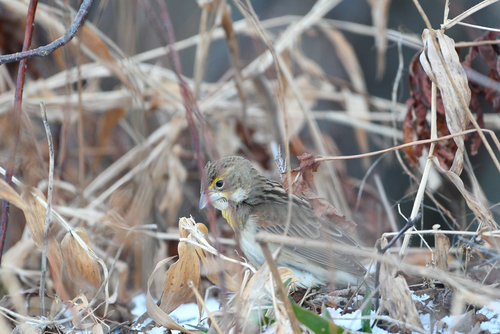 Rotschulterkardinal
Kurz gesagt
The most reliable field mark to separate Couch's Kingbird from Dickcissel is overall structure: Couch's Kingbird is a large-headed, big-billed flycatcher with a dark, slightly forked tail and bright yellow underparts, while Dickcissel is a smaller, chunky seed-eater with a thick, pale bill, rusty shoulder patch, and (in adult males) a bold black throat patch. Juvenile Couch's Kingbirds can show pale-edged wings and browner underparts, but never the streaked back or rust shoulder of Dickcissel. In flight or at rest, Dickcissel's smaller size, short tail, and sparrow-like jizz are immediately different from the upright, long-tailed kingbird. Habitat and voice also help: kingbirds perch in open woodlands and edges, while Dickcissels prefer grassy fields and prairies.
Bestimmungstipps
- Structure and size: Couch's Kingbird is much larger, with a big head and bill, and a long, slightly forked tail. Dickcissel is smaller, chunky, and short-tailed, with a thick, conical bill. This is often obvious even at a distance.
- Bill shape: Kingbird's bill is long, straight, and pointed (flycatcher-type); Dickcissel's is thick, short, and conical (finch-type), suited for seeds.
- Tail shape: Kingbird's tail is dark, long, and slightly forked, lacking white edges. Dickcissel's tail is short, square, and plain, with no fork.
- Head pattern (adults): Kingbird shows a pale gray head with darker cheeks and a pale throat, contrasting with the yellow belly. Dickcissel males have a gray crown and cheeks, a bold black throat patch, and a yellow eyebrow; females/immatures have brownish cheeks/crown and lack the black.
- Underparts color: Kingbird always has a bright yellow lower breast and belly (all ages), with a darker breast band. Dickcissel males have a yellow breast, but the belly is pale; females/immatures are mostly pale below with some yellow wash, never as bright as kingbird.
- Back and upperparts: Kingbird's back is grayish-olive, smooth and unmarked. Dickcissel's back is brown with black streaks, giving a sparrow-like appearance.
- Shoulder patch: Dickcissel shows a rusty (chestnut) patch on the shoulder (less obvious in females/immatures), absent in kingbird.
- Juvenile/immature marks: Young kingbirds have paler wing edges and browner underparts, but never show streaked flanks or back. Juvenile Dickcissels are streaked on the flanks and back, with brownish head and no black throat.
- Flight jizz: Kingbird in flight appears long-tailed and buoyant, often sallying for insects. Dickcissel is short-tailed, with rapid, bounding flight typical of sparrows/buntings.
- Perching behavior: Kingbird perches upright on exposed branches or wires; Dickcissel often perches on grass stems or low shrubs, sometimes in flocks.
- Habitat: Kingbird is found in wooded edges, near water, or suburban areas with trees. Dickcissel is in open grasslands, fields, or prairies, rarely near dense trees.
- Voice: Kingbird's call is loud, raspy, and varied; Dickcissel's song is a sharp, buzzy "dick dick cissel". If you hear the song, ID is straightforward.
- Sex/season pitfalls: Female and juvenile Dickcissels lack the black throat and are duller, but still show streaked back and rusty shoulder. Kingbird sexes are similar year-round.
- Context: A bird flycatching from a high perch in a wooded area is likely a kingbird; a bird singing from a grass stem in a field is likely a Dickcissel.
- Common pitfalls: Bright male Dickcissels can look superficially yellow-breasted like kingbirds, but always check for the black throat, streaked back, and smaller size. Young kingbirds are never streaked or rusty-shouldered.
Größe
Couch's Kingbird is substantially larger and heavier (39.0g vs. 26.85g [wikidata]), with a longer body and larger head. The kingbird's size is comparable to other large flycatchers, noticeably bulkier and longer-tailed than Dickcissel. Dickcissel is closer in size to a large sparrow or small bunting, with a compact, chunky build and shorter tail. When seen together, the kingbird's size and proportions are immediately more robust and elongated.
Gefieder
Juvenile Couch's Kingbirds have browner underparts and pale edges to the wing feathers, but even young birds show the kingbird's classic pattern: pale gray head with darker cheeks, grayish-olive upperparts, and bright yellow lower breast and belly. The tail is dark and slightly forked, lacking any white edges. Dickcissel, in all plumages, shows a brownish, streaked back, rusty patch on the shoulder (less obvious in females/immatures), and pale underparts. Adult male Dickcissels are distinctive with a black throat patch and yellow breast, but females and juveniles lack the black and are more subdued, with brownish cheeks/crown and streaked flanks. Dickcissel never shows the kingbird's clean yellow belly, dark cheeks, or large-headed look. In flight, Dickcissel's wings are dark with a rusty shoulder, and the tail is short and square, not forked.
Verhalten
Couch's Kingbird typically perches upright on exposed branches or wires, scanning for insects to sally after in open or lightly wooded areas. Its movements are deliberate, with frequent flycatching sallies and returns to a perch. Dickcissel is often seen perched on grasses or low shrubs in open fields, singing or foraging for seeds. Its behavior is more sparrow-like: hopping or walking on the ground, feeding in flocks, and less likely to sally for insects. Kingbirds rarely join mixed flocks, while Dickcissels often do outside the breeding season.
Lebensraum
Couch's Kingbird prefers lightly wooded habitats, forest edges, riparian corridors, and suburban areas with scattered trees, especially near water. It is rarely found in pure grassland. Dickcissel is a classic bird of open country, breeding in prairie grasslands, weedy fields, and agricultural areas with little to no tree cover. If you find the bird in a treeless field, Dickcissel is far more likely; a kingbird in such a setting would be unusual.
Stimme
Couch's Kingbird gives a loud, varied, and raspy call, more complex and variable in pitch than the simple, buzzy song of Dickcissel. Dickcissel's song is a sharp "dick dick" followed by a buzzed "cissel" or "chis chis chis"; its flight call is a low, electric buzz. Kingbird calls are harsher and more varied, while Dickcissel's are more mechanical and repetitive. Voice is a strong separator if heard well.
Texaskönigstyrann · Rotschulterkardinal · Meine schwierigen Vögel