

Motmot

Wachtel vs Rotschnabelfrankolin

Coturnix coturnix gegen Pternistis adspersus

Ein Quiz mit Wachtel und Rotschnabelfrankolin spielen
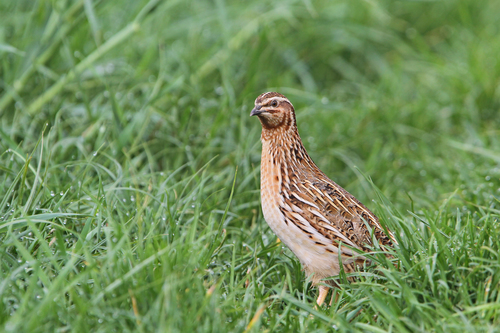
Wachtel (Coturnix coturnix) Wachtel

Rotschnabelfrankolin (Pternistis adspersus) Rotschnabelfrankolin

Medien

Laden…

Kurz gesagt

The most reliable field mark to separate Common Quail from Red-billed Spurfowl is size and structure: Common Quail is a very small, compact, long-winged bird, while Red-billed Spurfowl is much larger, with a heavier build and a distinctive red bill. In flight or on the ground, Common Quail shows a streaked brown plumage with a white eyestripe and is often only heard, not seen. Red-billed Spurfowl, by contrast, is boldly barred below, has a yellow eye-ring, and is much more conspicuous. If you see a small, fast-flying, cryptic gamebird, think quail; if you see a chicken-sized, boldly marked bird with a red bill, it's the spurfowl.

Bestimmungstipps

  1. Size is the quickest check: If the bird is chicken-sized or larger than a dove, it's a Red-billed Spurfowl. If it's much smaller, barely larger than a lark, it's a Common Quail. This works for all ages and sexes.
  2. Bill color and shape: Red-billed Spurfowl has a thick, bright red bill, obvious at close range. Common Quail's bill is small, dark, and inconspicuous. If you see a red bill, it's not a quail.
  3. Plumage pattern: Look for the Common Quail's streaked brown upperparts and white eyestripe (all ages), and in males, a white chin. Red-billed Spurfowl is boldly barred below and has a yellow eye-ring, lacking the quail's fine streaking and eyestripe.
  4. Underpart markings: Spurfowl always shows barred underparts; quail is more uniformly streaked and lacks bold barring.
  5. Eye-ring: Red-billed Spurfowl has a conspicuous yellow eye-ring, absent in Common Quail.
  6. Behavior: Quail are extremely secretive, often only flushed at close range and rarely seen in the open. Spurfowl are bolder, often seen walking in the open or at the edge of cover.
  7. Flight style: Common Quail flushes with a fast, direct flight, low to the ground, and quickly drops back into cover. Spurfowl take off noisily and may glide after a short burst.
  8. Vocalization: If you hear a repeated three-note chirp (three times in quick succession), it's Common Quail. Spurfowl do not give this call.
  9. Habitat and range: In southern Africa, a chicken-sized gamebird in arid scrub or bush is likely a spurfowl. In Eurasia or North Africa, or in cultivated grassland, a small, cryptic gamebird is likely a quail.
  10. Sexual dimorphism: Both species show some size difference between sexes, but this does not overlap: even a female spurfowl is much larger than a male quail.
  11. Group size: Spurfowl are often seen in small groups; quail are usually solitary or in loose, hidden parties.
  12. Visibility: If the bird is walking in the open and easy to observe, it's more likely a spurfowl. If it's only heard or flushed at close range, suspect quail.
  13. Migration: If seen in Europe or North Africa outside the breeding season, it's almost certainly a Common Quail, as spurfowl are not migratory and are restricted to southern Africa.
  14. Juvenile confusion: No distinctive juvenile wing pattern is described for either species, so rely on size and structure for immatures.
  15. Pitfall: Do not confuse Common Quail with Japanese Quail by call—Japanese Quail has a very different vocalization.

Größe

Common Quail is dramatically smaller: 16–18 cm in length, 70–140 g in weight, and a wingspan of 32–35 cm [wikipedia]. Red-billed Spurfowl is more than twice as long (males 38 cm, females 33 cm), and much heavier (males 340–635 g, females 340–549 g) [wikipedia]. Even a female spurfowl is several times the mass of a quail. In the field, the spurfowl appears chicken-like, while the quail is a tiny, compact bird.

Gefieder

No age-specific upperwing or flight pattern marks are described for either species in the sources. Common Quail of all ages is streaked brown above, with a white eyestripe and, in males, a white chin. Its plumage is cryptic and designed for camouflage in grass. Red-billed Spurfowl, regardless of age or sex, has barred underparts and a conspicuous yellow eye-ring. The spurfowl's plumage is bolder and less camouflaged, with a clear red bill. There is no mention of juvenile-specific wing pattern for either species, so these contrasts apply to all ages.

Verhalten

Common Quail is secretive and rarely seen, preferring to stay hidden in grass and only flushing at the last moment. It is more often detected by its call. In contrast, Red-billed Spurfowl is much bolder and more conspicuous, often seen walking in open areas or at the edge of cover. Spurfowl are also more likely to be seen in groups and are less likely to flush unless closely approached. The quail's flight is rapid and direct, while spurfowl take off with a noisy burst and then glide.

Lebensraum

Common Quail is a migratory species breeding in the Palearctic and wintering in Africa and southern India, favoring open grassland and agricultural fields. Red-billed Spurfowl is resident in southern Africa (Angola, Botswana, Namibia, South Africa, Zambia, Zimbabwe), and is found in more arid, scrubby habitats, often near water. While both can be found in open country, the spurfowl is more typical of southern African bush and savanna, while the quail is a bird of grasslands and cultivated fields.

Stimme

Common Quail is best detected by its call: three repeated chirps, each repeated three times in quick succession. This call is distinctive and often the only clue to the bird's presence. Red-billed Spurfowl's vocalizations are not described in the provided notes, but it does not give a quail-like repeated chirp. If you hear the classic quail call, you are not hearing a spurfowl.

Eine bessere Beschreibung senden

Nutze dieselben Abschnitte wie der Vergleich. Dein Text ist sofort veröffentlicht.

The most reliable field mark to separate Common Quail from Red-billed Spurfowl is size and structure: Common Quail is a very small, compact, long-winged bird, while Red-billed Spurfowl is much larger, with a heavier build and a distinctive red bill. In flight or on the ground, Common Quail shows a streaked brown plumage with a white eyestripe and is often only heard, not seen. Red-billed Spurfowl, by contrast, is boldly barred below, has a yellow eye-ring, and is much more conspicuous. If you see a small, fast-flying, cryptic gamebird, think quail; if you see a chicken-sized, boldly marked bird with a red bill, it's the spurfowl.

  1. Size is the quickest check: If the bird is chicken-sized or larger than a dove, it's a Red-billed Spurfowl. If it's much smaller, barely larger than a lark, it's a Common Quail. This works for all ages and sexes.
  2. Bill color and shape: Red-billed Spurfowl has a thick, bright red bill, obvious at close range. Common Quail's bill is small, dark, and inconspicuous. If you see a red bill, it's not a quail.
  3. Plumage pattern: Look for the Common Quail's streaked brown upperparts and white eyestripe (all ages), and in males, a white chin. Red-billed Spurfowl is boldly barred below and has a yellow eye-ring, lacking the quail's fine streaking and eyestripe.
  4. Underpart markings: Spurfowl always shows barred underparts; quail is more uniformly streaked and lacks bold barring.
  5. Eye-ring: Red-billed Spurfowl has a conspicuous yellow eye-ring, absent in Common Quail.
  6. Behavior: Quail are extremely secretive, often only flushed at close range and rarely seen in the open. Spurfowl are bolder, often seen walking in the open or at the edge of cover.
  7. Flight style: Common Quail flushes with a fast, direct flight, low to the ground, and quickly drops back into cover. Spurfowl take off noisily and may glide after a short burst.
  8. Vocalization: If you hear a repeated three-note chirp (three times in quick succession), it's Common Quail. Spurfowl do not give this call.
  9. Habitat and range: In southern Africa, a chicken-sized gamebird in arid scrub or bush is likely a spurfowl. In Eurasia or North Africa, or in cultivated grassland, a small, cryptic gamebird is likely a quail.
  10. Sexual dimorphism: Both species show some size difference between sexes, but this does not overlap: even a female spurfowl is much larger than a male quail.
  11. Group size: Spurfowl are often seen in small groups; quail are usually solitary or in loose, hidden parties.
  12. Visibility: If the bird is walking in the open and easy to observe, it's more likely a spurfowl. If it's only heard or flushed at close range, suspect quail.
  13. Migration: If seen in Europe or North Africa outside the breeding season, it's almost certainly a Common Quail, as spurfowl are not migratory and are restricted to southern Africa.
  14. Juvenile confusion: No distinctive juvenile wing pattern is described for either species, so rely on size and structure for immatures.
  15. Pitfall: Do not confuse Common Quail with Japanese Quail by call—Japanese Quail has a very different vocalization.

Common Quail is dramatically smaller: 16–18 cm in length, 70–140 g in weight, and a wingspan of 32–35 cm [wikipedia]. Red-billed Spurfowl is more than twice as long (males 38 cm, females 33 cm), and much heavier (males 340–635 g, females 340–549 g) [wikipedia]. Even a female spurfowl is several times the mass of a quail. In the field, the spurfowl appears chicken-like, while the quail is a tiny, compact bird.

No age-specific upperwing or flight pattern marks are described for either species in the sources. Common Quail of all ages is streaked brown above, with a white eyestripe and, in males, a white chin. Its plumage is cryptic and designed for camouflage in grass. Red-billed Spurfowl, regardless of age or sex, has barred underparts and a conspicuous yellow eye-ring. The spurfowl's plumage is bolder and less camouflaged, with a clear red bill. There is no mention of juvenile-specific wing pattern for either species, so these contrasts apply to all ages.

Common Quail is secretive and rarely seen, preferring to stay hidden in grass and only flushing at the last moment. It is more often detected by its call. In contrast, Red-billed Spurfowl is much bolder and more conspicuous, often seen walking in open areas or at the edge of cover. Spurfowl are also more likely to be seen in groups and are less likely to flush unless closely approached. The quail's flight is rapid and direct, while spurfowl take off with a noisy burst and then glide.

Common Quail is a migratory species breeding in the Palearctic and wintering in Africa and southern India, favoring open grassland and agricultural fields. Red-billed Spurfowl is resident in southern Africa (Angola, Botswana, Namibia, South Africa, Zambia, Zimbabwe), and is found in more arid, scrubby habitats, often near water. While both can be found in open country, the spurfowl is more typical of southern African bush and savanna, while the quail is a bird of grasslands and cultivated fields.

Common Quail is best detected by its call: three repeated chirps, each repeated three times in quick succession. This call is distinctive and often the only clue to the bird's presence. Red-billed Spurfowl's vocalizations are not described in the provided notes, but it does not give a quail-like repeated chirp. If you hear the classic quail call, you are not hearing a spurfowl.

Änderungen verwerfen?

Du hast ungespeicherte Änderungen. Wenn du jetzt gehst, gehen sie verloren.

Wachtel · Rotschnabelfrankolin · Meine schwierigen Vögel