

Rotbauchspelzer vs Braunbauchspelzer
Sporophila castaneiventris gegen Sporophila angolensis
Ein Quiz mit Rotbauchspelzer und Braunbauchspelzer spielen
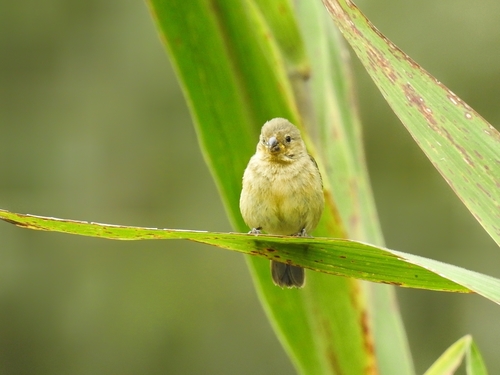 Rotbauchspelzer
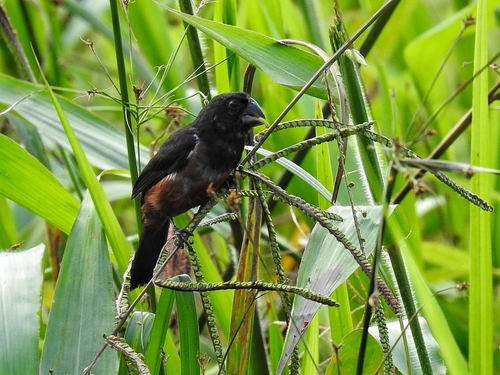 Braunbauchspelzer
Kurz gesagt
The most reliable field mark between Chestnut-bellied Seedeater and Chestnut-bellied Seed-Finch is the color and pattern of the adult male's head and upperparts: the Seedeater male is blue-gray above, while the Seed-Finch male is entirely black above and on the throat. Females are trickier, but the Seedeater is overall paler and more buff, while the Seed-Finch is richer brown with a whitish chin and cinnamon underparts. The Seed-Finch is noticeably larger and heavier, with a much deeper-based bill. In flight or perched, look for the Seed-Finch's white underwing coverts and small white patch at the base of the primaries (in males), which are absent in the Seedeater. Bill shape and size are also strong clues, especially at close range.
Bestimmungstipps
- Adult male head and upperparts: Seedeater males are blue-gray above, while Seed-Finch males are entirely black above and on the throat. This is the fastest way to separate adult males.
- White in the wing (males): Seed-Finch males show a small white patch at the base of the primaries (visible on closed wing) and white underwing coverts, which Seedeater males never show. Look for this in perched birds with partially open wings or in flight.
- White underwing coverts (both sexes): Seed-Finch of both sexes has white underwing coverts, visible in flight or if the bird stretches its wing. Seedeater never shows white in the wing at any age or sex.
- Bill size and shape: Seed-Finch has a much deeper-based and heavier bill than Seedeater. This is especially obvious in profile or close views. Seedeater's bill is thick but not as deep or broad.
- Size: Seed-Finch is noticeably larger and heavier (over 11 g vs. under 8 g for Seedeater). If you have a direct comparison or a good sense of scale, this is a strong clue.
- Adult male underparts: Both species have chestnut underparts, but in Seedeater the chestnut forms a broad band on the throat and breast, narrows through the belly, and widens again at the vent, with blue-gray flanks. In Seed-Finch, the entire underparts (breast, belly, flanks, undertail) are deep chestnut, with no blue-gray flanks.
- Adult female face and underparts: Seedeater females are paler, with a buff face and warm buff underparts, palest on the belly. Seed-Finch females are richer brown above, with a whitish chin, cinnamon breast, and paler cinnamon belly.
- Tail and wing color (females): Seedeater females have sandy brown edges on the wing coverts and a darker brown tail; Seed-Finch females have warm brown wings and tail, without the sandy edges.
- Leg and iris color: Both species have dark irises and dark legs, so this is not helpful for separation.
- Juvenile/immature birds: If you see white in the underwing or a white patch at the base of the primaries, it's a Seed-Finch (even in females and immatures). Seedeater never shows white in the wing at any age.
- Perched vs. flight views: In flight, look for the Seed-Finch's white underwing and primary patch (males). In perched birds, focus on head color (blue-gray vs. black in males) and bill depth.
- Geographic range: Only relevant at the southern edge of their ranges; otherwise, both species can occur together.
- Plumage pitfalls: Female and immature Seed-Finches can be confused with Seedeater females, but look for the richer brown tones, whitish chin, and cinnamon underparts in Seed-Finch, versus paler, buffier tones in Seedeater.
- No song or call difference provided: Do not rely on voice for separation unless you have other sources.
- Hybridization: Not relevant for field separation except in Colombia, where Seed-Finch may hybridize with Thick-billed Seed-Finch, not Seedeater.
Größe
Chestnut-bellied Seed-Finch is distinctly larger and heavier than Chestnut-bellied Seedeater. Seed-Finch measures 10.6–12.4 cm in length and weighs 11.4–14.5 g, while Seedeater is about 10 cm and 7.8 g. The Seed-Finch also has a much deeper and heavier bill, which is especially obvious in profile. If you see both together, the Seed-Finch looks bulkier and more robust overall, while the Seedeater is noticeably daintier.
Gefieder
- Adult males:
- Seedeater: Blue-gray head and upperparts, sometimes with a tiny white spot behind the bill; blackish tail with gray edges at base of outer feathers; wings blackish with grayish edges; throat and breast wide chestnut band narrowing through the belly, blue-gray flanks, chestnut vent and undertail.
- Seed-Finch: Entire head, throat, upperparts, tail, and wings are black; white underwing coverts and white bases to primaries form a small white patch on closed wing; underparts (breast, belly, flanks, undertail) deep chestnut; thighs black.
- Adult females:
- Seedeater: Warm sandy brown upperparts and head with buff face; wings and tail darker brown with sandy brown edges on coverts; underparts warm buff, palest on belly.
- Seed-Finch: Warm brown upperparts and tail; wings warm brown with white underwing coverts (no white primary patch); chin almost white, breast cinnamon, rest of underparts paler cinnamon.
- Juvenile/immature:
- No specific juvenile/immature wing pattern is described for either species, but the Seed-Finch's white underwing coverts (both sexes) and male's white primary patch are unique and visible in flight or when wing is spread. Seedeater lacks any white in the wing at all ages.
Verhalten
No diagnostic behavioral differences are described in the provided notes. Both are small seed-eating birds in the same family, and their general behavior is likely similar in the field.
Lebensraum
Both species overlap widely in South America, but the Seed-Finch is absent from Chile and Uruguay, while the Seedeater is also absent from Argentina and Paraguay. In areas of overlap, habitat is not a reliable separator based on the notes provided.
Rotbauchspelzer · Braunbauchspelzer · Meine schwierigen Vögel