

Karibikschwalbe vs Schuppenspottdrossel
Progne dominicensis gegen Allenia fusca
Ein Quiz mit Karibikschwalbe und Schuppenspottdrossel spielen
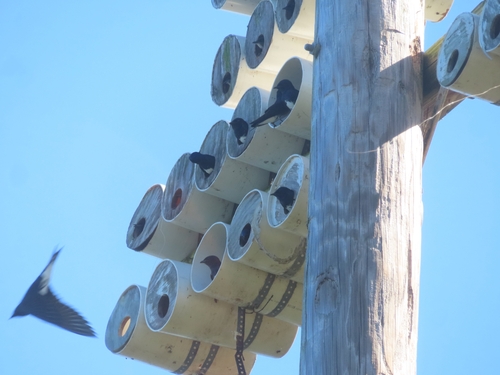 Karibikschwalbe
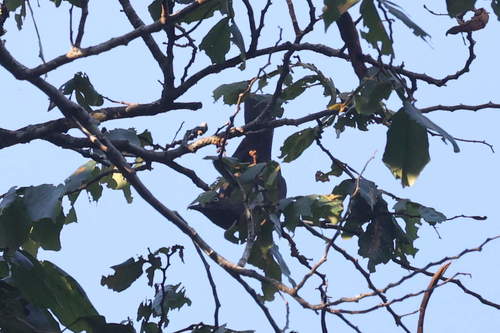 Schuppenspottdrossel
Kurz gesagt
The most reliable way to separate Caribbean Martin from Scaly-breasted Thrasher is by overall shape and flight style: the martin is a large, broad-winged swallow with a forked tail and rapid, agile flight, while the thrasher is a bulkier, longer-bodied songbird with a straight tail and slower, more direct movements. Adult male martins show glossy blue-black above with sharp white lower underparts, contrasting with the thrasher’s scaly-marked, streaked underparts and earth-toned upperparts. Juvenile and female martins can be duller, but never show the thrasher’s bold chest markings or white wing bar. Bill shape is also a quick clue: martins have a short, wide, flat bill for aerial feeding, while thrashers have a slightly decurved, thrush-like bill. Context and behavior—martins in open air, thrashers in dense foliage—are often decisive.
Bestimmungstipps
- Flight style: Martins are fast, agile fliers, often high and in open air; thrashers move slowly, usually in dense vegetation or on the ground.
- Tail shape: Caribbean Martin has a distinctly forked tail (all ages); Scaly-breasted Thrasher’s tail is straight and dark with white tips (all ages).
- Bill shape: Martins have a short, wide, flat bill for catching insects in flight; thrashers have a longer, slightly decurved, thrush-like bill for probing and foraging.
- Underparts: Adult male martins are glossy blue-black above with sharply white lower underparts; females/juveniles are duller but still have white lower underparts. Thrashers always show bold scaly markings on the chest and flanks, never clean white.
- Upperparts: Martins are glossy blue-black (male) or duller (female/juvenile); thrashers are gray-brown with reddish or dark tones, never glossy blue-black.
- Wing bar: Scaly-breasted Thrasher shows a single white wing bar (all ages), visible when perched or with wings folded; martin lacks any wing bar.
- Tail pattern: Thrasher’s tail has white tips to the outer feathers; martin’s tail is uniformly dark and forked.
- Jizz: Martins look streamlined and aerodynamic, with broad wings and a forked tail; thrashers are bulkier, longer-bodied, and more thrush-like in posture.
- Group size: Martins are often seen in groups, especially in flight; thrashers are solitary or in pairs.
- Habitat: Martins are in open areas, near water, or urban/rural sites; thrashers are in dense thickets or forest edges.
- Vocalization: Martins give short, gurgly calls; thrashers sing long, varied, mockingbird-like songs.
- Perched posture: Martins perch upright on wires or exposed branches, often in groups; thrashers sit more horizontally, often in cover.
- Seasonal confusion: Female and juvenile martins are duller but never show the thrasher’s scaly chest or wing bar; beware of dull martins in poor light.
- Feeding behavior: Martins catch insects in flight; thrashers forage on the ground or in foliage.
- Pitfall: In poor light, a dull martin may look brownish, but the lack of scaly underparts and presence of a forked tail will separate it from thrasher.
Größe
Scaly-breasted Thrasher is larger and heavier, averaging about 68 g and 23 cm in length, with a robust, thrush-like build. Caribbean Martin is slightly smaller at 18.5 cm and about 40 g, with a more streamlined, swallow-like silhouette. In the field, the martin looks slimmer and more aerodynamic, while the thrasher appears bulkier and longer-bodied. The difference in mass is notable if seen side-by-side, but shape is usually more obvious than size.
Gefieder
No age-specific upperwing patterns are described for either species that would be diagnostic in flight. Adult male Caribbean Martins are glossy blue-black above with crisp white lower underparts; females and juveniles are duller, with grey-brown breast and flanks but still white lower underparts. In contrast, all Scaly-breasted Thrashers (regardless of age or sex) have earth-toned upperparts, a dark gray-brown head, and a distinctive scaly appearance on the chest and flanks—created by bold gray-brown markings on whitish underparts. The thrasher also shows a single white wing bar (visible when perched or with wings folded) and white tips to the outer tail feathers. Juvenile/female martins never show the thrasher’s streaked or scaly underparts or white wing bar. The martin’s tail is forked, while the thrasher’s is straight and dark with white tips.
Verhalten
Caribbean Martins are almost always seen flying in the open, often high above ground, catching insects on the wing with agile, rapid movements. They are gregarious and may be seen in groups, especially near water or open areas. Scaly-breasted Thrashers are terrestrial or arboreal foragers, moving slowly and methodically through dense foliage or on the ground, often alone or in pairs. Their movements are more deliberate, and they rarely sally out into open air like martins.
Lebensraum
Caribbean Martins are found in open country, near water, urban areas, or rural sites with suitable nesting cavities (banks, buildings, coconut trees). They are rarely seen in dense undergrowth. Scaly-breasted Thrashers prefer dense thickets, forest edges, and shrubby habitats throughout the Lesser Antilles. If the bird is deep in brush or foraging on the ground, martin can be safely ruled out.
Stimme
Caribbean Martin gives a gurgly 'chew-chew' call, typical of swallows—short, simple, and not very musical. Scaly-breasted Thrasher has a much more complex song: a series of varied notes and phrases, reminiscent of a mockingbird but softer and slower. If you hear a long, varied, musical song, it is the thrasher; brief, simple calls point to martin.
Karibikschwalbe · Schuppenspottdrossel · Meine schwierigen Vögel