

Weißbinden-Schattenkolibri vs Streifenkehl-Schattenkolibri
Threnetes ruckeri gegen Phaethornis striigularis
Ein Quiz mit Weißbinden-Schattenkolibri und Streifenkehl-Schattenkolibri spielen
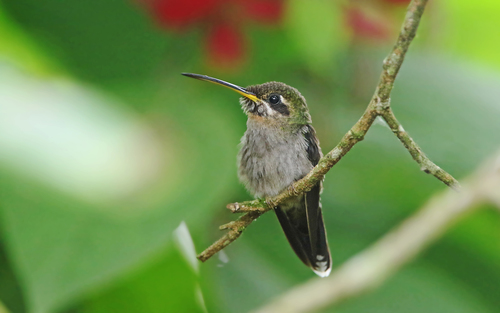 Weißbinden-Schattenkolibri
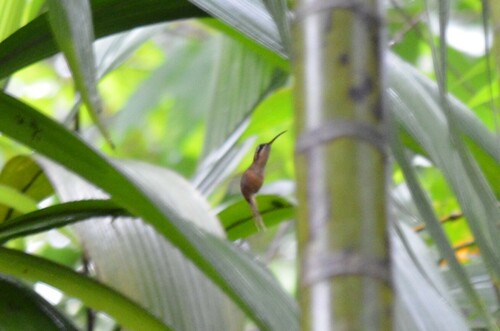 Streifenkehl-Schattenkolibri
Kurz gesagt
The most reliable field mark to separate Band-tailed Barbthroat from Stripe-throated Hermit is the bold, black tail band with white bases and tips on the Band-tailed Barbthroat, visible in both perched and flying birds of all ages. Stripe-throated Hermit lacks this strong tail pattern and instead shows a more uniformly dark tail with only pale tips. Size is also a strong clue: Band-tailed Barbthroat is noticeably larger and heavier than the diminutive Stripe-throated Hermit. Bill shape and facial pattern differ subtly, but can be tricky at a distance. Juveniles of both species are similar to adults, but the Barbthroat’s tail pattern remains distinctive. Focus on tail and overall size for the most reliable separation, especially in mixed flocks or fast-moving birds.
Bestimmungstipps
- Tail pattern (all ages): Band-tailed Barbthroat shows a bold black band near the tail tip, with white bases and tips to the tail feathers—very striking in both perched and flying birds. Stripe-throated Hermit has a mostly blackish tail with only pale (whitish or ochraceous) tips, lacking the strong banded look.
- Size and bulk: Barbthroat is noticeably larger and heavier (10–11 cm, 5–7 g) than the Hermit (9–10 cm, 2–3 g). In direct comparison or with other hummingbirds for scale, Barbthroat looks robust, Hermit looks dainty.
- Bill shape: Both have long bills, but Barbthroat’s is nearly straight (female slightly more decurved), while Hermit’s is distinctly long and decurved. At a distance, this is subtle, but close views may show the Hermit’s more pronounced curve.
- Facial pattern: Stripe-throated Hermit has a strong blackish mask, bordered above by a whitish-buff supercilium and below by a whitish-buff malar stripe. Barbthroat has a dark ear patch and chin, but lacks the Hermit’s sharp facial stripes.
- Throat color: Barbthroat’s throat is ochraceous to bright orange (especially in some subspecies), standing out against otherwise gray underparts. Hermit’s throat is pale greyish-brown with fine dark streaks, often faint and not always visible.
- Underparts: Barbthroat has gray underparts with some green feathers, while Hermit shows buff flanks and belly, and a pale greyish-brown central underpart.
- Upperparts: Barbthroat’s upperparts are bronze-green; Hermit’s are dull iridescent green with a pale rufous rump (especially in juveniles).
- Juvenile differences: Barbthroat juveniles have ochraceous feather edges but retain the diagnostic tail pattern. Hermit juveniles have a pale rufous back, but tail remains plain with pale tips only.
- Flight jizz: Barbthroat appears bulkier and more direct in flight; Hermit is more delicate and agile.
- Perched posture: Barbthroat often appears more upright and robust, while Hermit perches with a more slender, elongated look.
- Habitat context: Both can occur in forest understory and edges, but Barbthroat is more likely in semi-open or plantation areas, Hermit often in denser, humid forest near water.
- Song: Barbthroat’s song is a fast, high-pitched phrase with pauses; Hermit’s is a monotonous, squeaky series. If you hear a repetitive, unvaried squeak, lean Hermit; if you hear a more complex, trilled phrase, consider Barbthroat (especially in Pacific Costa Rica).
- Sex differences: Both sexes are similar in each species; bill curvature is slightly greater in female Barbthroat but not a strong field mark.
- Pitfalls: In poor light, the Hermit’s pale tail tips can look like a band, but never as bold or wide as Barbthroat’s. The Barbthroat’s ochraceous throat can appear dull in shadow, so rely on tail pattern and size.
- When in doubt: If you see a medium-sized hummingbird with a bold black-and-white banded tail, it is a Band-tailed Barbthroat. If the bird is small, with a plain dark tail and only pale tips, and shows a strong facial mask, it is a Stripe-throated Hermit.
Größe
Band-tailed Barbthroat is a medium-sized hummingbird, measuring 10–11 cm in length and weighing 5–7 g. In contrast, Stripe-throated Hermit is significantly smaller, at 9–10 cm and only 2–3 g. This makes the Barbthroat nearly twice as heavy and noticeably bulkier in the field. When seen together or with other hummingbirds for scale, the Barbthroat’s size and more robust build are apparent, while the Hermit appears delicate and slender.
Gefieder
- Juveniles and immatures: Both species’ young resemble adults, but the Barbthroat juvenile shows ochraceous feather edges, while Hermit juveniles have an overall pale rufous back. However, the Barbthroat’s black tail band with white bases and tips is present at all ages and is diagnostic.
- Adults: Band-tailed Barbthroat males and females have bronze-green upperparts, a dark ear patch and chin, and a distinctive ochraceous throat (especially bright orange in some subspecies). The tail is dark with a prominent black subterminal band and white at the base and tip of each feather, creating a strong banded effect. Stripe-throated Hermit adults have dull iridescent green upperparts, a pale rufous rump, buff flanks and belly, and a pale greyish-brown throat with fine dark streaks (often faint). Their tail is blackish with only pale tips (whitish to ochraceous, depending on subspecies), lacking the Barbthroat’s bold band. The Hermit’s face shows a blackish mask, bordered above and below by whitish-buff lines, which is less pronounced in Barbthroat.
Verhalten
Both species are typical hermit hummingbirds, feeding by trap-lining circuits of flowers and occasionally robbing nectar. Stripe-throated Hermit males form leks and sing to attract females, while Band-tailed Barbthroat males may linger near nests but do not participate in incubation. Both are solitary outside breeding, but the Hermit’s lekking behavior may be more conspicuous. In flight, Barbthroat appears bulkier and more direct, while Hermit is daintier and more agile.
Lebensraum
Band-tailed Barbthroat inhabits the understory and edges of primary forest, old second growth, shrublands, thickets, and plantations from sea level up to 1,200 m, ranging from southeastern Guatemala and Belize to western Ecuador and Venezuela. Stripe-throated Hermit occupies a similar range in Central and northwestern South America, but is generally found in humid lowland and foothill forests, often near water or in dense understory. Both can occur in disturbed habitats, but Barbthroat may be more tolerant of semi-open areas and plantations.
Stimme
Band-tailed Barbthroat’s song is a fast, high-pitched phrase of 5–10 notes, repeated with pauses, e.g., 'tzi-tzi-tsee-ee-tsi-tzi-tzi.' In Costa Rica, Pacific slope birds have a more complex song with trills. Stripe-throated Hermit’s song is high-pitched, squeaky, and monotonous, easily overheard but less varied. Both can be high-pitched and difficult to separate by ear unless familiar with local song structure.
Weißbinden-Schattenkolibri · Streifenkehl-Schattenkolibri · Meine schwierigen Vögel