

Motmot

Ainleywellenläufer vs Schwarzwellenläufer

Hydrobates cheimomnestes gegen Hydrobates melania

Ein Quiz mit Ainleywellenläufer und Schwarzwellenläufer spielen

Ainleywellenläufer (Hydrobates cheimomnestes) Ainleywellenläufer
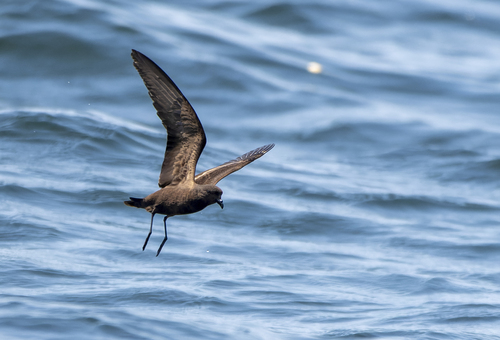
Schwarzwellenläufer (Hydrobates melania) Schwarzwellenläufer

Medien

Laden…

Kurz gesagt

The most reliable field mark for separating Ainley's Storm-Petrel from Black Storm-Petrel is the presence of a white rump patch in Ainley's, which is absent in Black Storm-Petrel. Ainley's is also distinctly smaller and has a more forked tail, while Black Storm-Petrel is larger, all dark, and lacks any white on the rump. In flight, Ainley's shows a contrasting white U-shaped rump patch with a central dark area, whereas Black Storm-Petrel is uniformly dark brown-black above and below. Structural differences—especially size and tail shape—are helpful at a distance or in poor light. Both species are dark overall and can appear similar from afar, but careful attention to rump color and overall size will resolve most field identifications.

Bestimmungstipps

  1. White rump patch (Ainley's only): Look for a bright white U-shaped rump patch with a central dark area on Ainley's Storm-Petrel; Black Storm-Petrel is entirely dark with no white on the rump. This is the single most reliable field mark in all ages and seasons.
  2. Overall size: Ainley's is noticeably smaller (about 18 cm) than Black Storm-Petrel (about 23 cm). If you see a group, compare relative size; Black Storm-Petrel will stand out as larger and bulkier.
  3. Tail shape: Ainley's has a more deeply forked tail, while Black Storm-Petrel's tail is less forked. This is best seen when the bird is banking or gliding.
  4. Plumage tone: Ainley's is dark sooty-brown, sometimes appearing black, but can look browner when worn. Black Storm-Petrel is a more uniform dark brown-black, with little variation.
  5. Feet projection: Ainley's feet do not extend beyond the tail in flight, while this is not noted for Black Storm-Petrel. This is a subtle mark and hard to judge unless seen well.
  6. Wing shape: Ainley's has fairly long wings with blunt points; Black Storm-Petrel's wings are longer and broader in proportion to its larger body.
  7. No age-specific upperwing marks: Neither species has distinctive juvenile or immature upperwing patterns (such as triangles or panels), so focus on rump and structure for all ages.
  8. Habitat and range context: If observed near Guadalupe Island in winter, Ainley's is more likely; elsewhere, especially farther north or south, Black Storm-Petrel is more probable. Both can occur offshore in the eastern Pacific.
  9. Behavior: Both species are pelagic and rarely seen near land except at breeding sites. Ainley's is nocturnal at colonies, but this is not helpful for field ID at sea.
  10. Bill, legs, and feet: Both have black bills, legs, and feet—these features do not help separate them.
  11. Plumage wear: Ainley's may appear browner when plumage is worn (pre-moult), but the white rump remains diagnostic.
  12. Perched views: Both are rarely seen perched except at colonies; field separation is usually made in flight.
  13. Sex and season: No sexual dimorphism or seasonal plumage differences are described for either species; all field marks apply year-round and to both sexes.
  14. Pitfalls: At a distance or in poor light, both can appear uniformly dark and similar in shape. Always look for the white rump on Ainley's; if absent, consider Black Storm-Petrel, especially if the bird is noticeably larger.
  15. When in doubt: If the rump is not visible and size is hard to judge, identification may not be possible. Wait for a better view or look for accompanying birds for comparison.

Größe

Black Storm-Petrel is significantly larger, measuring about 23 cm in length with a wingspan of 46–51 cm and a body mass around 61.5 g [wikidata]. Ainley's Storm-Petrel is smaller, about 18 cm in length (no mass given, but clearly lighter by proportion). This size difference is often apparent when both species are seen together, with Black Storm-Petrel appearing bulkier and longer-winged. If only one bird is present, Ainley's will look more delicate and compact, with shorter wings and a smaller body.

Gefieder

Ainley's Storm-Petrel (all ages) shows a distinctive white rump patch, U-shaped with a central poorly defined dark area; this is visible in flight and often even at a distance. The rest of the plumage is dark sooty-brown, appearing blackish from afar, but can look browner when worn. The tail is moderately long and distinctly forked. Black Storm-Petrel, by contrast, is uniformly dark brown-black above and below, with no white on the rump at any age or season. Its tail is less deeply forked and the overall plumage is more consistently dark, lacking the contrast of Ainley's. Both species have black bills, legs, and feet, but only Ainley's has feet that do not extend beyond the tail in flight—a subtle but sometimes useful mark. No age-specific upperwing pattern differences are described for either species, so the rump patch is the key plumage separator in all plumages.

Verhalten

Both species are pelagic and spend most of their lives over open ocean, rarely coming to land except to breed. Ainley's is nocturnal at its breeding colonies and nests in crevices or burrows. There is no specific behavioral difference in flight or feeding style noted between these two species in the sources, but Ainley's may appear slightly more buoyant or delicate due to its smaller size and more forked tail. Both are likely to be seen flying low over the water, picking at the surface.

Lebensraum

Ainley's Storm-Petrel breeds only on a few islets off Guadalupe Island, Mexico, and ranges south to the Galápagos, being most likely encountered off the Baja California Peninsula in winter. Black Storm-Petrel is also a pelagic species of the eastern Pacific, but the sources do not specify its breeding range here. Both may overlap in offshore waters, but Ainley's is much more restricted and localized, especially during the breeding season. If observed near Guadalupe Island in winter, Ainley's is more likely; elsewhere, especially farther north or south, Black Storm-Petrel is more probable.

Eine bessere Beschreibung senden

Nutze dieselben Abschnitte wie der Vergleich. Dein Text ist sofort veröffentlicht.

The most reliable field mark for separating Ainley's Storm-Petrel from Black Storm-Petrel is the presence of a white rump patch in Ainley's, which is absent in Black Storm-Petrel. Ainley's is also distinctly smaller and has a more forked tail, while Black Storm-Petrel is larger, all dark, and lacks any white on the rump. In flight, Ainley's shows a contrasting white U-shaped rump patch with a central dark area, whereas Black Storm-Petrel is uniformly dark brown-black above and below. Structural differences—especially size and tail shape—are helpful at a distance or in poor light. Both species are dark overall and can appear similar from afar, but careful attention to rump color and overall size will resolve most field identifications.

  1. White rump patch (Ainley's only): Look for a bright white U-shaped rump patch with a central dark area on Ainley's Storm-Petrel; Black Storm-Petrel is entirely dark with no white on the rump. This is the single most reliable field mark in all ages and seasons.
  2. Overall size: Ainley's is noticeably smaller (about 18 cm) than Black Storm-Petrel (about 23 cm). If you see a group, compare relative size; Black Storm-Petrel will stand out as larger and bulkier.
  3. Tail shape: Ainley's has a more deeply forked tail, while Black Storm-Petrel's tail is less forked. This is best seen when the bird is banking or gliding.
  4. Plumage tone: Ainley's is dark sooty-brown, sometimes appearing black, but can look browner when worn. Black Storm-Petrel is a more uniform dark brown-black, with little variation.
  5. Feet projection: Ainley's feet do not extend beyond the tail in flight, while this is not noted for Black Storm-Petrel. This is a subtle mark and hard to judge unless seen well.
  6. Wing shape: Ainley's has fairly long wings with blunt points; Black Storm-Petrel's wings are longer and broader in proportion to its larger body.
  7. No age-specific upperwing marks: Neither species has distinctive juvenile or immature upperwing patterns (such as triangles or panels), so focus on rump and structure for all ages.
  8. Habitat and range context: If observed near Guadalupe Island in winter, Ainley's is more likely; elsewhere, especially farther north or south, Black Storm-Petrel is more probable. Both can occur offshore in the eastern Pacific.
  9. Behavior: Both species are pelagic and rarely seen near land except at breeding sites. Ainley's is nocturnal at colonies, but this is not helpful for field ID at sea.
  10. Bill, legs, and feet: Both have black bills, legs, and feet—these features do not help separate them.
  11. Plumage wear: Ainley's may appear browner when plumage is worn (pre-moult), but the white rump remains diagnostic.
  12. Perched views: Both are rarely seen perched except at colonies; field separation is usually made in flight.
  13. Sex and season: No sexual dimorphism or seasonal plumage differences are described for either species; all field marks apply year-round and to both sexes.
  14. Pitfalls: At a distance or in poor light, both can appear uniformly dark and similar in shape. Always look for the white rump on Ainley's; if absent, consider Black Storm-Petrel, especially if the bird is noticeably larger.
  15. When in doubt: If the rump is not visible and size is hard to judge, identification may not be possible. Wait for a better view or look for accompanying birds for comparison.

Black Storm-Petrel is significantly larger, measuring about 23 cm in length with a wingspan of 46–51 cm and a body mass around 61.5 g [wikidata]. Ainley's Storm-Petrel is smaller, about 18 cm in length (no mass given, but clearly lighter by proportion). This size difference is often apparent when both species are seen together, with Black Storm-Petrel appearing bulkier and longer-winged. If only one bird is present, Ainley's will look more delicate and compact, with shorter wings and a smaller body.

Ainley's Storm-Petrel (all ages) shows a distinctive white rump patch, U-shaped with a central poorly defined dark area; this is visible in flight and often even at a distance. The rest of the plumage is dark sooty-brown, appearing blackish from afar, but can look browner when worn. The tail is moderately long and distinctly forked. Black Storm-Petrel, by contrast, is uniformly dark brown-black above and below, with no white on the rump at any age or season. Its tail is less deeply forked and the overall plumage is more consistently dark, lacking the contrast of Ainley's. Both species have black bills, legs, and feet, but only Ainley's has feet that do not extend beyond the tail in flight—a subtle but sometimes useful mark. No age-specific upperwing pattern differences are described for either species, so the rump patch is the key plumage separator in all plumages.

Both species are pelagic and spend most of their lives over open ocean, rarely coming to land except to breed. Ainley's is nocturnal at its breeding colonies and nests in crevices or burrows. There is no specific behavioral difference in flight or feeding style noted between these two species in the sources, but Ainley's may appear slightly more buoyant or delicate due to its smaller size and more forked tail. Both are likely to be seen flying low over the water, picking at the surface.

Ainley's Storm-Petrel breeds only on a few islets off Guadalupe Island, Mexico, and ranges south to the Galápagos, being most likely encountered off the Baja California Peninsula in winter. Black Storm-Petrel is also a pelagic species of the eastern Pacific, but the sources do not specify its breeding range here. Both may overlap in offshore waters, but Ainley's is much more restricted and localized, especially during the breeding season. If observed near Guadalupe Island in winter, Ainley's is more likely; elsewhere, especially farther north or south, Black Storm-Petrel is more probable.

Änderungen verwerfen?

Du hast ungespeicherte Änderungen. Wenn du jetzt gehst, gehen sie verloren.

Ainleywellenläufer · Schwarzwellenläufer · Meine schwierigen Vögel