

Zitting Cisticola vs Baikal Bush Warbler
Cisticola juncidis versus Locustella davidi
Play a quiz with Zitting Cisticola and Baikal Bush Warbler
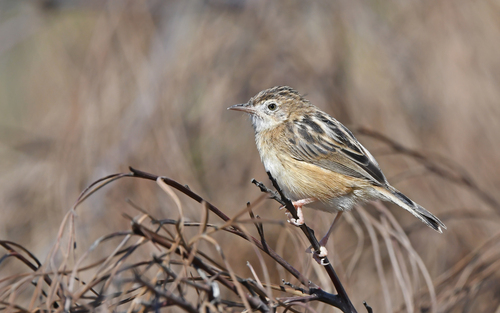 Zitting Cisticola
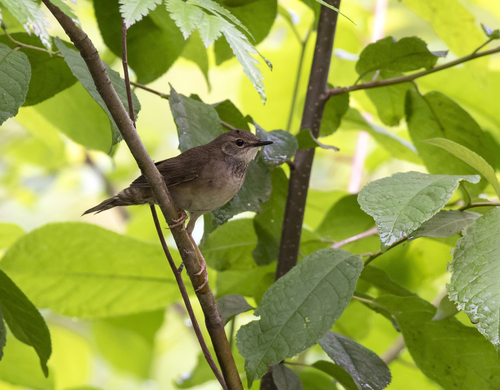 Baikal Bush Warbler
In short
The most reliable field mark to separate Zitting Cisticola from Baikal Bush Warbler is the cisticola's rufous rump and white-tipped brown tail, which are visible both in flight and when perched. Zitting Cisticola lacks any gold on the collar and shows a distinctive, often cocked, short tail, while Baikal Bush Warbler is more uniformly brownish and lacks the rufous rump and white tail tips. In flight, Zitting Cisticola's tail pattern is a quick check, especially on immature birds. Both species are small, brownish warblers of grassy habitats, but their structure, tail pattern, and behavior differ markedly.
Identification tips
- Rufous rump (all ages): Zitting Cisticola always shows a rufous rump in flight and often when perched; Baikal Bush Warbler's rump is plain brown.
- Tail pattern (all ages): Look for the cisticola's brown tail with conspicuous white tips, visible in flight and when the tail is fanned; Baikal Bush Warbler's tail is uniformly brown without white tips.
- Tail shape and carriage: Zitting Cisticola has a short, often cocked tail, giving a perky appearance; Baikal Bush Warbler's tail is longer, straighter, and rarely cocked.
- Flight display: If you see a small warbler performing a zigzagging, fluttering flight with repeated 'zit' calls, it's a Zitting Cisticola. Baikal Bush Warbler does not display in this way.
- Perching behavior: Zitting Cisticola often perches openly on grass stems or wires; Baikal Bush Warbler is much more skulking and rarely perches in the open.
- General coloration: Both are brownish above, but Zitting Cisticola is warmer-toned with a rufous rump; Baikal Bush Warbler is colder, more uniformly brown.
- Collar/gorget: Zitting Cisticola lacks any gold on the collar; Baikal Bush Warbler is also plain but does not show any contrasting collar or gorget.
- Habitat context: In open, dry grassland, especially in Europe, Africa, or southern Asia, Zitting Cisticola is far more likely. In dense, damp grass or undergrowth in northeast Asia, especially near wetlands, Baikal Bush Warbler is more probable.
- Voice: Listen for the cisticola's sharp, regular 'zit' calls, especially from a bird in display flight. Baikal Bush Warbler's song is not described here, but Locustella warblers usually have a mechanical, insect-like song, not a sharp 'zit'.
- Structure: Zitting Cisticola is compact, with a short bill and tail; Baikal Bush Warbler is more elongated, with a longer tail and bill.
- Seasonal context: Zitting Cisticola is resident or locally migratory in much of its range; Baikal Bush Warbler is a long-distance migrant, so consider the time of year and location.
- Regional variation: Zitting Cisticola shows some subspecific variation, but rump and tail pattern are consistent and diagnostic across its range.
- Pitfalls: Immature cisticolas may appear duller, but still show the rufous rump and white tail tips. Baikal Bush Warbler never shows these features at any age.
- When in doubt: If you cannot see the rump or tail pattern, rely on behavior (display flight and perching), habitat, and voice for additional clues.
- Quiz context: Most mix-ups occur with birds seen briefly in flight or in dense cover—prioritize rump and tail pattern, then behavior and voice, for confident separation.
Size
Both species are small warblers, but the available measurement (body mass 10.0g for Baikal Bush Warbler) suggests they are quite similar in size. Zitting Cisticola is also a tiny bird, so size alone is not a reliable separator in the field.
Plumage
For all ages, Zitting Cisticola shows a rufous rump and a brown tail with conspicuous white tips—these are visible in flight and often when perched, and are reliable even on juveniles and immatures. Baikal Bush Warbler, by contrast, is more uniformly brown above and below, lacking any rufous on the rump or white in the tail. Zitting Cisticola also lacks any gold on the collar, while Baikal Bush Warbler does not show contrasting collar coloration either, but is generally plainer overall. Subtle regional variation in Zitting Cisticola's plumage exists, but the rump and tail pattern remain consistent and diagnostic. No distinctive age-specific upperwing pattern is noted for either species in the available sources.
Behaviour
Zitting Cisticola is often seen performing a distinctive zigzagging flight display, especially during the breeding season, accompanied by repeated 'zit' calls. It frequently perches on exposed grass stems with its tail cocked. Baikal Bush Warbler is more secretive, typically skulking low in dense grass or undergrowth and rarely performing aerial displays. The cisticola's active, upright jizz and display flights contrast with the bush warbler's more furtive, mouse-like movements.
Habitat
Both species favor grassland or grassy habitats, but Zitting Cisticola is widespread in open grasslands across Europe, Africa, and Asia, often in drier or more open areas. Baikal Bush Warbler breeds in dense, moist grass or undergrowth, especially near wetlands, in the Russian Far East and northeast China, and winters in similar habitats further south. In regions of overlap, Zitting Cisticola is more likely in open, sunlit grassland, while Baikal Bush Warbler prefers damper, denser, and more shaded cover.
Voice
Zitting Cisticola is named for its distinctive, regular 'zit – zit – zit' call, often given in flight display. The call is a key field clue, especially in the breeding season. Baikal Bush Warbler's song and calls are not described in the provided notes, but Locustella warblers typically have insect-like, reeling or ticking songs, which differ from the cisticola's sharp, repetitive 'zit'.