

Zino's Petrel vs Fea's Petrel
Pterodroma madeira versus Pterodroma feae
Play a quiz with Zino's Petrel and Fea's Petrel
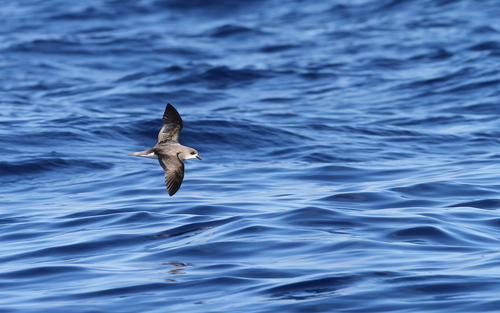 Zino's Petrel
 Fea's Petrel
In short
The most reliable field mark between Zino's Petrel and Fea's Petrel is size and bill structure, but these can be subtle at sea. Zino's is smaller and slimmer overall, with a noticeably finer, more delicate bill, while Fea's is bulkier with a stouter, thicker bill. Both species have similar grey upperparts with a dark 'W' across the wings, and their underwing patterns are mostly dark, but Zino's may show a distinctive large whitish panel on the underwing (though this is only visible in a minority of birds). In practice, separating these two at sea is extremely challenging, especially for lone birds or those not seen alongside each other. Focus on the combination of size, bill shape, and any underwing panel, but be honest about the high risk of confusion.
Identification tips
- Size and Structure: Zino's is smaller and slimmer overall, with a more delicate, slender bill. Fea's is bulkier, with a noticeably thicker, heavier bill. This is the most consistent field mark, but requires good views or direct comparison.
- Bill Shape: Zino's often shows a small, fine, and sometimes long bill (especially in females), while Fea's bill is always thicker and stouter. Bill shape is best judged in close views or photos; beware that some Zino's (likely males) can have bills approaching Fea's in robustness.
- Underwing Pattern: Look for a large whitish panel on the underwing of Zino's—this is diagnostic if seen, but is present in only about 15% of birds. Most Zino's and all Fea's have otherwise dark underwings with no panel.
- Underwing Triangle: Zino's shows a triangle of white at the front edge of the underwing near the body; Fea's underwing is generally uniformly dark. This mark is subtle and can be missed in poor light or distant views.
- Flank Color: Zino's has grey flanks contrasting with the white belly, while Fea's is described as having a plain white belly. This difference is subtle and not always visible.
- Head Pattern: Both species have a mottled whitish-brown forehead, dark cap, and a dark spot below and behind the eye. Head pattern is not reliably separable in the field.
- Upperwing and 'W' Marking: Both show a dark 'W' across the grey upperwing; this is not a useful separation mark.
- Tail Color: Zino's has a grey upper tail; no contrasting tail mark is noted for Fea's, but this is not a strong separation feature.
- Flight Style: Zino's may appear lighter and more buoyant in flight, shearing higher above the surface in strong winds with more angled wings. Fea's is also fast and impetuous, and the difference is subtle and only apparent with experience.
- Perched Birds: Both are rarely seen perched and not reliably separable by posture or behavior.
- Location: Zino's is endemic to Madeira; Fea's breeds in Cape Verde and Desertas. At sea, range can help, but overlap and vagrancy mean this is not diagnostic.
- Vocalizations: Both are silent at sea; breeding calls are very similar and not useful for separation unless at a known colony.
- Age and Season: No reliable age-specific field marks are known; all field marks apply to adults and immatures alike.
- Pitfalls: Many previously suggested marks (head, upperwing, flank pattern) are unreliable. Bill size and underwing panel are the best, but both can be ambiguous in the field.
- Confidence: Even with good views, separation can be very difficult. Use a combination of size, bill, and underwing pattern, but accept that some birds will remain unidentified.
Size
Zino's Petrel is smaller: 32–34 cm in length with an 80–86 cm wingspan, averaging 290 g. Fea's Petrel is larger: 33–36 cm in length and 86–94 cm wingspan. The size overlap is considerable, but Fea's is generally bulkier and longer-winged. At sea, this difference is subtle and hard to judge unless birds are seen together. The bill of Fea's is also thicker and heavier, while Zino's is more slender and delicate, especially in females. These structural differences are easier to appreciate on close, prolonged views or in photos.
Plumage
- Juvenile/Immature/Adult: No distinctive juvenile or immature upperwing pattern is described for either species, and age assessment in the field is not currently feasible due to lack of published information. For all ages, both species show a grey back and wings with a dark 'W' marking. The underwing of Zino's is blackish with a triangle of white at the front edge near the body, and in about 15% of birds, a large whitish panel is visible on the underwing (diagnostic if seen). Fea's underwing is generally uniformly dark, lacking a pale panel. Both have white bellies, but Zino's shows grey flanks, while Fea's is described as simply white. Head pattern, upperwing, and flank patterns are not reliably different in the field. The tail of Zino's is grey above; no contrasting tail mark is noted for Fea's.
Behaviour
Both species have a fast, impetuous flight typical of gadfly petrels. Zino's is said to have a lighter, more buoyant flight and may shear higher above the surface in strong winds with more angled wings, but this is subtle and not always apparent. Fea's is described as having a fast, impetuous flight as well, and the difference in jizz is not diagnostic unless you are very familiar with both. Perched birds are rarely seen and not separable by behavior.
Habitat
Both species are pelagic and occur in similar oceanic habitats. Zino's is endemic to Madeira, while Fea's breeds in the Cape Verde Islands and, in some taxonomies, the Desertas Islands. At sea, their ranges can overlap, but context may help: Zino's is only reliably found near Madeira, while Fea's is more likely off Cape Verde or Desertas. However, vagrancy and overlap mean that location alone is not diagnostic.
Voice
Both species are silent at sea. At breeding colonies, Zino's gives a long, mournful call reminiscent of a tawny owl and a less frequent whimpering sound. These calls are very similar to Fea's Petrel, and vocalizations are not useful for field separation unless at a known breeding site.